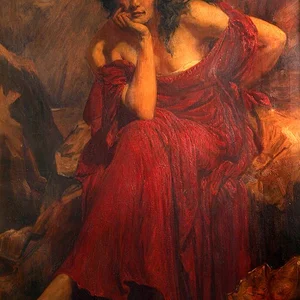

An enchantress and goddess of Welsh Celtic mythology, Ceridwen is the keeper of the cauldron of knowledge and inspiration (Awen). A figure of wisdom, transformation, and magic, she appears in medieval Welsh tales passed down orally before being recorded in the Mabinogion and other bardic texts.
Cerridwen
Ceridwen
10 min read
Frequently asked questions
Key Facts
- According to Welsh oral tradition, Ceridwen brews a potion of inspiration and knowledge (the Awen) in her magic cauldron, intended for her son Morfran
- Her servant Gwion Bach, tasked with stirring the cauldron, accidentally swallows three drops of the brew and gains all its wisdom — giving rise to the cycle of Taliesin
- The legend of Ceridwen is known primarily through the Book of Taliesin and other medieval Welsh manuscripts (12th–14th century), the fruit of a long oral tradition
- In Celtic mythology, the cauldron is a recurring symbol of rebirth, abundance, and divine knowledge
- Ceridwen is associated with the moon, the earth, and agricultural cycles, suggesting origins in a pre-Christian religion of the Brittonic world
Works & Achievements
The central narrative of the Ceridwen legend, recounting the preparation of the Awen, the pursuit of Gwion Bach, and the miraculous birth of Taliesin. This text is the primary source on the Welsh witch-goddess and forms the foundation of all subsequent bardic tradition.
A poem attributed to Taliesin describing a voyage into the Otherworld (Annwfn) to steal the magical cauldron; a text that establishes a direct link between Ceridwen's cauldron and the Celtic mythology of the Otherworld.
A mystical poem attributed to Taliesin in which the bard evokes his successive transformations, directly echoing the chase between Ceridwen and Gwion Bach. It expresses the Druidic philosophy of transformation and the continuity of the soul.
A corpus of poems attributed to Taliesin in which the bard recalls his origins in Ceridwen's cauldron and lays claim to a universal wisdom inherited from the goddess. This corpus establishes the institution of the bard as a transmitter of sacred wisdom.
A collection of Middle Welsh prose tales that constitute the principal written source on insular Celtic mythology. Ceridwen is mentioned as an enchantress and mother of Taliesin, guardian of the cauldron of knowledge.
Anecdotes
Ceridwen spent a year and a day brewing a magical potion in her cauldron, the Awen, intended for her son Morfran, nicknamed Afagddu (absolute darkness), to compensate for his ugliness with extraordinary wisdom. But it was Gwion Bach, the young servant tasked with stirring the cauldron, who accidentally received three burning drops on his hand and licked them, thereby claiming all the wisdom of the world for himself.
Furious, Ceridwen pursued Gwion Bach through a series of epic shape-shifting transformations: he became a hare, she a greyhound; he became a fish, she an otter; he took the form of a bird, she a hawk. Finally, Gwion transformed into a grain of wheat, and Ceridwen, having become a black hen, swallowed him. This chase symbolizes the endless cycle of transformation and rebirth in Celtic thought.
After swallowing Gwion Bach, Ceridwen carried him in her womb for nine months and gave birth to a child so beautiful that she could not bring herself to kill him. She abandoned him in a leather bag set adrift on the water on the eve of May 1st (Calan Mai). The child was rescued by the prince Elffin and became Taliesin, regarded as the greatest bard in the Welsh tradition, whose poems are still preserved in the fourteenth-century Book of Taliesin.
Ceridwen is often identified with a Great Goddess figure in Celtic tradition, mistress of birth, death, and rebirth. Her cauldron foreshadows, in some medieval interpretations, the motif of the Grail: a sacred vessel capable of nourishing, healing, and conferring knowledge. This symbolism carried through the centuries into the French and Welsh Arthurian romances of the Middle Ages.
In the poems attributed to Taliesin in the Book of Taliesin, the bard recalls his past life within Ceridwen's cauldron and describes the Awen as a force of divine inspiration flowing among druids and bards. This idea of wisdom conveyed through transformation rather than direct teaching lies at the heart of Celtic bardic pedagogy.
Primary Sources
And Gwion Bach took the ladle and stirred the cauldron. And it came to pass that three drops of the liquor flew out onto the finger of Gwion Bach. And because they were very hot, he put his finger to his mouth, and the moment those wondrous drops touched his lips, he knew all things to come.
I have been in many shapes before I took my present form. I have been a narrow gleaming sword. I was a drop in the air. I was a shining star. I was a word in a book. I was a book in the beginning.
There was once a man of noble standing and good repute named Tegid Foel, whose home was in the middle of Lake Tegid, and his wife was Ceridwen. And they had a son, Morfran ab Tegid.
Ceridwen applied herself to the dark arts and enchantments and all the occult sciences according to the arts and books of the Feryllt.
Key Places
The largest natural lake in Wales, home of Ceridwen and her husband Tegid Foel according to the Tale of Taliesin. It is on its shores that the witch-goddess's family lived and where the legend of the Cauldron of Awen has its origin.
Sacred island of the Brythonic druids and likely center of the cult and oral tradition that preserved the legends of Ceridwen. It was destroyed by the Romans in 60 AD, scattering the druidic knowledge that the figure of Ceridwen so powerfully symbolizes.
In Welsh Celtic cosmology, Caer Sidi is the Otherworld — dwelling place of the gods and heroic dead — where the cauldron of knowledge is said to originate. The poem Preiddeu Annwfn, attributed to Taliesin, evokes this Otherworld cauldron in connection with Ceridwen.
The coastal area where, according to some versions of the legend, the leather bag containing the newborn Taliesin was cast ashore and discovered by Elffin. The sea serves as a threshold between Ceridwen's world and that of mortals.
The sacred mountain range at the heart of Gwynedd, a region that forms the core of Welsh mythological tradition. These mountains were the likely setting for the bardic oral transmissions that preserved the legend of Ceridwen across centuries.
Typical Objects

The central sacred object of the Ceridwen legend, this cauldron contains the potion of inspiration and wisdom (the Awen) that she brews for a year and a day. It symbolizes transformation, knowledge, and rebirth, and is considered the mythical ancestor of the Holy Grail in Celtic tradition.

After Taliesin's birth, Ceridwen wrapped him in a leather bag and cast him into the sea on the eve of Calan Mai. This object symbolizes both abandonment and protection: it was thanks to this bag that the child was found by Elffin and survived his fate.

Medieval accounts mention that Ceridwen consulted the books of Fferyllt, a legendary alchemist of the Welsh bardic tradition, to compose the Awen potion. These works symbolize the transmission of esoteric knowledge and the mastery of occult arts.

A ritual tool used by druids and Celtic witches to harvest mistletoe and sacred herbs. Ceridwen, as a great herbalist, would have used this instrument to gather the plants needed to prepare her potion during ceremonies tied to the lunar cycles.

Ceridwen is associated with the moon in many interpretations of Celtic and neo-druidic tradition, aligning her rituals and the preparation of the Awen with the lunar cycles. The full moon symbolizes her power of knowledge, while the crescent represents her aspect of rebirth.

Ceridwen's totem animal in certain Welsh traditions, the white sow is a symbol of fertility, death, and rebirth. She embodies the nurturing yet terrifying face of the Great Goddess — the one who gives life and takes it back according to the natural cycles.
School Curriculum
Vocabulary & Tags
Key Vocabulary
Tags
Daily Life
Morning
In Welsh mythology, Ceridwen awakens the sacred cauldron at dawn, tending the fire beneath the great stone or metal vessel at the edge of Lake Tegid. She gathers the first herbs at sunrise, guided by her knowledge of medicinal and magical plants recorded in the books of Feryllt.
Afternoon
The day is devoted to the lengthy preparation of the Awen: watching over the simmering potion, directing her apprentice Gwion Bach in stirring the cauldron, and preparing ingredients according to lunar and solar cycles. She also teaches bardic traditions and ritual formulas to those worthy of receiving them.
Evening
At dusk, Ceridwen practices her divinatory arts and communicates with the spirits of the Otherworld (Annwfn). She sings the ancient poems (awenyddion) that maintain harmony between the world of the living and that of the dead, accompanied by the murmur of the lake and the wind through the sacred oaks.
Food
As a Celtic divine figure, Ceridwen is associated with ritual offerings: oat and rye porridge, sacrificial meats, sheep's and cow's milk, wild plants and woodland mushrooms. She eats only what comes from the forest or the lake, maintaining a permanent bond with wild nature.
Clothing
Ceridwen is depicted wearing heavy woolen robes in dark colors — forest green, purple, jet black — adorned with Celtic interlace embroidery and triple goddess symbols. She wears golden bronze torcs and bracelets, stone amulets engraved with triskelions, and a crown of mistletoe leaves.
Housing
According to myth, Ceridwen dwells in a home at the edge of Lake Tegid, perhaps a broch or a circular stone enclosure surrounded by a wooden palisade, at the heart of a grove of sacred oaks. The cauldron stands at the center of the ritual space, surrounded by dried herbs, runic stones, and resin torches.
Historical Timeline
Period Vocabulary
Visual Style
Style enluminure médiévale galloise mêlé de romantisme préraphaélite, avec une palette sombre et mystique dominée par les verts forêt, les pourpres et l'or de la lumière magique du chaudron. Motifs celtiques entrelacés et atmosphère entre monde des vivants et Autre Monde.
Sound Ambience
Ambiance d'un bord de lac gallois au crépuscule, entre bruissements de forêt de chênes, chant de bardes et bouillonnement du chaudron sacré sous les étoiles. Sons de la nature sauvage et de la magie en action, entre monde des vivants et Autre Monde celtique.
Liens externes & ressources
Références
Œuvres
Naissance et initiation de Taliesin (Hanes Taliesin)
Tradition orale antérieure au XIIe siècle, mise par écrit au XVIe siècle
Preiddeu Annwfn (Les Trésors de l'Autre Monde)
Attribué au VIe siècle, manuscrit du XIVe siècle (Livre de Taliesin)
Kat Godeu (La Bataille des Arbres)
Manuscrit du XIVe siècle (Livre de Taliesin)
Taliesin Pen Beirdd (Taliesin, chef des bardes)
Tradition bardique galloise, IXe-XIVe siècle
Mabinogion — références à Ceridwen et à l'Awen
Livres Blanc et Rouge de Rhydderch et Hergest, v. 1300-1400