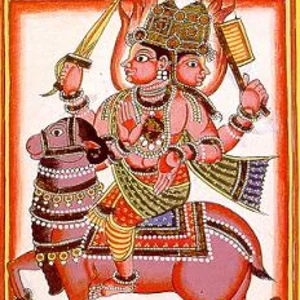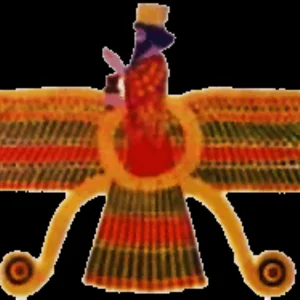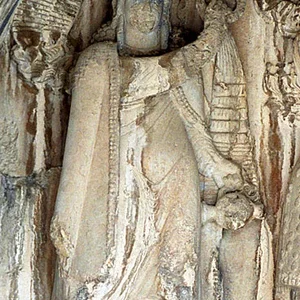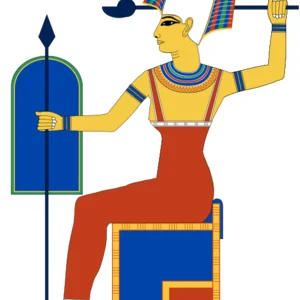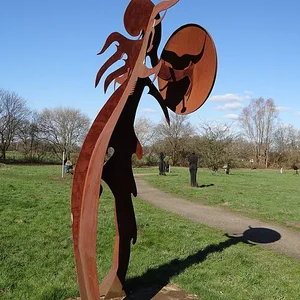

Demonic figure from Hebrew traditions and fallen angel of the Book of Enoch. In Leviticus, he is associated with the scapegoat ritual. According to Enochic tradition, he taught humans the metallurgy of weapons and the art of cosmetics.
Azazel
Azazel
11 min read
Frequently asked questions
Key Facts
- Mentioned in Leviticus (16:8-10) as the recipient of the goat bearing the sins of Israel sent into the wilderness
- In the Book of Enoch (chapters 6–9), Azazel is presented as one of the fallen Watchers who corrupt humanity
- According to Enoch, he taught men the crafting of weapons and women the use of makeup and jewelry
- His name is often interpreted as 'the goat that departs' or associated with a desert demon
- His figure influences the medieval Christian depiction of the devil and rebellious angels
Works & Achievements
A foundational text that establishes the scapegoat ritual during the Day of Atonement (Yom Kippur) and contains the only mention of Azazel in the canonical Hebrew Bible. This passage is the origin of the word 'scapegoat' in all Western languages.
A Jewish apocalyptic text attributed to the biblical patriarch Enoch, preserved in its entirety in Ethiopic (Gəʽəz). It develops an elaborate mythology of fallen angels, with Azazel as their leader, detailing his role in corrupting humanity before the Flood — a level of detail absent from the canonical Bible.
A fragment discovered at Qumran that expands the myth of the Watchers and their giant offspring, with Azazel among the main figures. This text shows that the figure of Azazel was a living tradition across several strands of Second Temple Judaism.
A Jewish apocalyptic text preserved in Old Church Slavonic, in which Azazel appears as a personified demonic figure who attempts to dissuade Abraham from his sacrifice. Here he is clearly cast as an adversary of the divine — a conceptual forerunner of the devil in the Abrahamic traditions.
A rabbinic tractate describing in detail the Yom Kippur ritual, including the exact procedure for the goat sent to Azazel. It is the primary source for understanding how the rite was actually performed in the Temple before its destruction in 70 CE.
Anecdotes
In Leviticus (chapter 16), the high priest of Israel would choose two goats on the Day of Atonement (Yom Kippur): one was sacrificed to God, while the other was symbolically loaded with all the sins of the people before being sent alive into the wilderness 'for Azazel.' This ritual is the origin of the term 'scapegoat,' still used today.
According to the Book of Enoch (an ancient Jewish text not included in the Hebrew Bible), Azazel was a 'Watcher,' an angel tasked with overseeing humanity. He reportedly transgressed divine law by descending to Earth, coupling with human women, and passing on to men the secrets of weapon-making and to women the arts of cosmetics and jewelry.
After his rebellion, Azazel was condemned by the archangel Raphael to be chained in a desolate place called Dudael, his hands and feet bound, cast into the darkness of a pit covered with jagged rocks. He was to remain there until the Last Judgment, deprived of all light. This punishment follows the logic of retribution: he who had corrupted the light of the world was condemned to darkness.
The very name Azazel has been debated among scholars for centuries: is it the name of a desert demon, a geographical location, or a Hebrew expression meaning 'goat that departs' or 'strong goat'? The Greek translation of the Bible (the Septuagint) rendered the word as 'apopompaios' (the one who is sent away), proving that even the ancients were uncertain of its exact meaning.
In the Dead Sea Scrolls discovered at Qumran (from 1947 onward), several texts mention Azazel as the leader of the fallen angels. The text 4Q203 describes him as the chief architect of humanity's corruption before the Flood, making him a far more central figure in the cosmology of ancient Jewish communities than the official Bible would suggest.
Primary Sources
Aaron shall cast lots over the two goats, one lot for the Lord and the other lot for Azazel. Aaron shall present the goat on which the lot fell for the Lord [...] but the goat on which the lot fell for Azazel shall be presented alive before the Lord to make atonement over it, and then sent away into the wilderness to Azazel.
Azazel taught men to make swords, knives, shields, and breastplates; he showed them metals and the art of working them; as well as bracelets, ornaments, the use of antimony, and the beautifying of eyelids. [...] And the Lord said to Raphael: bind the hands and feet of Azazel and cast him into darkness.
Azazel is identified as the leader of the corrupted Watchers, held responsible for introducing violence and immorality to Earth before the Flood. The fragments link his name to those of the other fallen angels and their acts of transgression against humanity.
And there came to me an unclean bird, speaking, and it said: 'What are you doing here, Abraham, in these holy places? You cannot see them.' [...] Then a divine voice said: 'This is disgrace, this is Azazel!' He is the keeper of Hell and the enemy of those who are righteous.
A crimson wool thread was tied between the horns of the goat that was to be sent into the wilderness. It was placed facing the gate through which it was to depart [...] the priest confessed over it all the sins of the children of Israel, and it was then led to the edge of a cliff and pushed backward.
Key Places
The desert surrounding Jerusalem was the symbolic domain of Azazel, an arid and hostile place identified in tradition as the dwelling of demons. It was here that the goat bearing the sins of Israel was sent each year, to what the Bible simply calls 'a desolate place,' 'a wilderness.'
It was within the Temple precinct that the Yom Kippur ritual took place: the high priest drew lots over two goats, sacrificed one in the Holy of Holies, and sent the other into the desert for Azazel. This site was the center of Israel's official worship for over a thousand years.
According to the Book of Enoch (chapter 6), it was on the peaks of Mount Hermon that the Watchers — the group of angels to which Azazel belonged — swore an oath before descending to Earth to unite with human women. The name 'Hermon' is linked etymologically to the Hebrew word 'herem' (forbidden, under a curse).
Site of the Essene monastery where the Dead Sea Scrolls were copied and preserved, including several texts that elaborate on the mythology of Azazel (the Book of Enoch, the Book of Giants). The discovery of these texts in 1947 transformed our understanding of ancient Judaism and the role of Azazel.
The name of the desert place mentioned in 1 Enoch (10:4–6) where Azazel is to be bound and cast into darkness until the Day of Judgment. Its exact location is unknown and likely symbolic — it represents the edge of the inhabited world, the boundary between ordered creation and chaos.
Typical Objects

The animal at the heart of the Levitical rite: the high priest would lay his hands upon its head, confessing the sins of all Israel, symbolically loading the creature with the people's transgressions before sending it into the desert 'for Azazel.' This image has endured through the centuries to the present day.

According to the Book of Enoch, Azazel revealed to humans the art of forging metal weapons — swords, knives, shields, and breastplates. This transmission of martial knowledge is presented as one of the causes of the violence that ultimately leads to the Flood.

Azazel is also portrayed in 1 Enoch as the one who teaches women the arts of makeup, jewelry, and adornment — including the use of antimony to darken the eyes. The polished bronze mirror symbolizes this transmission of vanity, which is condemned as a source of corruption.

According to the Talmud (tractate Yoma), a strip of crimson-dyed wool was tied between the horns of the goat sent to Azazel. If, after the goat was pushed off the cliff, the wool turned white, it was taken as a sign that the people's sins had been forgiven.

In 1 Enoch, the archangel Raphael is commanded to bind Azazel hand and foot, cast him into a pit in the desert, and cover him with rough, sharp-edged stones. These restraints symbolize the permanent immobilization of evil until the Last Judgment.

The Yom Kippur rite began with the casting of lots between two identical goats: one for YHWH, the other for Azazel. These lots — small wooden or stone objects according to rabbinic tradition — decided the fate of each animal and symbolized the division of the world between the divine and the forces of the wilderness.

The Mishnah (Yoma 6:6) describes a steep rock in the Judean desert, roughly twelve stations' walk from Jerusalem, from which the goat was thrown. This place — sometimes identified with Nahal Azazel in the Judean desert — marked the boundary between the world of the living and the realm of Azazel.
School Curriculum
Vocabulary & Tags
Key Vocabulary
Tags
Daily Life
Morning
In Enochic cosmology, Azazel has been chained in the darkness of the Dudael desert since his condemnation, deprived of light from the break of dawn. Before his fall, he would have spent his mornings watching humans from the heavens, fascinated by the daughters of men and the earthly activities he was forbidden to join.
Afternoon
According to the tradition of the Book of Enoch, it was in the full light of day that Azazel and the other Watchers forged their pact on Mount Hermon, descending to Earth to teach their forbidden knowledge — metallurgy, cosmetics, magic — to a humanity they deemed ill-equipped to survive.
Evening
At twilight, during Yom Kippur, this was the hour when the high priest sent the goat bearing the sins of Israel out into the desert 'for Azazel.' In rabbinical tradition, relay fires were lit from Jerusalem to the desert to signal back to the city whether the goat had arrived and whether the sins had been accepted.
Food
As both an angelic and demonic figure, Azazel does not eat in any human sense. In apocalyptic texts, demons and fallen angels are sometimes described as feeding on the sacrifices and offerings made to them — yet the goat sent to Azazel is not sacrificed; it is simply driven back into his domain.
Clothing
Later depictions of Azazel in Christian and Islamic traditions sometimes portray him as a dark winged creature, somewhere between angel and monster. In the context of the Hebrew rite, it is the goat that 'represents' him: a horned animal, dark-coated according to some traditions, marked with a crimson thread.
Housing
Azazel's domain is the wilderness: barren wastelands, rocky ravines, places without water or life where human presence fades away. In 1 Enoch, he is chained in an underground abyss in the Dudael desert, beneath jagged rocks, in complete darkness until the Last Judgment.
Historical Timeline
Period Vocabulary
Visual Style
Esthétique inspirée des manuscrits hébreux anciens et de l'iconographie mésopotamienne : ange déchu enchaîné dans un paysage désertique de pierre rouge, entre le sacré et le démoniaque, sous un ciel crépusculaire chargé de tension spirituelle.
Sound Ambience
Ambiance désertique solennelle mêlant le vent aride sur les rochers de Judée, le bêlement éloigné d'un bouc, et les murmures d'une prière collective au seuil entre le monde des vivants et le désert infini associé aux forces démoniaque.
Liens externes & ressources
Références
Œuvres
Lévitique 16 (Torah hébraïque)
rédigé entre le VIIe et le Ve siècle avant notre ère
Livre d'Hénoch (1 Hénoch)
IIIe-Ier siècle avant notre ère
Livre des Géants (4Q203 — Manuscrits de la mer Morte)
IIe siècle avant notre ère
Apocalypse d'Abraham
Ier-IIe siècle de notre ère
Traité Yoma (Mishna et Talmud de Babylone)
Mishna codifiée vers 200 de notre ère ; Talmud babylonien vers 500