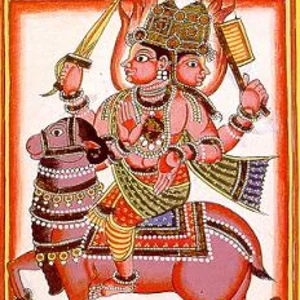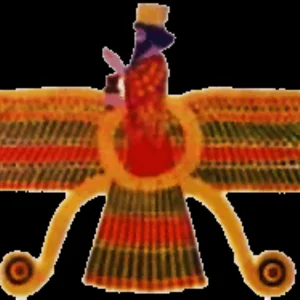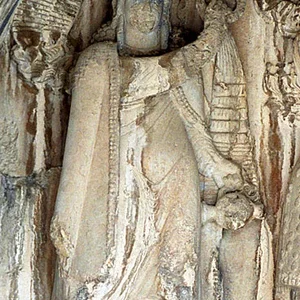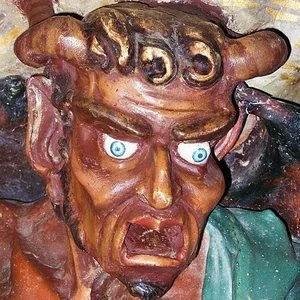

A demon of lust and wrath in Judeo-Christian and Persian traditions, Asmodeus is one of the oldest demonic figures in religious literature. He appears notably in the Book of Tobit, a deuterocanonical text, under the name Asmodaeus.
Asmodeus
Asmodeus
7 min read
Frequently asked questions
Key Facts
- Persian origin under the name Aeshma Daeva, demon of wrath in Zoroastrianism (4th century BCE)
- Mentioned in the Book of Tobit (2nd century BCE), a deuterocanonical text of the Bible
- Ranked as king of demons in the Goetia, a medieval demonology grimoire
- Associated with lust and the destruction of marriages in the rabbinical tradition
- Adopted in medieval and modern Western culture as an archetypal figure of vice
Works & Achievements
Deuterocanonical text in which Asmodeus appears by name for the first time as the demon who kills the husbands of Sarah. A foundational text for all subsequent tradition surrounding this demon.
Five Aramaic manuscripts and one Hebrew manuscript of the Book of Tobit discovered among the Dead Sea Scrolls, representing the oldest known physical attestations of the text.
Greek pseudepigraphical text describing Asmodeus as a demon interrogated by Solomon, who reveals his powers and weaknesses. Considerably expands the demonology surrounding this figure.
Talmudic passage recounting the adventures of Asmodeus, king of demons, who is subdued by Solomon to help build the Temple, before temporarily gaining the upper hand over his master.
Latin translation of the Book of Tobit that enshrines Asmodeus in the Western Catholic tradition and establishes him as a central figure in Christian medieval demonology.
Anecdotes
In the Book of Tobit, a deuterocanonical text written between the 4th and 2nd centuries BCE, Asmodeus successively kills the seven husbands of Sara on their wedding nights. He is finally driven away by Tobias, following the advice of the archangel Raphael: burning the heart and liver of a fish is enough to send the demon fleeing all the way to Egypt, where he is bound in chains.
The name Asmodeus most likely derives from the Persian Aeshma Daeva, literally 'the demon of wrath' in Zoroastrianism. This ancient Iranian figure was incorporated into Jewish tradition during the Achaemenid period, when the Jews lived under Persian rule following the Babylonian exile — a striking example of religious exchange between two great civilizations.
In the Babylonian Talmud, Asmodeus plays an unexpected role: King Solomon uses him to build the Temple of Jerusalem by cutting stones without iron tools, as required by Mosaic law. Asmodeus eventually overthrows Solomon from his throne for several years before being subdued once again.
The Testament of Solomon, a pseudepigraphical text dated between the 1st and 5th centuries CE, describes Asmodeus as a demon capable of stirring jealousy and discord between couples. Solomon questions him, and the demon reveals that his counter-sign is the name of the archangel Raphael and the smell of roasted fish liver.
During the Middle Ages, Christian theologians incorporated Asmodeus into their demonic hierarchy. The demonologist Johann Weyer, writing in the 16th century, drew on earlier sources to present him as the 'prince' of demons of lust — illustrating how this ancient figure was passed down and transformed across more than two millennia of religious tradition.
Primary Sources
And the demon Asmodeus loved her, and he killed each of her husbands before they had been with her as a wife. (Tob 3:8)
Solomon summoned Asmodeus, king of demons, to help him build the Temple. Asmodeus said to him: "You wish to subjugate me?" And Solomon showed him his ring engraved with the Name of God.
I am Asmodeus, and I sow discord and jealousy among spouses. I drive them apart and make them hate one another. My angel is Raphael, and my sign is the smoking liver of a fish.
Aeshma of the bloody mace, most violent of the demons of wrath, who sows destruction among men and cattle, whom the righteous Sraosha battles.
Key Places
The city where part of the story of Tobit takes place according to the Book of Tobit. It is the narrative setting in which Asmodeus exercises his deadly power over Sara's husbands.
The Persian city where Sara, the woman tormented by Asmodeus, lives in the Book of Tobit. This geographical choice reflects the Persian origins of the demonic figure.
The center of the Jewish exile under the Babylonians and later the Persians, and the place of contact between Jewish and Iranian traditions that gave rise to the figure of Asmodeus.
The Dead Sea site where Aramaic fragments of the Book of Tobit dating from the 1st century BCE were discovered, confirming the antiquity of the tradition surrounding Asmodeus.
The Hellenistic intellectual center where the Septuagint was translated and where the Book of Tobit was disseminated throughout the Greek world, spreading the figure of Asmodeus beyond the Semitic world.
Typical Objects

According to the Testament of Solomon, this ring engraved with the name of God and a pentagram allowed Solomon to subjugate Asmodeus and other demons to his will.

In the Book of Tobit, the archangel Raphael advises Tobias to burn these organs to produce a smoke that puts Asmodeus to flight, associating the demon with a symbolic vulnerability linked to purifying fire.

According to Talmudic tradition and the Testament of Solomon, Asmodeus is bound in chains after being subdued, symbolizing the mastery of evil through divine power or royal wisdom.

Mesopotamian and Persian tablets bearing formulas against demons of jealousy and lust form the material context in which the figure of Asmodeus emerged.

The Aramaic fragments discovered at Qumran (Dead Sea) constitute the oldest known material attestation of the text in which Asmodeus is named.

In the exorcism rituals of late antiquity, burning aromatics were used to repel demons such as Asmodeus, whose presence was associated with carnal corruption.
School Curriculum
Vocabulary & Tags
Key Vocabulary
Tags
Daily Life
Morning
As a mythological figure, Asmodeus has no daily existence in the literal sense. In the texts, he is described as wandering at night, seeking to seize the souls of humans given over to debauchery or rage. He was said to spend his nights prowling near marriage beds.
Afternoon
According to the Testament of Solomon, Asmodeus was most active when the sun was at its highest, troubling the minds of men with thoughts of jealousy and lust. He was said to roam the Persian and Mesopotamian deserts, searching for souls to corrupt.
Evening
At sunset, according to ancient exorcist texts, demons like Asmodeus were believed to grow in power. It was at night, according to the Book of Tobit, that he attacked newlyweds, killing them before the marriage could be consummated.
Food
Demonological tradition associates Asmodeus not with earthly food but with the absorption of human vital energy — particularly carnal desire and anger. The smoke of a burning fish liver was said to be unbearable to him, like a poison.
Clothing
No specific clothing is described in the sources. Later iconography depicts Asmodeus as a creature of monstrous, hybrid animal forms: three heads, rooster's feet, and a serpent's tail — reflecting his composite nature inherited from Persian and Jewish traditions.
Housing
According to the Book of Tobit, after being driven away by the fish smoke, Asmodeus was banished to the most remote regions of Egypt, where the archangel Raphael bound him. Tradition places him in deserts and wilderness areas, which in antiquity were associated with the presence of demons.
Historical Timeline
Period Vocabulary
Visual Style
Iconographie démoniaque hybride mêlant l'art perse achéménide, les reliefs babyloniens et l'esthétique des manuscrits enluminés judéo-hellénistiques, dominée par le rouge sombre et l'indigo profond.
Sound Ambience
Ambiance nocturne persane et mésopotamienne mêlant feux rituels, incantations araméennes et fumée d'aromates purificateurs, évoquant l'univers des textes exorcistes de l'Antiquité.
Liens externes & ressources
Références
Œuvres
Livre de Tobie (Tobit)
IVe–IIe siècle av. J.-C.
Fragments de Qumrân (4Q196-4Q200)
Ier siècle av. J.-C.
Testament de Salomon
Ier–Ve siècle apr. J.-C.
Talmud de Babylone — Tractate Guittin (68a-b)
Ve–VIe siècle apr. J.-C.
Vulgate latine de Jérôme — Liber Tobiae
390–405 apr. J.-C.