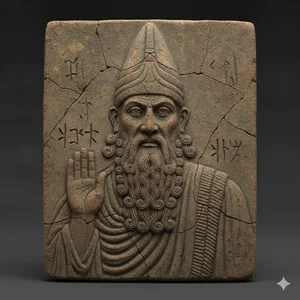

Supreme god of the Canaanite pantheon, master of rain, storms, and fertility. His cult was practiced across the ancient Near East from the 2nd millennium BCE and came into conflict with Hebrew monotheism. Demonized by the Abrahamic traditions, he became a demonic figure in medieval texts.
Baal
Baal
9 min read
Frequently asked questions
Key Facts
- Baal is attested in the cuneiform texts of Ugarit as early as the 14th century BCE.
- He battles and defeats Mot (god of death) and Yam (god of the sea) in the Canaanite mythological cycle.
- The prophet Elijah confronts the priests of Baal on Mount Carmel (9th century BCE, 1 Kings 18).
- Hebrew biblical authors condemned his worship as idolatry, contributing to his demonization.
- In the Goetia (a 17th-century medieval grimoire), Baal becomes the first king of Hell, commanding 66 legions of demons.
Works & Achievements
A set of six cuneiform tablets discovered at Ugarit, recounting Baal's battles against Yam and Mot, the construction of his palace, and his heavenly reign. It is the most important Canaanite mythological text to have survived to our time.
A Ugaritic epic narrative in which Baal intervenes as the protective deity of a human king. This text illustrates Baal's role as guarantor of kingship and fertility in Canaanite culture.
A collection of liturgical texts prescribing the offerings, sacrifices, and prayers addressed to Baal during seasonal festivals. These rituals reveal the institutional organization of his cult and its connection to the agricultural cycle.
A large courtyard temple uncovered in the excavations of Ugarit, one of the best-preserved examples of Canaanite religious architecture. Its proximity to the temple of El reflects the dual dominance of the Ugaritic pantheon.
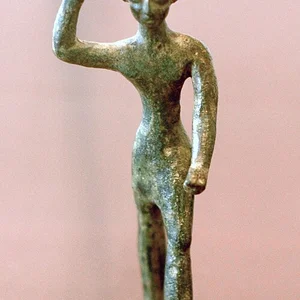
A corpus of sculpted stelae and bronze statuettes depicting Baal as a warrior god brandishing lightning, found throughout the Syro-Palestinian region. These works constitute the primary iconographic documentation of his cult.
Anecdotes
In the mythological tablets discovered at Ugarit in 1929, Baal faces Yam, the god of the sea and chaos, in an epic battle. Using two magical clubs forged by the craftsman god Kothar-wa-Khasis, Baal defeats Yam and establishes himself as king of the gods, thereby securing cosmic order against the forces of aquatic chaos.
Baal must also confront Mot, the god of death and the underworld. Defeated at first, he descends to the realm of the dead and all vegetation withers across the earth. His sister Anat retrieves his body, resurrects him, and Baal returns to the surface — a mythological explanation for the alternating dry and fertile seasons of the ancient Near East.
The Hebrew Bible recounts in 1 Kings 18 a dramatic confrontation between the prophet Elijah and 450 priests of Baal on Mount Carmel, around 875 BCE. The priests of Baal called upon their god in vain all day long, trying to kindle a fire on the altar; Elijah then called upon Yahweh, who sent fire down from heaven, demonstrating the supremacy of the Hebrew god according to biblical tradition.
The very name Baal simply means "master" or "lord" in Northwest Semitic — it was therefore not only a proper name but also a divine title. This explains why so many local forms of the cult existed: Baal Hammon in Carthage, Baal Peor in Moab, Baal Berith in Shechem, with each region venerating its own incarnation of the deity.
In medieval Christian and Jewish texts — notably the Lemegeton and the Key of Solomon — Baal was recast as a demon commanding legions of hell. His name, fused with that of Zebub (fly), gave rise to Beelzebub, one of the most famous devil figures in Western tradition. This demonization is a telling example of the process by which competing religions transform rival gods into demons.
Primary Sources
"Baal sent forth his voice in the clouds, he flashed his lightning to the earth. [...] Baal sat upon his royal throne, Hadad upon the seat of his dominion."
"Then Elijah said to all the people, Come near to me. And all the people came near to him. [...] Then the fire of the LORD fell and consumed the burnt offering, the wood, the stones, and the dust, and licked up the water that was in the trench."
"I, Azatiwada, whom Baal and Resheph of the Stags have blessed [...] Baal made me a father and mother to all the city."
"May Baal of heaven grant my lord life and very great and abundant strength."
"[...] and I took from there the vessels of Yahweh and dragged them before Chemosh."
Key Places
The main Canaanite city and a major center of Baal worship between 1400 and 1200 BCE. It was here that the mythological tablets were discovered in 1929, providing the foundational texts about Baal.
Site of the famous confrontation between the prophet Elijah and the 450 priests of Baal, as recounted in the Bible (1 Kings 18). This coastal promontory was a sacred Canaanite site known for its altars dedicated to Baal.
The Phoenician metropolis that exported the cult of Baal as far as Carthage and throughout the Mediterranean world. It was from Tyre that Queen Jezebel came — the most prominent promoter of Baal worship in Israel.
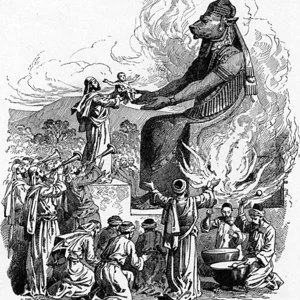
A Phoenician colony founded around 814 BCE where Baal Hammon became the supreme deity. It was here that controversial practices such as the tophet — a sanctuary associated with infant funerary deposits — were linked to his worship.
Capital of the Kingdom of Israel, where King Ahab built a temple to Baal under the influence of Jezebel. This temple was destroyed by Jehu around 842 BCE during his religious and political coup.
Typical Objects

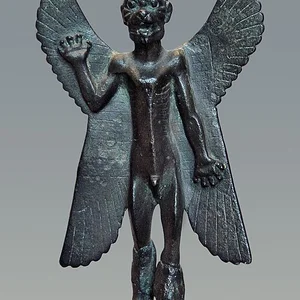
A gilded bronze figurine depicting Baal standing with one arm raised, holding a club or lightning bolt, wearing a horned helmet. These votive statuettes were placed in temples and homes to seek divine favor.

A large carved limestone stele discovered at Ugarit, showing Baal as a triumphant warrior standing over a mythological creature. It is one of the most celebrated iconographic representations of the god in Canaanite art.

A stone altar whose four corners are extended into projections shaped like bovine horns, a symbol of divine power associated with Baal and the bull. Many examples have been found across sites throughout Syria-Palestine.

A wooden post or ritual shrub erected near Baal's altars, representing the goddess Asherah, his consort or female counterpart. The Hebrew prophets repeatedly condemned their presence in Israelite sanctuaries.

Clay tablets inscribed in Ugaritic alphabetic cuneiform, the physical medium of the great mythological epics of Baal. These sacred archives bear witness to a sophisticated literary tradition in the service of the cult.

A ceramic or metal container used during rituals to pour liquid offerings — wine, oil, or water — in honor of Baal. Libations accompanied prayers for rain and the fertility of the fields.
School Curriculum
Vocabulary & Tags
Key Vocabulary
Tags
Daily Life
Morning
The priests of Baal's temple rise before dawn to purify the altars and prepare the morning offerings. They don white linen tunics and burn cedar resin incense to awaken the divine presence. The high priest recites invocation hymns facing the statue of the god, calling for dew and rain upon the surrounding fields.
Afternoon
The great ritual ceremonies take place in broad daylight, with processions around the temple and animal sacrifices — bulls and rams — on the horned altars. Worshippers bring votive offerings of oil, wine, and grain in exchange for divine protection over their crops and livestock. The scribe-priests copy and transmit mythological texts onto fresh clay tablets.
Evening
At sunset, the priests conduct nocturnal rites tied to Baal's cosmic battle against the forces of chaos and death. Ritual fires are lit on the rooftops of temples — the bamot, or high places — to guide the divine lightning. The community gathers for sacred banquets where the meat from the sacrifices is shared among the god, the priests, and the faithful.
Food
The priests and worshippers of Baal's temples consumed portions of sacrificial meat during communal sacred meals. Everyday food in Canaanite Near East consisted of barley and wheat bread, olive oil, figs, dates, lentils, and wine. The bull was the noblest sacrificial animal, reserved for the great seasonal festivals celebrating fertility.
Clothing
Priests wore white linen tunics — a symbol of ritual purity — sometimes embroidered with cosmic motifs, along with colored wool belts and leather sandals. The statue of the god Baal was dressed in precious textiles and adorned with gold and lapis lazuli jewelry during major festivals. Ordinary worshippers wore the short or long tunics typical of the Canaanite world, made from dyed sheep's wool.
Housing
Baal's temples were limestone structures built around an inner courtyard, with a throne room housing the divine statue. At Ugarit, the temple of Baal stood on the city's acropolis, overlooking the Mediterranean Sea. The priests lived in houses adjoining the sanctuaries, while the general population resided in flat-roofed stone and mudbrick houses arranged in dense residential quarters.
Historical Timeline
Period Vocabulary
Visual Style
Esthétique de l'art cananéen du Bronze Récent : stèles en calcaire sculptées, bronzes dorés, architecture en pierre ocre sous des cieux d'orage dramatiques aux éclairs d'or.
Sound Ambience
Ambiance orageuse et sacrée du Proche-Orient cananéen : tonnerre, vents de tempête sur les collines sèches, rituels sonores de bronze et de percussion dans les cours des temples phéniciens.
Liens externes & ressources
Références
Œuvres
Cycle mythologique de Baal (épopée d'Ougarit)
XIVe–XIIIe siècle av. J.-C.
Épopée de Keret
XIVe siècle av. J.-C.
Hymnes et rituels du temple de Baal à Ougarit
XIVe–XIIe siècle av. J.-C.
Temple de Baal à Ougarit
XVe–XIIIe siècle av. J.-C.
Représentations iconographiques (stèles et bronzes cananéens)
XVe–Xe siècle av. J.-C.