 flip
flipOld English Roast Beef and Yorkshire Pudding
Old English Roast Beef and Yorkshire Pudding
Why this dish? Babbage's anchor describes him eating 'according to Victorian bourgeois habits: roast meat, boiled vegetables.' Sunday roast beef, accompanied by Yorkshire pudding cooked under the spit to catch the drippings, was the totem dish of the class to which the mathematician belonged in his house on Dorset Street.
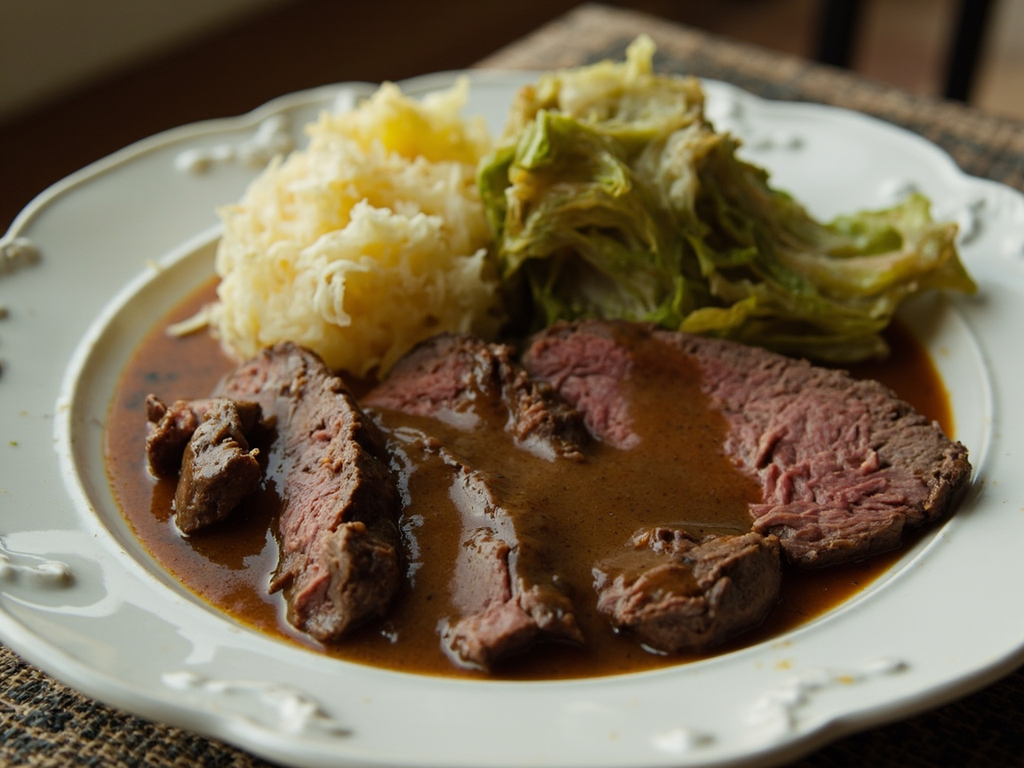
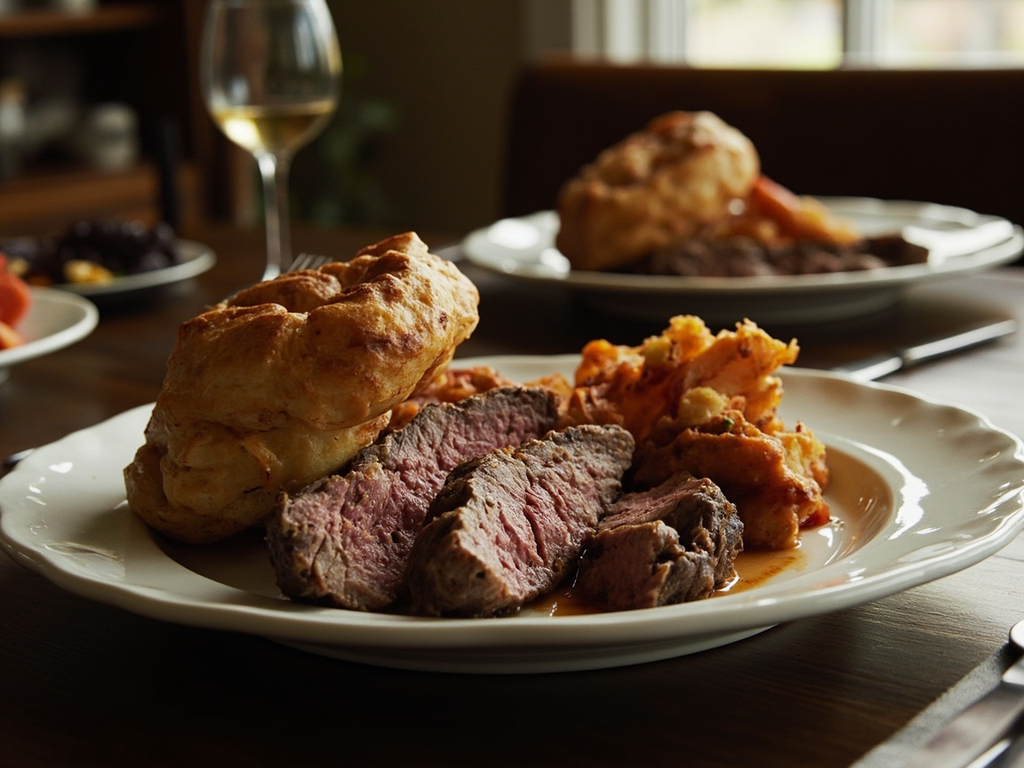
A piece of roast beef cooked to perfection, golden and juicy, served with a puffed, crispy Yorkshire pudding that soaks up the cooking juices. The most iconic dish of England, simple and hearty.
Allow me, Sir, to present the most reasonable dish there is: a fine piece of beef, not spoiled by useless sauces. At my table on Dorset Street, I ensure the roast turns with a steady motion before the fire — for regularity, you see, is the mother of all perfection. Under the spit I place a light batter that drinks the fat drop by drop, called Yorkshire pudding. Slice the meat thin, moisten it with its own juice, and you will have the dinner of an honest Englishman who thinks.
- •Piece of beef for roasting (rib or rib roast) — a fine piece for the household (main meat)
- •Wheat flour — a few handfuls (pudding batter)
- •Fresh eggs — a few (binder for batter)
- •Milk — a pint (pudding batter)
- •Salt and pepper — to taste (seasoning)
- •Beef dripping — the collected juice (cooking the pudding)
Old English Roast Beef and Yorkshire Pudding
A piece of roast beef cooked to perfection, golden and juicy, served with a puffed, crispy Yorkshire pudding that soaks up the cooking juices. The most iconic dish of England, simple and hearty.
Why this dish? Babbage's anchor describes him eating 'according to Victorian bourgeois habits: roast meat, boiled vegetables.' Sunday roast beef, accompanied by Yorkshire pudding cooked under the spit to catch the drippings, was the totem dish of the class to which the mathematician belonged in his house on Dorset Street.
Allow me, Sir, to present the most reasonable dish there is: a fine piece of beef, not spoiled by useless sauces. At my table on Dorset Street, I ensure the roast turns with a steady motion before the fire — for regularity, you see, is the mother of all perfection. Under the spit I place a light batter that drinks the fat drop by drop, called Yorkshire pudding. Slice the meat thin, moisten it with its own juice, and you will have the dinner of an honest Englishman who thinks.
Ingredients (period version)
- Piece of beef for roasting (rib or rib roast) — a fine piece for the household (main meat)
- Wheat flour — a few handfuls (pudding batter)
- Fresh eggs — a few (binder for batter)
- Milk — a pint (pudding batter)
- Salt and pepper — to taste (seasoning)
- Beef dripping — the collected juice (cooking the pudding)
Ingredients
- Roast beef (rib or sirloin) — 1.2 kg (main meat)
- Flour — 120 g (pudding batter)
- Eggs — 3 (binder)
- Milk — 175 ml (batter)
- Water — 75 ml (lightens batter)
- Beef dripping or neutral oil — 2 tbsp (cooking puddings)
- Salt, pepper — to taste (seasoning)
Method
- Bring the meat to room temperature 1 hour ahead. Preheat oven to 240 °C.
- Salt and pepper the roast, place on a rack over a pan. Roast 20 min at 240 °C, then reduce to 180 °C and cook about 15 min per 500 g for medium-rare.
- Prepare pudding batter: whisk flour, eggs, milk, water and a pinch of salt until smooth. Let rest while meat cooks.
- Remove roast, cover with foil and rest 20 min (residual heat finishes cooking).
- Increase oven to 230 °C. Put a little fat in muffin tin holes, heat 5 min in oven until smoking, then pour in batter and bake 20-25 min without opening: puddings puff and brown.
- Slice beef thinly, drizzle with juices, serve with puddings and boiled vegetables (carrots, cabbage, parsnips).
How it was made : At the time, the roast turned on a spit before the fireplace, driven by a weight mechanism or a roasting jack — a detail that would not have displeased Babbage, lover of automata. The Yorkshire pudding was cooked in the dripping pan placed under the meat to catch every drop of fat, a typical domestic economy.
The contemporary twist : Serve the Yorkshire pudding upside down as an edible small bowl, garnished with a shaving of fresh horseradish: a nod to the Victorian taste for horseradish.
Sources : Isabella Beeton, Book of Household Management, 1861 · Eliza Acton, Modern Cookery for Private Families, 1845
Charles Babbage · Charactorium