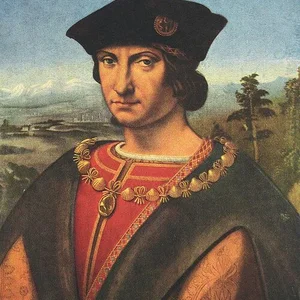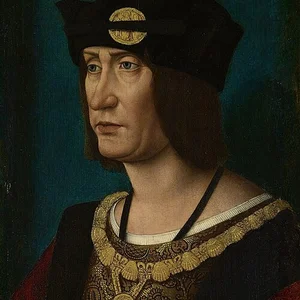

King of France from 1498 to 1515, Louis XII was nicknamed “Father of the People” for his fiscal and judicial reforms. He waged numerous Italian Wars to assert his claims over Milan and Naples.
Louis XII(1462 — 1515)
Louis XII
France
8 min read
Frequently asked questions
Key Facts
- 1498: Ascended to the throne upon the death of Charles VIII, his cousin who left no direct heir
- 1499: Conquest of Milan, claiming the duchy through his grandmother Valentine Visconti
- 1501: Temporary conquest of the Kingdom of Naples alongside Ferdinand II of Aragon
- 1506: Estates General of Tours, which awarded him the title of “Father of the People”
- 1515: Death of Louis XII, leaving the throne to his cousin Francis I
Works & Achievements
A major judicial ordinance deeply reforming the royal justice system: curbing abuses by royal officers, speeding up legal proceedings, and strengthening the protection of those subject to the law. It stands as one of the first great codifications of French judicial procedure.
From the very start of his reign, Louis XII cut the taille by roughly one third compared to the previous reign. This restrained fiscal policy, exceptional for the era, earned him widespread popular esteem and the title of "Father of the People."
Construction of a residential wing at the Château de Blois in a late Flamboyant Gothic style, decorated with the porcupine emblem and the royal motto. It bears witness to royal artistic patronage at the transition between the Middle Ages and the Renaissance.
Louis XII established French administration over the Duchy of Milan for more than a decade, cementing a lasting French presence on the Italian peninsula and channelling the influence of the Italian Renaissance into France.
A series of diplomatic alliances combining dynastic marriages, military pressure, and negotiations with the papacy, Venice, and the Italian states. This complex policy illustrates the modernisation of French royal diplomacy.
Anecdotes
Louis XII, then Duke of Orléans, rebelled against the regent Anne de Beaujeu and was taken prisoner after the defeat at Saint-Aubin-du-Cormier in 1488. He spent several years imprisoned at the château de Lusignan and then at Bourges, before being released in 1491. This captivity shaped in him a cautious character and a rare understanding of the suffering of ordinary people.
In 1498, to succeed Charles VIII who had died without an heir, Louis XII had to have his marriage to Joan of France, daughter of Louis XI, annulled. Pope Alexander VI granted the annulment in exchange for generous diplomatic gifts, and Louis XII immediately married Anne of Brittany, widow of Charles VIII, thereby securing the lasting union of Brittany with the French crown.
In 1506, the Estates General assembled at Tours granted Louis XII the title of “Father of the People” in recognition of his efforts to reduce taxes and reform justice. Since his accession, he had cut the taille by roughly a third — an exceptionally rare gesture on the part of any monarch of the era.
Louis XII’s emblem was the porcupine, an animal said to be able to launch its quills at a distance to defend itself. His motto, “Cominus et eminus” (near and far), meant that he was formidable both in close combat and at range, illustrating his power on both the military and diplomatic fronts.
After the death of Anne of Brittany in January 1514, Louis XII, aged 52 and weakened by illness, married the young Mary Tudor, sister of Henry VIII of England, in the hope of producing a male heir. This political union produced no children, and Louis XII died on 1 January 1515, just a few weeks after the wedding.
Primary Sources
And he was called by the people of France — nobles, merchants, laborers, and others alike — Father of the People, for the goodness and gentleness he showed toward his subjects.
We will and ordain that henceforth justice shall be rendered to our subjects briefly and summarily, without the formality of proceedings or the length of pleadings, according to the provisions of law and the customs of our realm.
King Louis the Twelfth of that name, who for his great goodness and generosity toward his people was surnamed Father of the People, was very sober and moderate in all his actions and expenditures.
It is our pleasure and will that our good and loyal subjects be treated with gentleness and justice, and that the officers of our crown not burden them with undue taxes and impositions.
Key Places
Birthplace of Louis XII and his favorite royal residence. He commissioned a Flamboyant Gothic wing decorated with his porcupine emblem, a testament to royal patronage at the crossroads of medieval and Renaissance styles.
Conquered in 1499 on the basis of rights inherited from Valentina Visconti, Milan was the central prize of Louis XII's Italian Wars. The city was at the time one of the wealthiest in Europe and a major hub of the Italian Renaissance.
The city where the Estates General of 1506 convened and awarded Louis XII the title of "Father of the People." Tours was at the time a significant city frequently chosen as the venue for major assemblies of the French kingdom.
The traditional site of coronations for the kings of France since the early Middle Ages. Louis XII was crowned here on 27 May 1498, receiving the holy anointing that, according to French monarchical tradition, conferred an almost divine character upon his kingship.
The Parisian royal residence where Louis XII died on 1 January 1515. This medieval mansion no longer exists — the present-day Place des Vosges now occupies its former site — but it served as the favorite residence of several kings of France.
Typical Objects

Louis XII's personal emblem, the porcupine appears on his coat of arms, his tapestries, and the decorations of the Château de Blois. A symbol of defensive power, it illustrated the royal motto *Cominus et eminus* (from near and far alike).

Like every Renaissance prince, Louis XII owned magnificent suits of armour forged by the finest Italian and German armourers, combining effective protection with refined decoration featuring royal emblems.

Louis XII's major ordinances, such as the Ordinance of Blois (1499), were written on parchment, sealed with the great royal wax seal, and registered in the parlements. These documents carried the force of law throughout the kingdom.

The supreme insignia of monarchical power, worn at the coronation in Reims and during grand ceremonial occasions. It symbolised the continuity of the Capetian monarchy and the divine legitimacy of the sovereign.

A richly illuminated personal prayer book that accompanied the king in his daily devotions. Louis XII's Book of Hours bears witness to royal patronage and the outward piety displayed by the sovereigns of the French Renaissance.

An insignia of power presented at the coronation, held in the right hand during official ceremonies and depicted in royal portraits and seals. It embodied the sovereign authority of the king over his kingdom.
School Curriculum
Vocabulary & Tags
Key Vocabulary
Daily Life
Morning
Louis XII rose early, true to his habits as a frugal king. His day began with Mass celebrated in the royal chapel in the presence of the court. He would then convene his Privy Council to deliberate on the affairs of the kingdom: dispatches from ambassadors, petitions from officers, and military and fiscal decisions.
Afternoon
Afternoons were devoted to royal audiences, where Louis XII — known for his accessibility — received petitions and grievances from his subjects. Hunting in the forests around Blois or Amboise also occupied part of his time, an indispensable pursuit for any Renaissance prince.
Evening
Evening gatherings at court revolved around banquets, but Louis XII was renowned for his sobriety, a sharp contrast to the splendor of the Italian courts. Music, readings from chronicles, and entertainments enlivened the evenings, in the company of Queen **Anne of Brittany**, herself a recognized patron of the arts.
Food
Louis XII was known for his plain and frugal table, which stood in stark contrast to the lavish banquets of the Italian Renaissance. His diet centered on game meats, bread, vegetables, and wines from the Loire Valley. His frugality, frequently noted by chroniclers, reinforced his image as a king close to his people.
Clothing
Louis XII wore the ceremonial garments typical of Renaissance sovereigns: doublets of velvet or silk, fur-lined cloaks, and chaperons or caps adorned with jewels. His emblem of the porcupine appeared on embroideries and tapestries. For his Italian campaigns, he donned full plate armor forged by the finest armorers.
Housing
Louis XII resided primarily at the **Château de Blois**, which he had enlarged with a new wing, but he also stayed frequently at **Amboise** and the **Hôtel des Tournelles** in Paris. During military campaigns in Italy, he lodged in captured palaces or fortified headquarters, surrounded by a sizable court.
Historical Timeline
Period Vocabulary
Liens externes & ressources
Références
Œuvres
Ordonnance de Blois sur la réformation de la justice
1499
Réduction de la taille et réforme fiscale
1498-1515
Aile Louis XII du château de Blois
1498-1503
Gouvernement du Milanais (1499-1512)
1499-1512
Politique diplomatique et ligues italiennes
1504-1513