
Charybdis is a sea monster from Greek mythology, daughter of Poseidon and Gaia, transformed into a devastating whirlpool by Zeus. She swallows the waters three times a day in the Strait of Messina, threatening any ship that draws near. Odysseus encounters her during his long journey home to Ithaca.
Charybdis
Charybdis
9 min read
Frequently asked questions
Key Facts
- Charybdis is mentioned in Homer's Odyssey (8th c. BCE), in Books XII and XXIII
- The ancients placed her in the Strait of Messina, between Sicily and Italy
- She swallows and spits back the waters three times a day, creating a deadly abyss
- Zeus transformed her into a whirlpool to punish her greed (she had stolen cattle from Heracles)
- Odysseus escapes Charybdis by clinging to a fig tree hanging above the whirlpool
Works & Achievements
Book XII of the Odyssey is the primary source on Charybdis. Homer describes in detail the monster's behavior, Circe's warning, and Odysseus's two passages past the whirlpool — the second of which is a solitary fight for survival.
Hesiod codifies the genealogy of Greek gods and monsters, including the sea creatures born from Poseidon's unions. This work establishes the cosmogonic framework within which Charybdis takes her place as a primordial force.
In this Hellenistic epic, Jason and the Argonauts sail past the strait of Scylla and Charybdis on their return voyage with the Golden Fleece, demonstrating the myth's enduring vitality three centuries after Homer and its integration into other heroic cycles.
Virgil revisits the passage of Charybdis during Aeneas's journey fleeing Troy for Italy. Book III of the Aeneid ensures the transmission of the Greek myth into Latin culture and, through it, into the entire Western literary tradition.
Ovid evokes Scylla and Charybdis in his tales of monstrous transformations, helping to spread and fix their image in the Roman imagination and in later medieval iconography.
Anecdotes
Originally, Charybdis was a naiad, daughter of Poseidon and Gaia. She had committed a sacrilege by stealing the cattle of Heracles to offer them to her father, god of the sea. Zeus, furious at this act of defiance, struck her with a thunderbolt and hurled her into the waves, transforming her into a monstrous whirlpool condemned to swallow and spew back the waters three times a day.
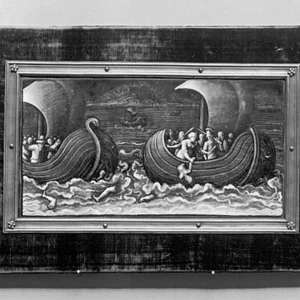
In Book XII of the Odyssey, the sorceress Circe warns Odysseus of the danger posed by Charybdis and Scylla, two monsters positioned on either side of a narrow strait. Odysseus must choose his path carefully: sailing close to Scylla will cost him a few men, but drawing near Charybdis risks swallowing his entire ship. This impossible dilemma gave rise to the expression 'between Scylla and Charybdis' — caught between two equally terrible dangers, equivalent to 'out of the frying pan and into the fire.'
During his second passage past Charybdis, Odysseus had already lost his ship. Swept by the current toward the abyss, he clung with all his strength to a wild fig tree that overhung the whirlpool. He waited, suspended above the void, until Charybdis spat out the wreckage of his raft, then dropped down and swam away. This scene illustrates the hero's resourcefulness when faced with unleashed natural forces.
The Ancients placed Charybdis in the Strait of Messina, between Sicily and Calabria, and this location is not entirely fanciful. The strait is indeed crossed by complex and sometimes violent sea currents, driven by differences in water levels between the Tyrrhenian Sea and the Ionian Sea. Whirlpool phenomena there have been documented since Antiquity, which explains why Greek sailors, struck by these turbulent waters, anchored the myth of a devouring monster to this spot.
Unlike most monsters in Greek mythology, Charybdis is never truly defeated by a hero. Odysseus escapes her, but only through cunning and luck. This detail is significant: the uncontrollable natural forces represented by Charybdis cannot be 'killed' — they can only be navigated around. Greek mythology thus expresses the very real awareness that sailors had of the dangers of sailing the Mediterranean.
Primary Sources
"Below, you will see the other rock, Odysseus. It is lower; the two are close together, within bowshot of each other. There grows a great wild fig tree thick with leaves; beneath it, divine Charybdis sucks down the black water. Three times a day she spews it forth, and three times she gulps it down in a terrible manner."
"When Charybdis had drunk down the salt water of the sea, I dropped down into it, and swam swiftly through the water between the two rocks."
Hesiod alludes to the unions of Poseidon and the monsters born of marine gods, placing Charybdis among the primordial powers descended from Gaia and the deities of the sea.
"They were already passing the rock of Scylla and the deadly whirlpool of Charybdis, whose churning waters roared with a terrible sound."
"On the right, Scylla; on the left, insatiable Charybdis: three times she swallows the waves down to the abyss, and three times she hurls them back toward the stars in a mass of foam."
Key Places
The mythical home of Charybdis, this strait stretching roughly 32 km separates Sicily from mainland Italy. Complex currents and whirlpools have been documented here since antiquity, giving rise to the myth.
It is on this island that the sorceress Circe warns Odysseus of the dangers of Charybdis and Scylla, giving him precise instructions for navigating the strait. She plays a key role in transmitting the myth within the Odyssey.
Odysseus's final destination, it is to reach this Greek island in the Ionian Sea that he must face Charybdis twice. Ithaca is the symbolic anchor of the Homeric journey.
The island where Odysseus's companions slaughter the sacred Cattle of the Sun, triggering Zeus's wrath and the shipwreck that leaves Odysseus alone to face Charybdis. Ancient tradition identifies it with Sicily.
A Greek colony founded in the 8th century BCE across from Messina, Rhegion was the starting point for sailors approaching the treacherous strait. Its inhabitants passed down accounts of the dangers posed by the currents.
Typical Objects

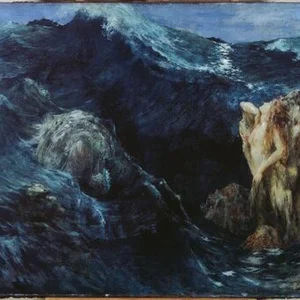
The whirlpool is the visible and terrifying manifestation of Charybdis. Three times a day, she sucks in and then spews out the waters of the strait with a tremendous roar, creating a vortex capable of swallowing an entire ship.

This tree grows on the cliffside, above the abyss of Charybdis. In the Odyssey, it is to its branches that Odysseus clings to survive the whirlpool, making the fig tree the symbol of the last resort in the face of death.

As the divine father of Charybdis, Poseidon is the master of seas and storms. The trident, his principal attribute, symbolizes the marine power of which Charybdis is a monstrous emanation.

Built on the island of Calypso, this raft is destroyed by the storm sent by Zeus following the transgression of Odysseus's companions. Its wreckage, spat out by Charybdis, allows Odysseus to seize it and swim to safety.

In the Odyssey, Charybdis is associated with a low, dark rock, opposite the towering rock of Scylla. This dark promontory marks the boundary of the monster's domain and symbolizes the threshold between the world of the living and the abyss.

The Strait of Messina, where the waters of the Tyrrhenian Sea and the Ionian Sea meet, is the real geographical setting that inspired the myth. The conflicting currents that form there account for the legend's enduring power.
School Curriculum
Vocabulary & Tags
Key Vocabulary
Daily Life
Morning
At daybreak, Charybdis performs her first swallowing of the waters: the Strait of Messina roars, the waves spiral down into the abyss with a deafening crash, then grow calm again. Sailors who frequent the strait at dawn watch anxiously for this dreaded moment, known to every experienced pilot of the Aegean Sea.
Afternoon
In the middle of the day, Charybdis swallows the waters a second time. The surface of the strait churns into a spiral, sweeping away everything that floats within its dangerous reach. Ships that must cross the strait try to hug the rock of Scylla, accepting the loss of a few men rather than face total destruction.
Evening
At dusk, the third swallowing takes place. Then Charybdis spits the waters back out in a violent surge. The wreckage of sunken ships, the bodies of sailors, and the trunks of trees rise back to the surface: the monster has 'digested' its meal, and the sea regains a momentary calm — until the following morning.
Food
Charybdis 'feeds' by swallowing the waters of the sea along with everything they contain: fish, seaweed, shipwrecked sailors, entire vessels. Her hunger is cosmic and uncontrollable, inherited from her divine nature as a daughter of Poseidon and Gaia. She embodies the devouring appetite of the ocean itself.
Clothing
As a sea monster born from a transformed nymph, Charybdis wears no clothing in any human sense. In some traditions she is depicted as a face or torso rising from the whirlpool, surrounded by black foam, her hair indistinguishable from seaweed and the pull of the currents.
Housing
Charybdis 'lives' beneath a low, dark rock in the depths of the Strait of Messina, where the sea is deepest and the currents most unpredictable. Her lair is not a cave but the abyss itself — a liquid, black, and bottomless chasm at the heart of the most feared maritime passage in the Greek world.
Historical Timeline
Period Vocabulary
Visual Style
Style inspiré de la céramique grecque antique et des frises à fond sombre, avec un tourbillon central dominateur baigné de bleus-noirs profonds et de blanc écumeux, entre deux falaises volcaniques menaçantes.
Sound Ambience
Une ambiance sonore dominée par le grondement sourd et cyclique d'un tourbillon géant, avec les échos de vagues furieuses contre des falaises noires et les cris lointains de marins terrifiés.
Liens externes & ressources
Références
Œuvres
L'Odyssée — Homère
VIIIe siècle av. J.-C.
La Théogonie — Hésiode
Vers 700 av. J.-C.
Les Argonautiques — Apollonios de Rhodes
IIIe siècle av. J.-C.
L'Énéide — Virgile
29-19 av. J.-C.
Les Métamorphoses — Ovide
8 apr. J.-C.