
Cretan princess of Greek mythology, daughter of King Minos and Pasiphae. She helps the Athenian hero Theseus defeat the Minotaur by giving him a thread to navigate the labyrinth. Abandoned on the island of Naxos, she becomes the wife of the god Dionysus.
Ariadne
Ariadne
8 min read
Frequently asked questions
Famous Quotes
« "Without me, you would have died in the winding passages of the labyrinth" — words attributed to Ariadne by tradition, recorded by Ovid in the Heroides (Letter X)»
Key Facts
- Daughter of King Minos of Crete and Pasiphae, according to Greek mythological tradition
- Gives Theseus a thread (the "thread of Ariadne") so he can find his way out of the labyrinth after killing the Minotaur
- Flees Crete with Theseus, but is abandoned by him on the island of Naxos
- Married by the god Dionysus after her abandonment, and elevated to divine status in some versions of the myth
- Her story is attested in Greek written sources, notably Hesiod (Theogony) and, on the Latin side, Ovid (Heroides, Metamorphoses)
Works & Achievements
Ariadne is said to have taught or inspired a ceremonial dance mimicking the winding paths of the labyrinth, mentioned by Homer on the Shield of Achilles. This ritual dance was practiced for a long time on the island of Delos.
The symbolic act of handing Theseus a thread is Ariadne's defining 'work' in mythology. This act of practical intelligence gave rise to the proverbial expression 'Ariadne's thread' across European languages.
By marrying the god Dionysus, Ariadne attains immortality. This divine union is regarded as a reward for her virtues, making her one of the few mortals elevated to the status of goddess in Greek mythology.
Dionysus transforms Ariadne's bridal crown into a constellation. The Corona Borealis (Northern Crown) is a constellation visible from the northern hemisphere, an eternal testament to the god's love for the Cretan princess.
Anecdotes
When Theseus arrives in Crete among the young Athenians destined for the Minotaur, Ariadne falls in love with him at first sight. She secretly gives him a ball of thread — the famous 'Ariadne's thread' — so he can find his way back through the labyrinth designed by Daedalus. Without her, Theseus would have defeated the monster but died lost in the endless corridors.
After the victory over the Minotaur, Theseus takes Ariadne aboard his ship and flees Crete. But during a stop on the island of Naxos, he abandons her while she sleeps, with no clear explanation. Some myths say Athena ordered him to leave her; others suggest Theseus was simply cowardly and ungrateful.
Abandoned on the shores of Naxos, Ariadne is discovered by the god Dionysus, god of wine and revelry, who falls desperately in love with her. He marries her and immortalizes her by placing her wedding crown — the Corona Borealis — among the stars of the sky, where it can still be seen today.
Ariadne's thread has become a universal metaphor for anything that helps us find our way through a complex situation or difficult reasoning. This image has run through philosophy, literature, and the sciences from Antiquity to the present day, testifying to the enduring power of this myth.
Primary Sources
Hephaestus depicts on Achilles' shield a round dance of young people like the one Ariadne once taught at Knossos.
Golden-haired Dionysus took fair-tressed Ariadne, daughter of Minos, as his wife, and Zeus the son of Cronos made her immortal.
A fragment evoking the abandonment of Ariadne on Naxos, preserved within the Greek lyric tradition.
Ariadne watched Theseus sail away over the foaming waves, consumed by immense grief in her heart; she could not turn her eyes from the treacherous shore.
Ariadne, daughter of Minos and Pasiphae, fell in love with Theseus and gave him a thread so that he could find his way out of the labyrinth after killing the Minotaur.
Key Places
Capital of the kingdom of her father Minos and seat of the royal palace where the labyrinth built by Daedalus was located. It is here that Ariadne meets Theseus and gives him the life-saving thread.
Greek island where Theseus abandons the sleeping Ariadne on the shore after their escape from Crete. It is on this island that Dionysus discovers her and makes her his wife, elevating her to the status of goddess.
A stopover on Theseus's return journey, where the rescued young Athenians performed the 'crane dance' (geranos) in honor of Ariadne, according to Plutarch. This dance mimicked the winding passages of the labyrinth.
The city of which Theseus is crown prince, which every year sent a tribute of seven young men and seven young women to the Minotaur. Theseus's victory, made possible by Ariadne, frees Athens from this bloody tribute.
A legendary underground structure created by the architect Daedalus to imprison the Minotaur. Some archaeologists believe the complexity of the palace at Knossos inspired this myth. It is here that Ariadne's fate is decided.
Typical Objects

The iconic object of the myth — a ball of wool or linen that Ariadne gives to Theseus so he can find his way out of the labyrinth. This simple object has become the universal symbol of guidance through complexity.

A crown given to Ariadne by Dionysus on their wedding day, forged by Hephaestus according to some versions. After Ariadne's death or apotheosis, Dionysus transformed it into a constellation, still visible in the night sky.

Ariadne also gave Theseus a sword to slay the Minotaur, in addition to the thread. It symbolizes the concrete, courageous help she offers the hero — at the risk of betraying her own father, King Minos.

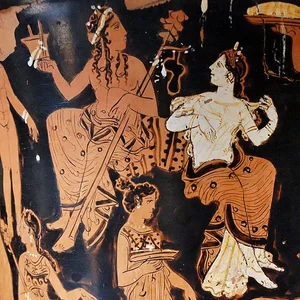
The quintessential attribute of Dionysus, Ariadne's husband, the kantharos is a two-handled cup used in Bacchic rituals. On Greek vases, Ariadne is often depicted holding this cup alongside her divine spouse.

An object associated with the Dionysian mysteries to which Ariadne belongs. Torches light the nocturnal processions held in honor of Dionysus, and recall the light Ariadne brings to Theseus in the darkness of the labyrinth.

In several ancient depictions, Ariadne is portrayed as a skilled weaver — an art befitting her status as a Cretan royal princess. Her embroideries depicted the deeds of gods and heroes.
School Curriculum
Vocabulary & Tags
Key Vocabulary
Tags
Daily Life
Morning
Ariane wakes at sunrise in the royal apartments of the palace of Knossos, where servants bring her perfumed water for her morning ablutions. She dresses in the colorful flounced skirt and open-front tunic typical of Minoan fashion, then offers libations to the goddesses, particularly Potnia, the divine Mistress.
Afternoon
The princess oversees the weaving workshops where the palace women embroider precious fabrics, attends court meetings, and receives instruction in religious rites from the priestesses. In the mythological world, it is during these afternoons that she first glimpses Theseus and chooses to help him, risking her father's wrath.
Evening
Evenings at the palace of Knossos come alive with banquets, acrobatics, and sacred bull-leaping games. As the king's daughter, Ariane presides over certain religious ceremonies tied to the worship of the Minoan gods. After her marriage to Dionysus, her evenings are devoted to Bacchic celebrations, dancing, and mysteries in honor of the god of wine.
Food
Like any Cretan princess, Ariane's diet draws from the bounty of the Mediterranean: barley bread, olives, broad beans, goat cheese, dried fish, and seasonal fruits (figs, grapes, pomegranates). The wine of Dionysus — her future husband — holds a ritual place at feast-day meals and religious ceremonies.
Clothing
Minoan fashion is refined and richly colored: Ariane wears a long skirt of layered flounces adorned with geometric and floral motifs, a short-sleeved tunic left open at the front in keeping with Cretan custom, and supple leather sandals. Her curly hair is carefully styled and decorated with gold diadems and colored ribbons.
Housing
The palace of Knossos is a monumental multi-story structure with interior courtyards, halls lined with columns painted red and black, and frescoes depicting dolphins, griffins, and acrobats. The royal apartments feature a rudimentary system of pipes for running water — a remarkable luxury for the era.
Historical Timeline
Period Vocabulary
Visual Style
Esthétique mêlant les fresques minoennes de Cnossos et la peinture sur vase athénienne, avec une palette méditerranéenne chaude, des motifs de labyrinthe et des symboles dionysiaques.
Sound Ambience
Ambiance du palais de Cnossos entre mer, torches et musiques rituelles, mêlant le quotidien crétois aux sonorités mystérieuses du labyrinthe et des fêtes dionysiaques.
Liens externes & ressources
Références
Œuvres
La danse du labyrinthe (geranos)
Époque mythique, transmission orale
Le fil salvateur — acte fondateur
Époque mythique
Mariage avec Dionysos et apotheose
Époque mythique
Corona Borealis — la couronne céleste
Époque mythique, décrite par Ératosthène ~240 av. J.-C.