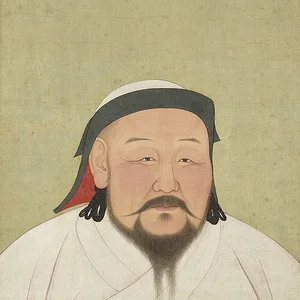

Grandson of Genghis Khan, Kublai Khan founded the Yuan dynasty in China and ruled from 1260 to 1294. He expanded the Mongol Empire to its greatest extent and opened China to international trade, most notably welcoming Marco Polo.
Kublai Khan(1215 — 1294)
Kublai Khan
dynastie Yuan en Chine
7 min read
Frequently asked questions
Key Facts
- 1215: Birth of Kublai Khan, grandson of Genghis Khan
- 1260: Becomes Great Khan of the Mongol Empire
- 1271: Founds the Yuan dynasty and proclaims the Empire of China
- 1275: Receives Marco Polo at his court in Khanbaliq (Beijing)
- 1294: Death of Kublai Khan, end of the Mongol Empire's golden age
Works & Achievements
By adopting a Chinese reign name and founding the Yuan Dynasty, Kublai Khan established the first foreign conquest dynasty to rule all of China, synthesizing Mongol and Chinese cultures.
Kublai Khan had a monumental new capital built north of the former Jin capital, featuring an orthogonal layout, lavish palaces, and a perimeter wall stretching 28 km.
Kublai Khan unified his empire's monetary system by imposing state-issued paper money, facilitating trade along the Silk Roads and inspiring awestruck admiration from Marco Polo.
Kublai Khan had the Grand Canal extended and restored over more than 1,700 km to connect Hangzhou to Khanbaliq, ensuring the capital's rice supply and boosting domestic trade.
At Kublai Khan's request, the Tibetan monk Drogön Chögyal Phagpa created a new universal script intended to transcribe all languages of the empire, reflecting the ruler's ambition to unify his vast realm.
The naval victory at Yamen ended the resistance of the Southern Song and placed the entirety of Chinese territory under Mongol authority for the first time since the era of divided kingdoms.
Anecdotes
Kublai Khan was the first Mongol ruler to settle permanently in China, adopting the customs and rituals of Chinese civilization. His Mongol advisors criticized him for abandoning nomadic traditions, but he understood that governing such a vast empire required adapting to its peoples.
In 1271, Kublai Khan received the Venetian merchant Marco Polo at his court, who remained in his service for nearly seventeen years. Upon returning to Europe, Marco Polo dictated his memoirs from a Genoese prison, giving rise to the famous Book of the Marvels of the World, which opened Asia to European eyes.
Kublai Khan attempted to invade Japan twice, in 1274 and 1281. Both expeditions were devastated by typhoons that the Japanese called kamikaze, meaning 'divine winds.' These failures marked the first major military defeats of the Mongol Empire.
An avid hunting enthusiast, Kublai Khan organized spectacular hunting parties that mobilized thousands of beaters, elephants, and falconers. Marco Polo described with wonder these lavish processions that swept across the plains around Beijing for weeks at a time.
To facilitate trade across his immense empire, Kublai Khan developed and imposed the use of paper money — the 'chao' — a Chinese invention he extended across all his territories. Marco Polo was astonished to find that simple pieces of paper had replaced gold and silver in everyday transactions.
Primary Sources
The Great Lord is of middle height, neither too tall nor too short; his limbs are well-formed. His complexion is white and ruddy like a rose. His eyes are black and fine, his nose well shaped and prominent.
Kublai, the fourth son of Tolui, inherited his father's legacy and showed from his youth a superior intelligence to that of his brothers in matters of governance.
Kublai Khan established his capital at Khanbaliq and built there palaces of unparalleled magnificence, surrounding the city with walls and gardens where animals from every province of the empire roamed freely.
Emperor Shizu [Kublai Khan] instituted civil examinations adapted to Chinese scholars, promulgated laws promoting agriculture, and ordered the construction of public granaries to prevent famines.
Key Places
Capital of Kublai Khan's empire, renamed Khanbaliq ('City of the Khan'), it was built on a regular grid plan and housed palaces that Marco Polo described as the most beautiful in the world.
Kublai Khan's summer capital, Shangdu was a pleasure city surrounded by gardens and game-rich forests. The English poet Coleridge immortalized it under the name Xanadu in his famous Romantic poem.
Former capital of the Southern Song dynasty, Hangzhou was conquered by Kublai Khan in 1276. Marco Polo, who visited after the conquest, described it as 'the most noble and magnificent city in the world.'
The ancient Mongol capital founded by Genghis Khan on the steppes of Central Asia. Kublai Khan abandoned it in favor of Khanbaliq, symbolizing the shift of the center of power toward China.
An important commercial city in China where Marco Polo claims to have served as governor for three years in the service of Kublai Khan, illustrating the openness of the Yuan administration to foreigners.
Typical Objects

The seal of Emperor Yuan, carved from green jade, bore the Chinese characters attesting to the sovereign's celestial authority. Its use symbolized Kublai's adoption of Chinese imperial rites.

Kublai Khan popularized the use of state-issued paper banknotes to facilitate trade across the empire. Marco Polo was astonished by this monetary system, entirely unknown in Europe.

Short but extraordinarily powerful, crafted from horn, wood, and sinew, this bow was the emblematic weapon of the Mongol cavalry. Despite his settled lifestyle, Kublai Khan maintained an elite guard of cavalry archers armed with these bows.

Even while residing in his palaces at Khanbaliq, Kublai Khan kept lavishly decorated yurts to honor Mongol nomadic traditions. These richly adorned tents served as venues for certain receptions and ceremonies.

Kumiss, a fermented drink made from mare's milk, was the traditional Mongol beverage. Kublai Khan drank it from golden cups during great festivities, surrounding the ritual with symbols of power.

Falconry was Kublai Khan's favorite sport; he owned hundreds of trained falcons. Marco Polo described the imperial hunting parties where thousands of birds of prey were released across the plains.
School Curriculum
Vocabulary & Tags
Key Vocabulary
Daily Life
Morning
Kublai Khan rose early for Buddhist and Taoist morning rituals presided over by his religious advisors. He then received reports from his generals and administrators from the four corners of the empire, sometimes delivered by relay riders who had traveled hundreds of kilometers.
Afternoon
Afternoons were often devoted to official audiences in the throne room, where foreign ambassadors, merchants, and officials presented themselves according to strict ceremonial protocol. He also oversaw military and commercial affairs, surrounded by secretaries drafting decrees in multiple languages.
Evening
Evenings at court were marked by lavish banquets flowing with kumiss and wine, enlivened by musicians, acrobats, and storytellers from across Asia. Kublai Khan, a large man with a hearty appetite, sometimes received foreign visitors such as Marco Polo at these formal dinners.
Food
Kublai Khan's table reflected the diversity of his empire: Mongol roasted meats (mutton and horse), refined dishes from Song Chinese cuisine, spices from India and Persia, and exotic fruits transported by the imperial postal relay system. Kumiss, fermented mare's milk, remained the ceremonial drink of Mongol celebrations.
Clothing
Kublai Khan wore court robes of silk embroidered with golden dragons, topped with the imperial bonnet and its egret plume. During traditional Mongol festivals, he dressed in fur and felt garments echoing the traditions of the steppes. His attire varied with the occasion: simple and practical for hunting, sumptuous for diplomatic audiences.
Housing
Kublai Khan resided in the imperial palace of Khanbaliq, a complex of courtyards and buildings enclosed by walls and ornamental gardens. In summer, he stayed at Shangdu — his summer capital — which featured forests and meadows designed to evoke the Mongol steppes. Luxurious yurts erected in the palace gardens allowed him to reconnect with the nomadic traditions of his ancestors.
Historical Timeline
Period Vocabulary
Visual Style
Le style visuel de l'époque de Kubilai Khan fusionne la majesté impériale chinoise — laque rouge, toits dorés, dragons — avec les ornements nomades mongols, dans une palette de rouge, or et jade.
Sound Ambience
L'ambiance sonore de la cour de Kubilai Khan mêle les percussions cérémonielles mongoles aux cloches des temples bouddhistes, dans le brouhaha polyglotte d'un empire à l'apogée de sa puissance commerciale.
Liens externes & ressources
Références
Œuvres
Fondation de la Dynastie Yuan
1271
Construction de Khanbalik (nouvelle Pékin)
1267-1285
Réforme du système monétaire et généralisation du papier-monnaie
1260-1280
Extension du Grand Canal
1280-1293
Création de l'alphabet Phags-pa
1269
Unification de la Chine sous les Yuan
1279