 flip
flipBanitsa with Sirene — Rolled Phyllo Pie from Gabrovo
Banitsa with Sirene — Rolled Phyllo Pie from Gabrovo
Why this dish? Christo Javacheff was born in 1935 in Gabrovo, Bulgaria, into a family of textile industrialists. Banitsa, a phyllo and cheese pastry rolled into a spiral, is THE Bulgarian morning and Sunday dish — the one of a Balkan childhood before exile. The gesture of rolling thin dough around the filling is not without echo with a life's work: wrapping, folding, draping fabric.
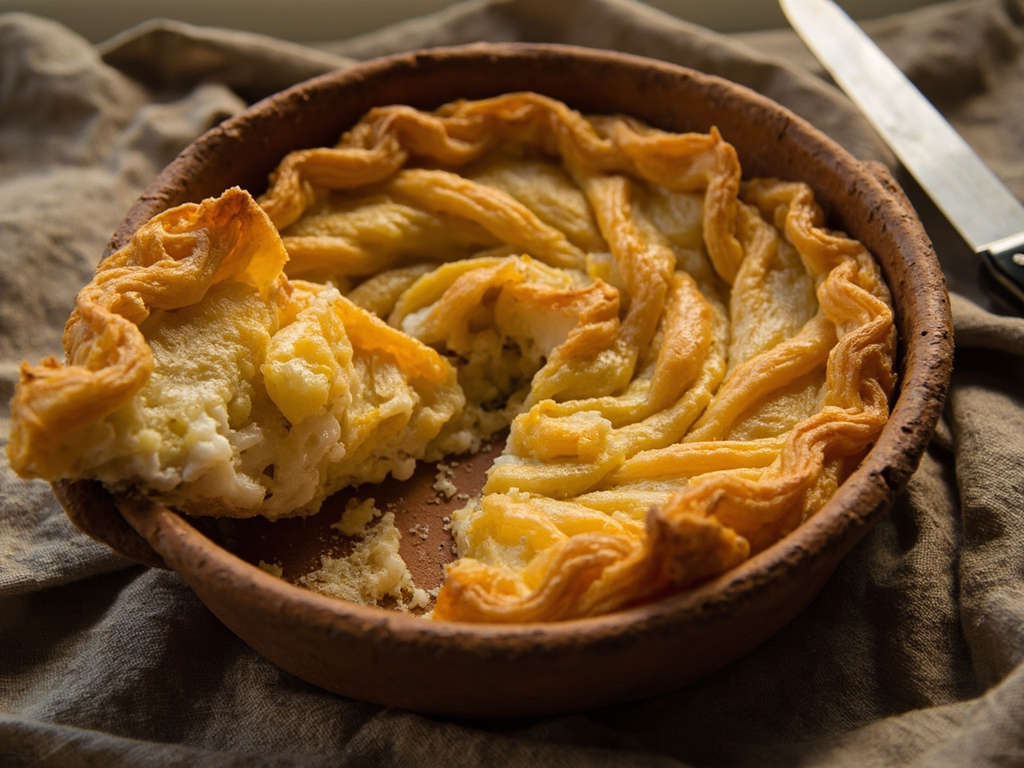
A long sheet of very thin phyllo, brushed with butter, filled with crumbled sheep's milk cheese bound with eggs and yogurt, then rolled into a snail shape and baked until golden. Crispy outside, soft and salty inside.
At home in Gabrovo, Sunday began with the smell of butter and sirene. My mother would stretch the dough until you could see daylight through it — thin as the fabric we stretch, you see, so thin you feared tearing it. We'd roll it loosely, like a snail, and slide it into the oven. The secret, I'll tell you: a little yogurt in the egg, so the inside stays tender while the top cracks. That's what I carried when I left the country — not the walls, that gesture.
- •Hand-stretched phyllo dough — one large thin sheet (crispy wrapper)
- •Sirene (brined sheep's milk cheese) — two good handfuls, crumbled (salty filling)
- •Farm eggs — two or three (binder)
- •Bulgarian yogurt — one ladleful (softness and acidity)
- •Melted butter — as needed for brushing (flakiness)
Banitsa with Sirene — Rolled Phyllo Pie from Gabrovo
A long sheet of very thin phyllo, brushed with butter, filled with crumbled sheep's milk cheese bound with eggs and yogurt, then rolled into a snail shape and baked until golden. Crispy outside, soft and salty inside.
Why this dish? Christo Javacheff was born in 1935 in Gabrovo, Bulgaria, into a family of textile industrialists. Banitsa, a phyllo and cheese pastry rolled into a spiral, is THE Bulgarian morning and Sunday dish — the one of a Balkan childhood before exile. The gesture of rolling thin dough around the filling is not without echo with a life's work: wrapping, folding, draping fabric.
At home in Gabrovo, Sunday began with the smell of butter and sirene. My mother would stretch the dough until you could see daylight through it — thin as the fabric we stretch, you see, so thin you feared tearing it. We'd roll it loosely, like a snail, and slide it into the oven. The secret, I'll tell you: a little yogurt in the egg, so the inside stays tender while the top cracks. That's what I carried when I left the country — not the walls, that gesture.
Ingredients (period version)
- Hand-stretched phyllo dough — one large thin sheet (crispy wrapper)
- Sirene (brined sheep's milk cheese) — two good handfuls, crumbled (salty filling)
- Farm eggs — two or three (binder)
- Bulgarian yogurt — one ladleful (softness and acidity)
- Melted butter — as needed for brushing (flakiness)
Ingredients
- Phyllo dough — 1 package (≈ 270 g, 6-8 sheets) (crispy wrapper)
- Sheep's milk feta — 250 g (salty filling)
- Eggs — 3 (binder)
- Plain yogurt (stirred) — 150 g (softness and acidity)
- Melted butter — 80 g (flakiness)
Method
- Crumble the feta into a bowl, add eggs and yogurt, mix while keeping some chunks.
- Lay out a phyllo sheet, brush with melted butter, spread a little filling along the entire length.
- Roll loosely into a log, then coil that log into a spiral (snail) in the center of a buttered round pan.
- Repeat with remaining sheets, extending the spiral.
- Brush the top with butter, bake at 180 °C for 35-40 min until the banitsa is golden.
- Let cool for 10 min before slicing: the cheese will firm up slightly.
How it was made : In pre-war Bulgaria, the dough (kori) was hand-stretched on a large floured table until translucent — a skill passed from mother to daughter. New Year's banitsa often hid small wish messages rolled inside the dough (the *banitsa s kasmet*).
The contemporary twist : Slip a small wax paper with the title of an artwork into one portion, like Bulgarian New Year wishes — a nod to ephemeral art: unwrap, discover, discard the wrapper.
Christo and Jeanne-Claude · Charactorium