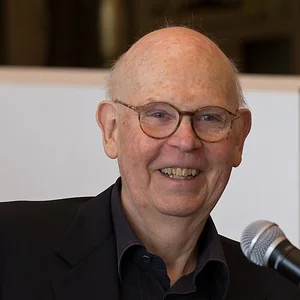

Swedish-American sculptor born in 1929, a major figure of Pop Art. He is celebrated for his monumental sculptures of everyday objects made from soft materials or at large scale, transforming the ordinary into works of art.
Claes Oldenburg(1929 — 2022)
Claes Oldenburg
États-Unis, Suède
8 min read
Frequently asked questions
Key Facts
- Born on January 28, 1929, in Stockholm, he grew up in the United States
- In 1961, he opened 'The Store', an environment-installation in New York reproducing consumer goods in painted plaster
- From the 1960s onward, he created his celebrated 'soft sculptures' — rigid objects reproduced in soft vinyl (Soft Typewriter, 1963)
- Together with Coosje van Bruggen, he created numerous monumental public sculptures, including Clothespin (1976) in Philadelphia
- He died on July 18, 2022, in New York
Works & Achievements
An installation in which Oldenburg transformed a commercial space in Manhattan into a gallery selling painted plaster replicas of food and everyday objects. This founding work of Pop Art deliberately blurred the boundary between art and commerce.
A sculpture made of painted canvas and foam depicting a giant hamburger 132 cm in diameter. It is one of Oldenburg's first "soft sculptures" and introduces fast food as a legitimate artistic subject.
A life-size typewriter made of soft vinyl that sags under its own weight. It embodies Oldenburg's defining approach: making what is hard "soft" in order to question our relationship with everyday technology.
A monumental sculpture installed at Yale University combining a giant lipstick with tank treads. A political protest against the Vietnam War, it became a symbol of art's engagement in public debate.
A 13-meter-tall Corten steel sculpture installed in the center of Philadelphia. Oldenburg's first major public commission, it brought his monumental work into the American urban landscape.
Created with Coosje van Bruggen for the Walker Art Center in Minneapolis, this sculpture depicts an enormous 15-meter spoon topped with a red cherry. It has become one of the most beloved public sculptures in the United States.
A monumental sculpture depicting a typewriter eraser — an object now obsolete in the digital age. With nostalgia and humor, Oldenburg pays tribute to the intellectual tools of the twentieth century.
Anecdotes
In 1961, Claes Oldenburg transformed an ordinary shop on the Lower East Side of New York into a total work of art: he opened 'The Store', a fictional boutique filled with plaster sculptures imitating clothing, shoes, and food. Visitors could purchase these fake products, blurring the boundary between art and everyday consumer goods.
During the Vietnam War, Oldenburg installed in 1969 in the courtyard of Yale University a provocative sculpture: an enormous lipstick mounted on military tank treads. This work, titled 'Lipstick (Ascending) on Caterpillar Tracks', combined a feminine symbol of seduction with a war machine, denouncing the conflict with humor and irony.
Oldenburg is one of the pioneers of 'soft sculpture': he created objects normally made of hard materials — typewriters, electric fans, telephones — in padded soft vinyl. These sagging, shapeless objects, lying limply on a surface, provoked both laughter and a sense of uncanniness, challenging our relationship with the things of everyday life.
For the city of Philadelphia, Oldenburg created in 1976 a monumental sculpture representing a simple clothespin, 14 meters tall, in Corten steel. Installed in the heart of the city, facing City Hall, the work was both ridiculed and admired, embodying his founding principle: elevating the most mundane object to the status of an artistic icon.
With his partner and collaborator Coosje van Bruggen, Oldenburg conceived 'Spoonbridge and Cherry' (1988), a giant 52-meter spoon straddling a pond, topped with a red cherry. Having become the emblem of the Minneapolis Sculpture Garden, this playful and colorful sculpture illustrates Pop Art's ability to make art accessible to everyone.
Primary Sources
I am for an art that is political-erotical-mystical, that does something other than sit on its ass in a museum. I am for an art that grows up not knowing it is art at all.
The Store was a store, with the exception that everything in it was made by me and cost as much as paintings. I wished to do a work that was totally submerged in ordinary life.
I want to make things that nobody wants to look at as art at first, and then make them look at them as art — that is the trick, and the point.
The colossal monument is a way of transforming the familiar into the strange — to place in the city an object that everyone knows but has never seen at this scale, and thereby to see the city anew.
Key Places
Claes Oldenburg's birthplace, born on January 28, 1929. His dual Swedish-American identity shaped his detached, ironic view of American consumer culture.
The city where Oldenburg settled in 1956 and lived until his death in 2022. It was in Manhattan that he opened "The Store," organized his happenings, and developed his entire major body of work.
The city where he grew up after his family settled there in 1936, and where he studied at the Art Institute of Chicago. This industrial, working-class city fueled his interest in everyday objects.
Oldenburg earned his bachelor's degree here in 1950, then in 1969 installed his provocative sculpture Lipstick on Caterpillar Tracks on campus as a protest against the Vietnam War.
The sculpture Clothespin (1976) stands at the heart of the business district. It was one of Oldenburg's first major public commissions and brought his work into everyday urban space.
This contemporary art museum has been home since 1988 to the sculpture Spoonbridge and Cherry, created with Coosje van Bruggen. It has become Oldenburg's most photographed work and the museum's signature icon.
Typical Objects

Oldenburg transformed this mundane everyday object into a 13-meter monumental sculpture, installed in Philadelphia in 1976. The clothespin, enlarged to an extreme scale, becomes both humorous and imposing, questioning our relationship with familiar objects.

In 1963, Oldenburg created a typewriter made of soft vinyl that collapses under its own weight. This normally rigid and functional object becomes unusable and almost alive, symbolizing his critique of industrial society and its tools.

This hamburger made of painted canvas and foam, over a meter in diameter, is one of Oldenburg's first soft sculptures (1962). It presents fast food as an emblem of American consumer culture.

Combining a feminine symbol with a war machine, this 1969 sculpture was a political protest against the Vietnam War, installed at Yale. It embodies Oldenburg's ability to transform an everyday object into a political statement.

This monumental 1988 sculpture installed in Minneapolis depicts a 15-meter spoon topped with a red cherry. It has become the emblem of the Walker Art Center and is a perfect example of Oldenburg's characteristic humor.

For his 1961 installation, Oldenburg created dozens of roughly painted plaster replicas of sandwiches, cakes, shoes, and clothing, mimicking the display windows of popular New York shops.

This monumental 1999 sculpture depicts a circular eraser from the mechanical typewriter era — an object rendered obsolete in the digital age. Oldenburg celebrates the intellectual tools of the 20th century with nostalgia and humor.
School Curriculum
Vocabulary & Tags
Key Vocabulary
Tags
Daily Life
Morning
In the 1960s, Oldenburg began his day in his Lower East Side studio in Manhattan, a space cluttered with vinyl, kapok, plaster, and paint. He devoted his mornings to making sculptures, often working by hand with deliberately craft-based and "rough" techniques.
Afternoon
Afternoons were often spent preparing happenings with fellow artists (Jim Dine, Allan Kaprow, Red Grooms). He would plan performances, write notes and scripts, and photograph his own works in progress.
Evening
New York's art scene regularly spilled into the evenings, in galleries, lofts, and the Judson Memorial Church, where artists, dancers, poets, and avant-garde musicians crossed paths. Oldenburg was an active participant in this creative ferment, so characteristic of 1960s New York.
Food
Like many New York artists of that generation living on modest incomes, Oldenburg often ate at the popular diners and luncheonettes of Manhattan — those cheap restaurants whose window displays directly inspired him for *The Store*. Everyday American food (hamburgers, hot dogs, ice cream) became a central theme in his work.
Clothing
Oldenburg wore the typical attire of New York artists in the 1960s: jeans, a simple shirt, sometimes a work coat stained with paint. He embodied the image of the artist-craftsman working with his hands, far removed from any concern for elegance or self-presentation.
Housing
Like most artists of his generation in New York, Oldenburg lived and worked in industrial lofts in the Lower East Side or SoHo — large spaces that allowed him to build large-scale sculptures. His studio was also his home, in neighborhoods that were then working-class and affordable, before their gentrification in the 1980s.
Historical Timeline
Period Vocabulary
Liens externes & ressources
Références
Œuvres
The Store
1961
Soft Typewriter (Machine à écrire molle)
1963