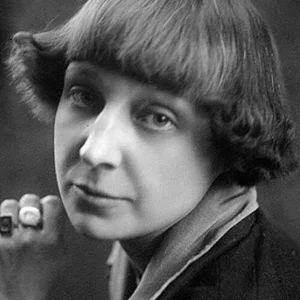

One of the greatest Russian poets of the 20th century, Marina Tsvetaeva was born in Moscow in 1892. Exiled in Europe after the Bolshevik Revolution, she returned to the USSR in 1939 and took her own life in 1941, leaving behind a body of lyric poetry of rare intensity.
Marina Tsvetaeva(1892 — 1941)
Marina Tsvetaeva
Union soviétique, Empire russe
8 min read
Frequently asked questions
Famous Quotes
« I am a page for your pen. I receive everything. I am a white page.»
« My poems, written so early that I did not yet know I was a poet.»
Key Facts
- Born in Moscow in 1892 into a family of intellectuals (her father founded the Museum of Fine Arts in Moscow)
- Published her first poetry collection at age 18 in 1910
- Lived in exile in Prague and then Paris from 1922 to 1939, separated from her homeland by the 1917 revolution
- Returned to the USSR in 1939; her husband was executed and her daughter arrested by the NKVD
- Died by suicide by hanging in Yelabuga on August 31, 1941, having been evacuated during the Nazi invasion
Works & Achievements
Her first collection, published at eighteen, noticed by Symbolist critics. It already reveals Tsvetaeva's distinctive voice, blending youthful intimacy with lyrical ambition.
A major collection written during the Revolution and Civil War, capturing the tension between historical chaos and devotion to poetic craft. It cemented her place among the great Russian poets.
Two long lyric poems composed in Prague, inspired by a passionate love affair, considered among the peaks of 20th-century Russian poetry for their emotional intensity and formal virtuosity.
A fantastical narrative poem drawing on Russian folk tradition, blending the bylina register with Tsvetaeva's personal lyricism. It reflects her deep interest in Russian cultural roots.
An autobiographical prose essay on the intimate and formative relationship Tsvetaeva held with Pushkin's work from childhood. A valuable document on the shaping of a poetic consciousness.
A cycle of poems written in response to the Nazi occupation of Czechoslovakia, one of Tsvetaeva's rare overtly political works, marked by exceptional fury and anguish.
An epistolary exchange between Tsvetaeva, Rainer Maria Rilke, and Boris Pasternak, published posthumously. These letters are an exceptional document of European literary life in the interwar years.
Anecdotes
Marina Tsvetaeva began writing poetry at the age of six, in several languages: Russian, French, and German. Her mother, a pianist, passed on to her an intense love of art, and when she died of tuberculosis in 1906, Marina turned to writing as her way of working through grief.
In 1910, at just eighteen, Tsvetaeva self-published her first collection, 'Evening Album', without telling her father. The Symbolist poet Valery Bryusov, a leading literary figure of the time, immediately recognized her talent and devoted a glowing review to it in a literary journal, launching her career.
During the Russian Civil War (1918–1920), Marina Tsvetaeva lived in desperate poverty in Moscow. She placed her two daughters in an orphanage so they would be fed, but the younger one, Irina, died of starvation at the age of three in 1920. This tragedy would haunt all of her subsequent work.
In exile in Prague and then Paris during the 1920s, Tsvetaeva kept up a passionate poetic correspondence with Rainer Maria Rilke and Boris Pasternak. These letters, themselves genuine literary works, bear witness to an intellectual friendship and mutual admiration among three of the greatest European poets of the twentieth century.
Upon returning to the USSR in 1939, Tsvetaeva saw her husband Sergei Efron and her daughter Ariadna arrested by the NKVD. Evacuated to Yelabuga in 1941 during the German invasion, isolated, without work or resources, she hanged herself on August 31, 1941. She left three farewell letters, one addressed to her son Georgy, who would also die at the front a year later.
Primary Sources
Pushkin infected me with love. With the word love. Since then, all words of love, in all languages, are Pushkin's words.
I cannot live without writing. For me, writing is breathing. I know how to do nothing else.
You will bind my absence to your existence, you will sense through a tear — that it is me.
You are the first poetic reality I have encountered in my life — you are what I would have wanted to be.
Hunger. Cold. The children. And yet — verses. You cannot kill that.
Key Places
Tsvetaeva was born and raised in this house in the Arbat district, now converted into a museum. It was here that she wrote her first poems and forged her poetic identity, deeply tied to the city of Moscow.
The first stop of her exile (1922–1925), Prague was a period of relative creative calm for Tsvetaeva. She wrote several of her major works there, including 'Poem of the Mountain' and 'Poem of the End'.
Tsvetaeva spent fifteen years in the modest suburbs of Paris, living in great poverty. Despite her isolation within the émigré community, she produced a considerable body of work in both prose and poetry.
A provincial town where Tsvetaeva was evacuated during the German invasion in 1941. It was here, in complete destitution and with no news of her husband or children, that she took her own life on August 31, 1941.
A seaside resort in Crimea where Tsvetaeva met her future husband Sergei Efron in 1911, at the home of the poet Maximilian Voloshin. This place symbolizes the carefree years before the revolution.
Typical Objects

Tsvetaeva filled school notebooks with her poems, often written under precarious conditions. These manuscripts, preserved despite great hardship, are now considered priceless literary archives.

In exile in Paris, Tsvetaeva used a small typewriter to prepare her texts for Russian émigré journals, which were her main — and meager — source of income.

A symbol of Russian domestic life, the samovar was a fixture at literary gatherings in the Parisian émigré apartments where Tsvetaeva would read her poems aloud.

Photographs of Tsvetaeva frequently show her wrapped in a large dark shawl, an emblematic garment of the women poets of the Russian Silver Age.

For Tsvetaeva, letter-writing was an art form in its own right; her letters to Rilke, Pasternak, and Teskova are regarded as major literary works.

Shaped by her reading of Bryusov, Blok, and Akhmatova, Tsvetaeva owned a library of Russian and European poetry that she partly carried with her into exile.
School Curriculum
Vocabulary & Tags
Key Vocabulary
Tags
Daily Life
Morning
Tsvetaeva rose before dawn to write, the only quiet moment in an overcrowded household. She prepared tea in the samovar and settled at her desk, cluttered with notebooks and dictionaries, writing in one sustained flow until the children woke up.
Afternoon
Afternoons were devoted to the domestic chores that weighed heavily on life in exile: shopping on a meager budget, mending clothes, taking the children to school. She sometimes took on translations or wrote articles for émigré journals to earn a few francs.
Evening
In the evenings, she attended the readings and literary gatherings of the Russian émigré community in Paris — meetings in small apartments where poets read their work aloud. Back home, she would return to her correspondence late into the night.
Food
Tsvetaeva's diet in exile was frugal and often inadequate: black bread, thin soups, potatoes. In her letters, she describes the shame of being unable to feed her children properly. Strong, sweet tea was her only daily luxury.
Clothing
Tsvetaeva wore simple, worn dresses, often dark in color, covered by a large black woolen shawl that served both as adornment and protection against the cold of poorly heated apartments. She cared little for Parisian elegance, entirely indifferent to bourgeois vanity.
Housing
In exile in Paris, the family lived in small suburban apartments — in Meudon, Clamart, Vanves — often just two rooms for four people. The walls were bare, the furniture sparse; the kitchen table doubled as her writing desk. Upon returning to the USSR in 1939, she lived in even more precarious conditions, with no fixed address.
Historical Timeline
Period Vocabulary
Visual Style
Un style visuel intimiste et sombre, entre clair-obscur expressionniste et esthétique photographique des années 1920, reflétant la tension entre la richesse intérieure d'une poète et la précarité de son existence en exil.
Sound Ambience
L'univers sonore de Tsvetaïeva mêle le silence studieux des petites heures du matin à Paris, le grincement de la plume sur le papier et les bruits feutrés d'un appartement modeste de banlieue, ponctués de réminiscences musicales de Moscou.
Liens externes & ressources
Références
Œuvres
Album du soir (Vecherniy albom)
1910
Verstes (Vyorsty)
1921
Le Poème de la Montagne et Le Poème de la Fin
1924–1926
Le Gars (Molodets)
1924
Mon Pouchkine
1937
Poème à la Tchéquie (Stikhi k Chekhii)
1938–1939
Correspondance à trois (Lettres à Rilke et Pasternak)
1926