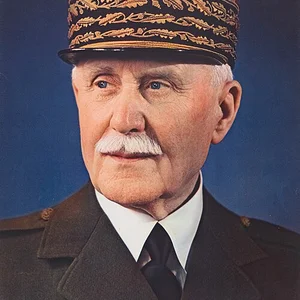

Marshal of France and celebrated military commander known for his victory at Verdun in 1916, Philippe Pétain became head of the French government in 1940 and established the authoritarian French State of Vichy. A collaborator during the German occupation, he remains one of the most controversial figures in French history.
Philippe Pétain(1856 — 1951)
Philippe Pétain
France
9 min read
Frequently asked questions
Key Facts
- 1916: French victory at Verdun — Pétain becomes a national military hero
- 1917: Commander-in-Chief of the French armies, he restores troop morale following the mutinies
- 1940: Signs the armistice with Germany (June 22) and becomes head of the French government
- 1940–1944: Establishes the French State (Vichy regime), pursuing a policy of collaboration and authoritarianism
- 1945: Tried for treason, sentenced to death (commuted to life imprisonment), dies in 1951
Works & Achievements
By taking command of Verdun, Pétain organised a troop rotation system and a revolutionary logistics network via the Voie Sacrée (Sacred Way). This major military achievement allowed France to hold against the German offensive and established his national reputation.
Appointed commander-in-chief in May 1917, Pétain restored the morale and discipline of the French army by improving soldiers' conditions and avoiding needless costly offensives. This action prevented the total military collapse of France.
Armed with the full powers voted on 10 July 1940, Pétain ended the Third Republic and established an authoritarian regime founded on the motto 'Work, Family, Fatherland'. This regime collaborated with Nazi Germany and enacted, among other measures, the Jewish Statutes.
Enacted as early as October 1940, this legislation excluded Jews from the civil service, the military, and numerous professions. It was a racial discrimination law adopted on Vichy's own initiative, without direct requirement from the Germans.
A collection of speeches, messages, and programmatic texts in which Pétain outlined his doctrine of the National Revolution. These texts advocated a return to traditional values, corporatism, and authority, in opposition to republican and democratic values.
Anecdotes
During the Battle of Verdun in 1916, Pétain organized the famous 'Voie Sacrée' (Sacred Way), a continuous supply route connecting Bar-le-Duc to Verdun. More than 6,000 trucks circulated day and night, allowing the French army to hold against the German offensive. This exemplary logistical organization forged his legend as the 'savior of Verdun'.
In 1917, following the mutinies that shook the French army, exhausted by bloody offensives, Pétain was appointed commander-in-chief. Rather than carrying out mass executions, he chose to improve the living conditions of the soldiers, granted them leave, and promised to wait for tanks and the Americans before launching any new offensive. The mutinies gradually ceased.
On June 17, 1940, Pétain, then 84 years old, delivered a radio address announcing that France must 'cease fighting'. The following day, from London, General de Gaulle responded with his famous Appeal of June 18. These two speeches alone embody the rift within France in the face of German occupation.
At the Montoire meeting on October 24, 1940, Pétain shook Hitler's hand in front of photographers. This image, widely circulated, came to symbolize the policy of collaboration with Nazi Germany. Pétain then declared on the radio that he was entering 'the path of collaboration', a phrase that would leave a lasting mark on collective memory.
In 1945, Pétain refused to flee to Germany and chose to return to France to stand trial. His trial, in July–August 1945, was one of the most significant in French judicial history. Sentenced to death, his sentence was commuted to life imprisonment by de Gaulle, who did not wish to execute the victor of Verdun. He died on the Île d'Yeu in 1951, at the age of 95.
Primary Sources
It is with a heavy heart that I tell you today that we must cease the fighting. I have addressed myself this night to the adversary to ask him whether he is ready to seek with me, between soldiers, after the struggle and in honor, the means of putting an end to the hostilities.
I met last Thursday with the Chancellor of the Reich. This meeting has raised hopes and provoked anxieties. I owe you some explanations on this matter. Such a collaboration has been envisaged between the two countries. I have accepted the principle of it.
Defeat invites us to return to the traditions of our forefathers. Work, Family, Fatherland: such is the motto around which our efforts of recovery are ordered.
I have nothing to reproach myself for. I played the role of shield to protect the French people. My policy of collaboration spared France many misfortunes.
I am returning to France to receive the judgment of my country, whatever the consequences may be for my person. All my life I have sought only to serve France.
Key Places
Scene of the longest and deadliest battle of the First World War (1916), Verdun is inseparable from the legend of Pétain. It is here that he forged his reputation as a 'saviour' by organising the French resistance.
Seat of the French State government from 1940 to 1944, the Hôtel du Parc is the place from which Pétain and his ministers exercised their power under German occupation. Vichy became synonymous with collaboration and authoritarianism.
Prison where Pétain was held from 1945 until his death in 1951. This isolated Atlantic location was chosen to keep the elderly marshal away from any risk of political demonstrations in his favour on the mainland.
Town where, on 24 October 1940, the famous meeting between Pétain and Hitler took place, officially sealing the policy of Franco-German collaboration. The handshake between the two men was photographed and became an iconic image of this period.
Pétain's birthplace in northern France, where he was born on 24 April 1856 into a peasant family. This place recalls his humble origins and his openly displayed attachment to the rural and traditional values he would champion at Vichy.
Typical Objects

The supreme insignia of the French military hierarchy, the marshal's baton was presented to Pétain in 1918 following the victory. It embodies the full military authority and glory that Pétain would invoke to legitimize his power at Vichy.

Pétain appeared systematically in military uniform, displaying his seven marshal's stars. This attire underscored his desire to present himself as a military leader above political parties, a guarantor of order and the nation.

The Vichy regime made extensive use of Pétain's image in propaganda posters. His portrait as a benevolent old man was plastered across schools, town halls, and public spaces to embody the tutelary figure of the National Revolution.

A symbol of the modernization of military communications during the Great War, the field telephone was the central command tool that Pétain used at Verdun to coordinate the French defense in real time.

The currency of the French State bore the symbols of the Vichy regime, notably the francisque and the motto 'Work, Family, Fatherland', replacing the republican 'Liberty, Equality, Fraternity'. It materialized the ideological break with the Republic.

The official insignia of the Vichy regime, this medieval-inspired double axe replaced the republican Cross of Lorraine and became the symbol of Pétain's National Revolution, awarded to those who swore him personal allegiance.
School Curriculum
Vocabulary & Tags
Key Vocabulary
Tags
Concept
Daily Life
Morning
Pétain rises early, a habit deeply rooted in his military life. He begins his day by reading military reports or government telegrams, accompanied by a coffee. In Vichy, he receives his principal ministers first thing in the morning to review affairs of state.
Afternoon
The afternoon is devoted to official audiences, government meetings, and the signing of legislative texts. Pétain also grants audiences to French delegations and German representatives, constantly navigating between the occupier's demands and Vichy's room for maneuver.
Evening
Evenings are often quieter, dedicated to reading or small official receptions in the lounges of the Hôtel du Parc. Pétain, a great lover of traditional French meals, dines simply and retires early, a sign of military life discipline maintained despite his advanced age.
Food
Pétain eats in the French manner, with a preference for simple, regional dishes from northern France. He drinks wine in moderation, in keeping with the bourgeois and military customs of his era. His dietary restraint reflects the values of sobriety and return to the land that he advocates politically.
Clothing
In all circumstances, Pétain wears his Marshal of France uniform, adorned with his seven stars, his decorations, and his military medals including the Médaille Militaire and the Légion d'honneur. Outside official occasions, he may don a sober civilian suit, but the uniform remains his preferred attire and his mark of authority.
Housing
During the Vichy period (1940–1944), Pétain resides primarily at the Hôtel du Parc, converted into a governmental palace. He also has a residence at the Hôtel du Majestic. These well-appointed hotel establishments in the spa town become the everyday and symbolic setting of Vichy power.
Historical Timeline
Period Vocabulary
Visual Style
Style visuel entre photographie de guerre sépia et propagande art déco vichyste, avec une palette austère évoquant la tragédie nationale, l'uniforme militaire et les bureaux sombres du gouvernement de Vichy.
Sound Ambience
Ambiance sonore mêlant le commandement militaire de la Grande Guerre — artillerie, radio crachotante — et l'atmosphère austère de la France de Vichy, avec ses discours radiodiffusés et ses bureaux de province.
Liens externes & ressources
Références
Œuvres
Organisation de la défense de Verdun et de la Voie Sacrée
1916
Redressement de l'armée française après les mutineries
1917
Instauration de l'État français (régime de Vichy)
Juillet 1940
Statut des Juifs
Octobre 1940
La France nouvelle - discours et écrits
1940-1944