 flip
flipTzoalli, the Amaranth Paste of the Gods
Tzoalli, the Amaranth Paste of the Gods
Why this dish? Coatlicue is the mother of Huitzilopochtli, the sun god. During great Mexica festivals, effigies of deities were shaped from amaranth paste (tzoalli), placed as offerings, and then shared in a sacred communion. Offering this sweet paste to the Earth Mother was to return to her a part of the life she gives.
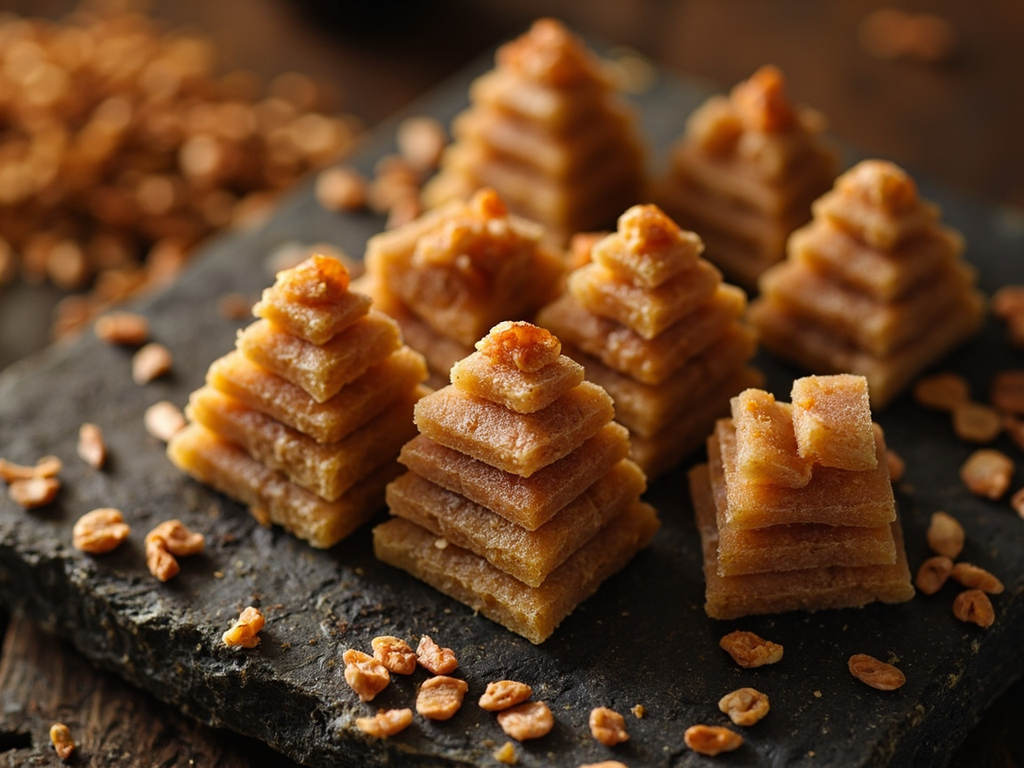
A moldable paste made from toasted amaranth seeds bound with agave syrup and honey. It is pressed into molds to take the shape of mountains or sacred figures. Sweet, crunchy, it melts slowly in the mouth — a celestial snack before being a treat.
Draw near, child of men, and fear not. I am She of the serpent skirt, the womb from which the Sun springs. My priests ground for me the tiny amaranth seeds, those grains I make sprout from the furrows, and bound them with wild bees' honey. From this paste they kneaded my mountain and my face, then they broke and ate them, so that my flesh might become theirs. Taste in your turn, and remember: what nourishes is always born from the earth to which you return.
- •Toasted and puffed amaranth seeds (huauhtli) — two full handfuls (base, sacred grain)
- •Wild bee honey — enough to bind (binder and sweetness)
- •Agave syrup (reduced aguamiel) — a drizzle (sweetness of the maguey)
Tzoalli, the Amaranth Paste of the Gods
A moldable paste made from toasted amaranth seeds bound with agave syrup and honey. It is pressed into molds to take the shape of mountains or sacred figures. Sweet, crunchy, it melts slowly in the mouth — a celestial snack before being a treat.
Why this dish? Coatlicue is the mother of Huitzilopochtli, the sun god. During great Mexica festivals, effigies of deities were shaped from amaranth paste (tzoalli), placed as offerings, and then shared in a sacred communion. Offering this sweet paste to the Earth Mother was to return to her a part of the life she gives.
Draw near, child of men, and fear not. I am She of the serpent skirt, the womb from which the Sun springs. My priests ground for me the tiny amaranth seeds, those grains I make sprout from the furrows, and bound them with wild bees' honey. From this paste they kneaded my mountain and my face, then they broke and ate them, so that my flesh might become theirs. Taste in your turn, and remember: what nourishes is always born from the earth to which you return.
Ingredients (period version)
- Toasted and puffed amaranth seeds (huauhtli) — two full handfuls (base, sacred grain)
- Wild bee honey — enough to bind (binder and sweetness)
- Agave syrup (reduced aguamiel) — a drizzle (sweetness of the maguey)
Ingredients
- Puffed amaranth — 150 g (crunchy base)
- Agave syrup — 90 g (main binder)
- Liquid honey — 40 g (sweetness and hold)
- Water — 1 tbsp (to thin syrup if needed)
Method
- Gently heat the agave syrup and honey in a saucepan until they simmer and become syrupy (about 110°C, the mixture forms a thread).
- Remove from heat, pour in the puffed amaranth and mix quickly to coat well.
- Firmly press the still-warm paste into small molds (or a parchment-lined frame) to 1.5 cm thickness.
- Let set for 30 minutes, unmold and cut into shapes (mountains, solar disks) with an oiled knife.
- Store in an airtight container away from humidity.
How it was made : Tzoalli is abundantly described by Friar Bernardino de Sahagún in the 16th century. For the feast of Panquetzaliztli, priests modeled a large effigy of Huitzilopochtli from amaranth and agave honey paste, which was broken and distributed to the community: a communion rite called *teoqualo*, 'the god is eaten.' Amaranth was so linked to the sacred that Spanish colonists tried to ban its cultivation.
The contemporary twist : Press the paste into bars and roll the edges in crushed pumpkin seeds: a 'pre-Columbian energy bar' to slip into a backpack.
Sources : Bernardino de Sahagún, Historia general de las cosas de Nueva España (Codex de Florence), XVIe s. · Sophie D. Coe, America's First Cuisines, University of Texas Press, 1994
Coatlicue · Charactorium