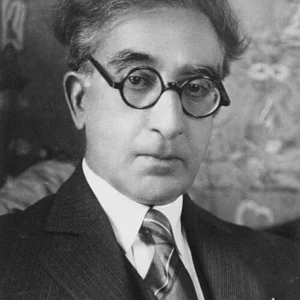

Constantine Cavafy was a Greek poet born and died in Alexandria, Egypt. Regarded as one of the major figures of modern Greek poetry, he blended references to Hellenistic antiquity, meditations on time, and intimate evocations. His work, long known only to a small circle, was not fully recognized until after his death.
Constantine Cavafy(1863 — 1933)
Constantine Cavafy
Grèce, Égypte, Empire ottoman
6 min read
Frequently asked questions
Famous Quotes
« When you set out for Ithaka, hope that your road is a long one, full of adventure and discovery.»
Key Facts
- Born in 1863 in Alexandria into a well-off Greek family of the diaspora.
- Worked for many years as a civil servant in the Egyptian Ministry of Public Works (irrigation).
- Wrote the poem “Ithaka,” one of his most famous texts, published in 1911.
- Circulated his poems during his lifetime as loose leaflets, with no true commercially printed collection.
- Died in Alexandria in 1933; his international recognition was largely posthumous.
Works & Achievements
A short poem on confinement and isolation, one of his first fully personal texts.
A tribute to those who do their duty with integrity, even when they know defeat is inevitable.
A famous poem in which a city waits in vain for the arrival of the “barbarians,” an allegory of waiting and collective fear.
A bitter meditation: you cannot flee your past, the inner city follows you everywhere. One of his most quoted texts.
A masterpiece inspired by the Odyssey: what matters is not the destination but the richness of the journey.
A poem on dignity in the face of defeat, urging one to say farewell without self-deception, listening to Alexandria as it departs.
The first collection to gather his poems, published after his death: it definitively established his stature as a major poet.
Anecdotes
Cavafy never published a true collection during his lifetime. He printed his poems on loose sheets or thin pamphlets that he distributed himself to a circle of friends and chosen readers, endlessly correcting and reordering them. This extreme discretion explains why his fame came only after his death.
For nearly thirty years, this great poet earned his living as a modest office clerk at the Egyptian Ministry of Public Works, in the Irrigation Service of Alexandria. He wrote his verses in the evening, after his days as a civil servant.
The English novelist E. M. Forster, who met him in Alexandria during the First World War, introduced him to the English-speaking public. He described him as “a Greek gentleman in a straw hat, standing absolutely motionless and at a slight angle to the universe.”
Cavafy died on 29 April 1933, the exact day of his seventieth birthday, taken by cancer of the larynx. Born and died in Alexandria on the same day of the year, he spent almost his entire life in that cosmopolitan city.
It is said that he enjoyed the location of his apartment on Lepsius Street: below it was a brothel “for the flesh,” close by a church “that forgives sins,” and a little further on the hospital “where one dies.” This neighbourhood summed up, he would say with irony, the whole of the human condition.
Primary Sources
As you set out for Ithaca, hope that the road is long, full of adventure, full of discovery.
And now, what will become of us without the barbarians? Those people were, after all, a kind of solution.
You will not go to other lands, to other shores. The city will follow you. You will wander the same streets.
As befits you who were worthy of such a city, go firmly to the window and say goodbye to the Alexandria that is leaving.
A Greek gentleman in a straw hat, standing absolutely motionless at a slight angle to the universe.
Key Places
Cosmopolitan city where Cavafy was born, lived and worked for nearly all his life, and where he died. It is the setting and the soul of his work.
Alexandrian home where he composed most of his late work. Today it houses the Cavafy Museum.
Cradle of his mother's family, where the Cavafys took refuge from 1882 to 1885 after the bombardment of Alexandria.
Where the family lived during his childhood for business; there he gained a perfect command of English.
Greek capital where he was hospitalized in 1932 and underwent a tracheotomy for his throat cancer.
Typical Objects

Poems printed on loose sheets or thin pamphlets that Cavafy assembled and distributed himself to his chosen readers. This was his personal mode of “publishing,” far from the publishing houses.

Writing instruments with which he tirelessly composed and revised his verses, often late into the night.

The light source in his apartment on Lepsius Street, by whose glow he worked on his poems once night had fallen.

Account and correspondence book from the Ministry of Public Works, a witness to his life as a civil servant whose post funded his freedom as a poet.

The stiff straw hat that was a hallmark of his silhouette, immortalized by the description E. M. Forster gave of it.

Works on Greek antiquity, Ptolemaic Egypt, and the Byzantine Empire, from which Cavafy drew many of his characters and themes.
School Curriculum
Vocabulary & Tags
Key Vocabulary
Tags
Daily Life
Morning
In the morning, Cavafy would go to his office at the Ministry of Public Works, in the Irrigation Service. There he handled files and correspondence, like any civil servant in colonial Alexandria.
Afternoon
The afternoon was divided between administrative duties and visits to the city's Greek cafés and clubs. There he discussed literature, history, and politics with a small circle of friends.
Evening
It was in the evening, once home, that he became fully a poet. By the light of his lamp, he tirelessly composed, crossed out, and reorganized his verses, sometimes over several years before deeming them complete.
Food
He led the life of an Alexandrian bourgeois and ate the city's Mediterranean and Levantine cuisine: vegetables, fish, fruit, coffee. A heavy smoker, he consumed a great many cigarettes, which no doubt contributed to his cancer of the larynx.
Clothing
He dressed in the European fashion, in the dark suit of a civil servant, finished off with spectacles and, in summer, the straw boater that struck Forster. An understated and slightly old-fashioned elegance.
Housing
He lived as a bachelor in an apartment on Lepsius Street, on the second floor, crammed with books, paintings, and antiques. This modest but atmospheric home has today become a museum.
Historical Timeline
Period Vocabulary
Liens externes & ressources
Références
Œuvres
Les Murs
1896
Thermopyles
1903
En attendant les barbares
1904
La Ville
1910
Le Dieu abandonne Antoine
1911
Édition collective posthume
1935