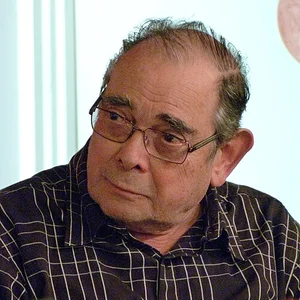

Gébé (1929-2004) was a French press cartoonist, screenwriter and comic book author. A major figure of the satirical press, he was editor-in-chief of Hara-Kiri and Charlie Hebdo, and the author of the famous utopia L'An 01.
Gébé(1929 — 2004)
Gébé
France
4 min read
Frequently asked questions
Famous Quotes
« We stop everything, we think it over, and it's no bad thing.»
Key Facts
- Born on July 17, 1929 in Paris under the name Georges Blondeaux.
- Joined the team of Hara-Kiri in the 1960s, a satirical newspaper founded by Professor Choron and Cavanna.
- Published in Charlie Hebdo from 1970 onward, becoming one of its key figures and its editor-in-chief.
- Created L'An 01, a utopian comic book, adapted for the screen in 1973 by Jacques Doillon (with his participation).
- Died on April 4, 2004 in Paris.
Works & Achievements
A drawn utopia that became a cult classic, calling for people to “stop everything” and rethink society. It is Gébé's most famous work.
A film adaptation co-directed by Gébé and Jacques Doillon, featuring sequences by Alain Resnais and Jean Rouch.
Gébé was one of the key figures and leaders of the “mean and nasty newspaper,” a laboratory for French black humour.
When the newspaper was revived, Gébé became its editor-in-chief, shaping its satirical and graphic direction.
A work in which Gébé blends drawing and text to evoke illness and the sanatorium, in a more intimate register.
Anecdotes
Before becoming a cartoonist, Georges Blondeaux — Gébé's real name — worked as an industrial draftsman for the SNCF (the French national railway company), where he drew technical plans for machines. His pen name “Gébé” comes quite simply from the pronunciation of his initials, G. B.
In 1970, Gébé imagined a peaceful utopia in the pages of Charlie Hebdo titled L'An 01 (The Year 01), whose rallying cry has remained famous: “We stop everything, we think it over, and it's no fun.” The idea was to stop working and chasing profit in order to rethink society.
When the Minister of the Interior banned Hara-Kiri Hebdo in 1970 after a mocking cover about the death of General de Gaulle, the team bounced back at once by founding a new paper: Charlie Hebdo. Gébé was part of this band of rebellious cartoonists.
L'An 01 was adapted for the cinema in 1973: Gébé co-directed the film with Jacques Doillon, and two great filmmakers, Alain Resnais and Jean Rouch, each shot a sequence. The cartoonist thus went from the sheet of paper to the screen.
When Charlie Hebdo was reborn in 1992 after years of interruption, Gébé became its editor-in-chief, once again taking on the role of leader of a satirical editorial team that he had already held at Hara-Kiri.
Primary Sources
We stop everything, we think it over, and it's no laughing matter.
A step to the side, and there we go. The first step to the side: those who want to stop, stop.
Key Places
Town in the northeastern suburbs of Paris where Georges Blondeaux was born in 1929.
Capital city where Gébé spent his entire career as a press cartoonist and where he died in 2004.
Heart of the satirical newspaper of which Gébé was editor-in-chief, notably during its 1992 relaunch, in Paris.
Typical Objects

A tilted surface on which Gébé sketched his editorial cartoons and comic strips. It is the cartoonist's everyday tool.

Tools for black line drawing, characteristic of editorial caricature. The pen allows for nervous, expressive strokes.

A weekly of humor and political criticism, such as Hara-Kiri or Charlie Hebdo, where Gébé's drawings and comic strips appeared.

The workstation of the industrial draftsman that Georges Blondeaux was before his satirical career. There he traced precise mechanical plans.

A bound collection gathering comic pages, such as L'An 01 published by Éditions du Square. It captures the work as a lasting object.
School Curriculum
Vocabulary & Tags
Key Vocabulary
Daily Life
Morning
Like many editorial cartoonists, Gébé often began his day at his drawing table, pencil in hand, searching for the idea of the day. The pace of a weekly paper meant meeting regular deadlines.
Afternoon
The afternoon was split between drawing, writing scripts, and editorial meetings where the team chose the week's topics, front pages, and caricatures.
Evening
In the evening, the life of a satirical paper carried on through discussions and final wrap-ups, especially as printing time approached. Gébé played the role of an organizer and team leader.
Food
His diet was that of a twentieth-century Parisian, somewhere between quick meals eaten while working and outings to the cafés and bistros where the press world would gather.
Clothing
Gébé wore the ordinary clothes of his time, without any pomp: simple jackets and sweaters, far from any uniform, in keeping with the free and nonconformist spirit of his crew.
Housing
He lived and worked in the Paris region, as close as possible to the newsrooms and printing houses that kept French satirical journalism alive.
Historical Timeline
Period Vocabulary
Liens externes & ressources
Références
Œuvres
L'An 01
1970-1972
Direction de Hara-Kiri
années 1960-1970
Rédaction en chef de Charlie Hebdo
à partir de 1992
Berck (récit dessiné)
1974