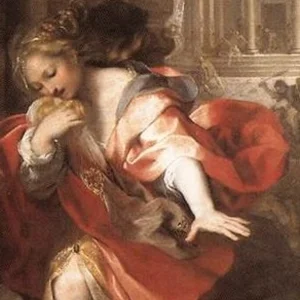

Creusa is a princess from Greek mythology, daughter of King Priam and Hecuba, and wife of the Trojan hero Aeneas. She disappears during the fall of Troy, and her ghost appears to Aeneas to foretell his destiny.
Creusa
Creusa
7 min read
Frequently asked questions
Key Facts
- Daughter of Priam, king of Troy, and Hecuba
- Wife of the hero Aeneas, to whom she bears a son, Ascanius (Iulus)
- Disappears during the fall of Troy (told in the Aeneid, Book II by Virgil)
- Her ghost appears to Aeneas to foretell his journey and the founding of a new kingdom in Italy
- A figure transmitted through the Greco-Roman tradition, notably Virgil (1st century BC)
Works & Achievements
Creusa is the lost wife whose death, transformed into prophecy, frees Aeneas for his mission. Her farewell scene is one of the most moving passages in Rome's national epic.
Through her son Ascanius, nicknamed Iulus, Creusa is the mythical ancestor of the gens Iulia, the family of Julius Caesar and the emperor Augustus, the foundation of the legend of Rome's origins.
In this lost poem of the Epic Cycle, Creusa is saved from captivity by a goddess, an older version than Virgil's and a witness to the diversity of Greek traditions.
The great painter Polygnotus depicted Creusa among the Trojan women in his famous Sack of Troy, described by Pausanias, proof of her place in the Greek imagination.
In Berlioz's grand opera inspired by the Aeneid, the fall of Troy and Aeneas's flight take up the episode in which Creusa fades from the hero's destiny.
Anecdotes
As Troy fell in flames, Aeneas fled the city carrying his aged father Anchises on his shoulders and leading his son Ascanius by the hand. Creusa walked behind them, but in the darkness, the smoke, and the panic, she lost her way and vanished. It is one of the most famous scenes in Virgil's *Aeneid*.
Distraught, Aeneas turned back to search for his wife in the burning city, crying out her name amid the rubble. It was then that the shade of Creusa, taller than she had been in life, appeared to him: she was already dead, and only her ghost could still speak to him.
Creusa's spectre comforted Aeneas and revealed his destiny to him: a long exile across the seas, his arrival in Hesperia (Italy) near the river Tiber, and a new kingdom with a royal bride. Her disappearance thus freed Aeneas to found the line that would lead, according to Roman legend, to Rome.
Three times Aeneas tried to embrace the shade of his wife, and three times his arms closed on empty air: the image slipped away like a breath or a dream. Here Virgil echoes a scene from Homer, in which Odysseus tries in vain to embrace the shade of his mother in the Underworld.
According to another tradition, older than Virgil (the poem the *Sack of Troy* and the painter Polygnotus at Delphi), Creusa does not truly die: she is saved from slavery to the Greeks by a goddess, Aphrodite (the mother of Aeneas) or Cybele, the Great Mother of the gods, who spares her the misfortune of the Trojan captive women.
Primary Sources
“Why do you indulge so in mad grief, O my sweet husband? These misfortunes do not come to pass without the will of the gods.”
“Three times I tried to throw my arms around her neck; three times the image, vainly grasped, fled my hands, like the light wind, much like a fleeting dream.”
“A long exile awaits you, and you must plough the vast plain of the sea; you will reach Hesperia, where the Lydian Tiber flows in a gentle course through rich farmlands.”
Pausanias describes the great painting of the Sack of Troy made by Polygnotus at Delphi, in which Creüsa could be seen among the Trojan women, saved by the favour of the Mother of the Gods and of Aphrodite.
Key Places
City on the coast of Asia Minor where Creusa, daughter of King Priam, lives. It is there that she vanishes during the burning of the city by the Greeks.
Royal residence at the heart of Troy, where Creusa grows up among the family of Priam and Hecuba. The palace is ransacked and burned on the night of the city's fall.
Ancient sanctuary appointed by Aeneas as the rallying point for his family during the escape. Creusa was to meet him there, but she became lost before reaching it.
Mountain overlooking the plain of Troy, refuge of Aeneas and the Trojan survivors after the escape. From there his long exile, foretold by the shade of Creusa, will begin.
Greek sanctuary where the painter Polygnotus depicted the Sack of Troy in the 5th century BC. Creusa appeared there among the Trojan women, saved by the goddesses.
Distant land that the shade of Creusa foretells to Aeneas as the goal of his journey. She will never set foot there, but her prophecy seals the future founding of the Roman line.
Typical Objects

A long veil of fine fabric worn by the women of Priam's court, covering the head and shoulders. It symbolizes the status of Creusa, a princess and royal wife.

A gold band encircling the brow of Trojan princesses. A sign of the royal birth of the daughter of Priam and Hecuba.

Small statuettes of the gods who protect the household and the city, which Aeneas carries out of burning Troy. They embody the continuity of the Trojan house all the way to Italy.

An enormous hollow wooden horse in which the Greek warriors hide to enter the city. Its trickery brings about the fatal night when Creusa vanishes.

A sacred statue of Athena (Pallas) believed to protect Troy as long as it remained within its walls. Its theft by the Greeks heralds the fall of the city and the misfortune of Priam's family.

The torches and firebrands that set the city ablaze during the sack. The fire turns Creusa's palace and familiar streets into a labyrinth of smoke in which she loses her way.
School Curriculum
Vocabulary & Tags
Key Vocabulary
Tags
Daily Life
Morning
A princess in Priam's palace, Creusa rises in the women's quarters (the gynaeceum). Attended by her maidservants, she bathes, perfumes her skin with oils, and ties up her hair before the day's first offerings to the household gods.
Afternoon
The afternoon is spent spinning wool and weaving at the loom set up against the wall, the noblest of activities for Trojan women. Creusa also watches over her young son Ascanius and, alongside the other princesses, receives guests in the palace halls.
Evening
The evening gathers Priam's great family around the meal, enlivened by the songs of the bards who celebrate heroes and gods. There Creusa rejoins her husband Aeneas, an admired prince and the son of a goddess.
Food
People eat barley and wheat bread, flatcakes, cheese, olives, figs, and fruit. Meat — chiefly beef, mutton, and goat — is roasted during sacrifices and washed down with wine mixed with water, in the tradition of the Bronze Age palaces.
Clothing
Creusa wears a long chiton of linen or fine wool, draped and fastened at the shoulder with fibulae, along with a veil covering her head. A golden diadem, necklaces, and bracelets mark her rank as a king's daughter.
Housing
She lives in the vast royal palace of Troy, with its high walls, inner courtyards, and many chambers described by Homer. There the women occupy reserved quarters, adorned with hangings and furnished with chests of precious wood.
Historical Timeline
Period Vocabulary
Liens externes & ressources
Références
Œuvres
Personnage de l'Énéide de Virgile (Chant II)
vers 29-19 av. J.-C.
Mère d'Ascagne (Iule)
Antiquité légendaire
Figure de l'Iliou Persis (Sac de Troie)
VIIe-VIe siècle av. J.-C.
Sujet de la fresque de Polygnote à Delphes
vers 460 av. J.-C.