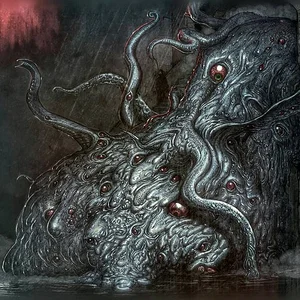

Cthulhu is a fictional cosmic entity created by American writer H.P. Lovecraft, first appearing in 1928 in the short story "The Call of Cthulhu." A monstrous, tentacled deity slumbering in the sunken city of R'lyeh, it embodies cosmic horror and humanity's insignificance before the unknown.
Cthulhu
Cthulhu
5 min read
Frequently asked questions
Key Facts
- Created by H.P. Lovecraft in the short story "The Call of Cthulhu," published in 1928 in *Weird Tales* magazine
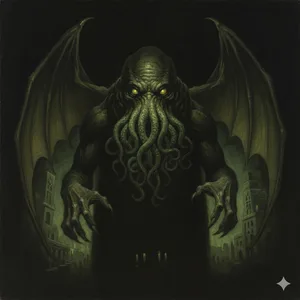
- Described as a gigantic entity combining traits of an octopus, a dragon, and a humanoid, with wings
- Lies sleeping in the underwater city of R'lyeh, located in the Pacific Ocean
- Central figure of the "Cthulhu Mythos," a shared universe expanded by many authors after Lovecraft's death in 1937
- Became a major pop culture icon (role-playing games, video games, literature, film) from the late 20th century onward
Works & Achievements
Foundational short story that introduces Cthulhu, R'lyeh, and the concept of cosmic horror.
Antarctic novella that expands the mythology of the Great Old Ones and their pre-human past.
Tale linking sea cults and abyssal creatures to the lineage of Lovecraftian entities.
Posthumous systematization of Lovecraft’s universe, ensuring its editorial survival through Arkham House.
Major gaming adaptation that spread the creature into global popular culture.
Anecdotes
Cthulhu was born from the pen of H.P. Lovecraft in the summer of 1926, but the text "The Call of Cthulhu" was not published until February 1928 in the pulp magazine *Weird Tales*. Lovecraft, little recognized in his lifetime, was paid by the page and remained virtually unknown until his death.
Lovecraft insisted that the name be unpronounceable by a human mouth. In his letters, he suggested an approximation like "Khlûl'-hloo," specifying that the true sounds exceeded the human vocal apparatus — a way of emphasizing the creature's radical strangeness.
The ritual phrase "Ph'nglui mglw'nafh Cthulhu R'lyeh wgah'nagl fhtagn" ("In his house at R'lyeh, dead Cthulhu waits dreaming") is one of the most famous sentences in weird fiction. Lovecraft invented it from scratch, with no real grammar.
The term "Cthulhu Mythos" is not Lovecraft's: it was coined by his friend August Derleth after 1937 to describe the shared universe born from these stories. Lovecraft encouraged other authors to reuse his creatures, creating a collective mythology.
Today Cthulhu is an icon of popular culture: plush toys, board games, role-playing games, and cameos in films. This posthumous fame contrasts sharply with the poverty in which Lovecraft died in 1937.
Primary Sources
The thing cannot be described — there is no language for such abysses of shrieking and immemorial chaos, for such a contradiction of all matter, force, and cosmic order.
Ph'nglui mglw'nafh Cthulhu R'lyeh wgah'nagl fhtagn — "In his house at R'lyeh, dead Cthulhu waits dreaming."
The syllables were determined by a physical apparatus quite different from ours; the closest human approximation would be something like "Khlûl'-hloo".
Key Places
Cyclopean metropolis submerged in the South Pacific where Cthulhu sleeps; Lovecraft gives its coordinates as 47°9′S, 126°43′W.
Lovecraft's hometown and the city he loved, a recurring setting and the real birthplace of the entire mythos.
Imaginary city housing Miskatonic University, home of forbidden knowledge in Lovecraft's work.
Swampy region where police discover a cult performing a secret rite to Cthulhu in the story.
Typical Objects

In the story, a young sculptor dreams of shaping a plaque depicting Cthulhu; it is the first tangible clue to the entity's existence.

A small greenish statuette showing a tentacled and winged figure, found during a secret cult gathering in Louisiana.

A fictional forbidden grimoire, attributed to the mad Arab Abdul al-Hazred, said to contain knowledge of Cthulhu and the Great Old Ones.

A ship's log recounting the rise of R'lyeh and a direct encounter with the creature, a key piece of the investigation.

Articles about nightmares, suicides, and collective delusions that the narrator cross-references to reconstruct Cthulhu's awakening.
School Curriculum
Vocabulary & Tags
Key Vocabulary
Tags
Daily Life
Morning
Cthulhu has no human routine: he has been "sleeping" for eons in the sunken city of R'lyeh. His existence is measured in cosmic cycles, not mornings. As long as the stars are not aligned, his deathlike slumber continues in the abyss.
Afternoon
No activity in the human sense: the entity remains frozen, "dead but dreaming." His dreams, says Lovecraft, contaminate the minds of artists and the sensitive around the world, sowing nightmares and visions of cyclopean cities.
Evening
When R'lyeh briefly emerges due to an earthquake, Cthulhu stirs and manifests, spreading terror and madness among those who encounter him, before plunging back beneath the waves with his city.
Food
The myth does not attribute ordinary food to him. He is a cosmic entity that devours and annihilates rather than feeds; his followers imagine he will "cleanse" the Earth upon his awakening.
Clothing
No clothing: Cthulhu is described as a tentacled mass with a squid-like head, a scaly and rubbery body, equipped with membranous wings and claws—an anatomy that defies human description.
Housing
His dwelling is R'lyeh, a metropolis of greenish stone with impossible geometries, sunken at the bottom of the Pacific, where he waits in a sealed crypt for the return of favorable times.
Historical Timeline
Period Vocabulary
Visual Style
Une direction artistique d'horreur cosmique : entité tentaculaire géante, architecture engloutie aux angles impossibles, ténèbres abyssales et phosphorescences verdâtres.
Sound Ambience
Une ambiance abyssale et oppressante mêlant grondements sous-marins, pierre qui s'éveille et psalmodies cultistes lointaines.
Liens externes & ressources
Références
Œuvres
« The Call of Cthulhu »
1928
« At the Mountains of Madness »
1936
« The Shadow over Innsmouth »
1936
Le « Cthulhu Mythos » d'August Derleth
1939
Jeu de rôle « Call of Cthulhu » (Chaosium)
1981