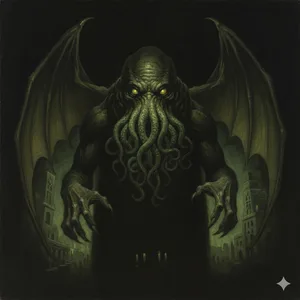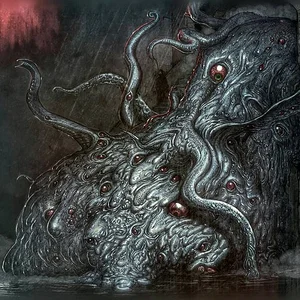

The shoggoth is a fictional creature invented by American writer H. P. Lovecraft in his novella "At the Mountains of Madness" (1931). A formless, gelatinous protoplasmic mass, it belongs to the Cthulhu Mythos and has no real historical or folkloric existence.
Shoggoth
Shoggoth
6 min read
Frequently asked questions
Key Facts
- Creature invented by H. P. Lovecraft in "At the Mountains of Madness", written in 1931 and published in 1936.
- Described as a formless protoplasmic mass, capable of temporarily forming organs and limbs.
- According to the fiction, shoggoths were created as slaves by the "Elder Things".
- Belongs to the Cthulhu Mythos, a shared universe used by several fantasy authors.
- Became a recurring figure in popular culture (role-playing games, video games, novels) since the 20th century.
Works & Achievements
Foundational work where the shoggoth appears; a cosmic horror novella set in Antarctica.
Another polar and cosmic tale by Lovecraft that extends and deepens the mythology of extraterrestrial races.
Short story that lays the groundwork for the “Cthulhu Mythos” to which the shoggoth belongs.
Antarctic novel from which Lovecraft borrows the cry “Tekeli-li” for his shoggoths.
Game adaptation that made the shoggoth a famous monster among generations of players.
Numerous graphic adaptations that fixed the visual image of the creature in popular culture.
Anecdotes
The shoggoth first appears in H. P. Lovecraft's novella *At the Mountains of Madness*, written in 1931 and serialized in the American pulp magazine *Astounding Stories* in 1936. It is one of the last major creatures the author added to his universe, the "Cthulhu Mythos".
In the story, shoggoths are not gods but slaves: Lovecraft imagined them as biological tools created by an alien race, the "Elder Things," before they rebelled against their masters. This is an allegory of the slave turning against the creator.
The cry attributed to shoggoths, "Tekeli-li! Tekeli-li!," is a direct borrowing from Edgar Allan Poe's only novel, *The Narrative of Arthur Gordon Pym of Nantucket* (1838), which Lovecraft admired. It is an acknowledged homage from one author to another.
Lovecraft died poor and almost unknown in 1937 at age 46. It was his friends who, by founding the publishing house Arkham House in 1939, saved his work from oblivion: without them, the shoggoth and Cthulhu would likely never have achieved their current worldwide success.
The word "shoggoth" has now entered popular culture: it appears in video games, role-playing games like *Call of Cthulhu*, songs, and even recently as a metaphor used by researchers to describe artificial intelligences, seen as formless and unpredictable creations.
Primary Sources
It was a terrible, indescribable thing, vaster than any subway train — a shapeless congeries of protoplasmic bubbles, faintly self-luminous, with myriads of temporary eyes forming and unforming as pustules of greenish light.
Tekeli-li! Tekeli-li! — that cry rose from the depths, and we recognized the horrible call once described by the ill-fated Poe.
The gigantic birds of a livid white incessantly uttered their eternal cry of Tekeli-li! as they fled before us.
All my tales are based on the fundamental premise that common human laws and interests and emotions have no validity or significance in the vast cosmos-at-large.
Key Places
Lovecraft's birthplace and lifelong home; he conceived most of his universe here, including the shoggoth.
Setting of "At the Mountains of Madness": it is in a dead city beneath the ice that the expedition discovers the shoggoths.
Imaginary New England university that organizes the expedition; recurring location in the Cthulhu Mythos.
Frozen cyclopean metropolis in the Antarctic mountain range, where the shoggoths live and revolt.
Editorial office of the pulp magazine that initially rejected the story, delaying the shoggoth's public debut.
Liens externes & ressources
Références
Œuvres
« Les Montagnes hallucinées » (At the Mountains of Madness)
écrit 1931, publié 1936
« Dans l'abîme du temps » (The Shadow Out of Time)
1936
« L'Appel de Cthulhu »
1928
« Les Aventures d'Arthur Gordon Pym » d'Edgar Allan Poe
1838
Jeu de rôle « L'Appel de Cthulhu » (Chaosium)
1981
« Mountains of Madness » illustrés et bandes dessinées
années 1980-2010