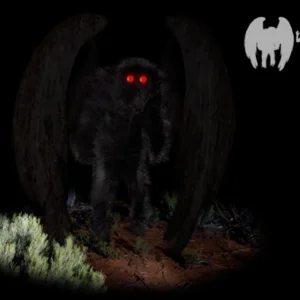

The Mothman is a legendary North American creature described as a winged being with large red eyes. Its sightings were reported in Point Pleasant, West Virginia, between 1966 and 1967. Having become a major figure in cryptozoology, it inspires contemporary stories and folklore.
Mothman
Mothman
8 min read
Frequently asked questions
Key Facts
- First reported sightings near Point Pleasant (West Virginia, USA) in November 1966.
- Described as a winged humanoid about 2 meters tall with glowing red eyes.
- Wave of sightings between 1966 and 1967 reported by local press.
- Associated in folklore with the collapse of the Silver Bridge (December 15, 1967).
- Popularized by John Keel's book *The Mothman Prophecies* (1975) and later the film (2002).
Works & Achievements
First work to systematically analyze testimonies about the Mothman alongside other unidentified creatures. It lays the groundwork for serious journalistic investigation into the phenomenon.
Foundational book of the modern legend, in which Keel links the 1966–1967 sightings to the Silver Bridge disaster. Translated into several languages, it remains the definitive reference on the subject.
A reference work in cryptozoology that places the Mothman in the context of major waves of unexplained sightings in the United States during the 20th century.
Film adaptation starring Richard Gere, loosely based on Keel's book. The movie significantly boosted the international fame of the legend, attracting a global audience.
Bronze sculpture erected on Main Street in Point Pleasant. It has become the most recognized visual icon of the creature, reproduced on countless merchandise and postcards.
Annual gathering attracting thousands of paranormal enthusiasts and pop culture fans every third weekend of September. It transforms Point Pleasant into the ephemeral world capital of the Mothman.
Anecdotes
On November 12, 1966, five men attending a funeral in Clendenin Cemetery (West Virginia) spotted a brown humanoid creature flying up from the trees. This was the very first official mention of the **Mothman** in local newspaper archives, published the very next day in the regional press.
On the night of November 14–15, 1966, two young couples — Roger and Linda Scarberry, Steve and Mary Mallette — encountered the creature near an abandoned industrial area known as the 'TNT Area.' They described a being over two meters tall, with glowing red eyes, capable of following their car at over 160 km/h without even flapping its wings.
On December 15, 1967, the **Silver Bridge**, a suspension bridge spanning the **Ohio River** at Point Pleasant, collapsed and killed 46 people. Residents immediately linked the thirteen months of **Mothman** sightings to this disaster, making him an omen of doom — an interpretation that would forge his worldwide reputation.
Journalist **John Keel** conducted a field investigation in Point Pleasant in 1967 and collected over a hundred testimonies. He developed the theory of 'ultraterrestrials,' claiming that the **Mothman** was not an unknown animal but an entity from another dimension; his 1975 book *The Mothman Prophecies* definitively popularized the legend.
Since 2003, Point Pleasant has hosted the annual **Mothman Festival**, attracting thousands of visitors passionate about the paranormal and cryptozoology. The town even erected a bronze statue on Main Street — a rare example of a cryptid becoming a municipal emblem and a full-fledged tourist economic driver.
Primary Sources
Two couples reported seeing a large flying creature with glowing red eyes near the old TNT plant. The creature, described as larger than a man with a wingspan of ten feet, reportedly chased their car at speeds exceeding 100 miles per hour.
Local police received numerous reports of a large, bird-like creature with red eyes in the TNT area north of Point Pleasant. Officers investigating the scene found no physical evidence but confirmed that multiple unrelated witnesses had given remarkably consistent descriptions.
The Mothman sightings of 1966–1967 represent a concentrated series of encounters with an unidentified aerial entity. Witnesses consistently described a large, dark, manlike form with huge wings and hypnotic red eyes, capable of extraordinary aerial speed.
For thirteen months, Point Pleasant was haunted by a winged apparition that seemed to herald disaster. The collapse of the Silver Bridge brought those months of terror to an abrupt end, as if the entity had accomplished its dreadful mission.
Key Places
Town of about 4,000 residents on the Ohio River, epicenter of all sightings between 1966 and 1967. Today it is nicknamed 'Mothman Capital of the World' and partly thrives on paranormal tourism.
Abandoned World War II industrial area dotted with underground bunkers, where most sightings occurred. Its eerie atmosphere and deserted tunnels have fueled paranormal stories since 1966.
Spanning the Ohio River between Point Pleasant and Gallipolis (Ohio), this bridge collapsed on December 15, 1967, killing 46 people. Its collapse forever fixed the Mothman in the role of disaster omen.
Museum dedicated to the legend, opened in 2005 in the heart of Point Pleasant. It holds archives of testimonies, period press clippings, and objects related to the 1966–1967 events.
Locality where five men reported the very first sighting on November 12, 1966, during a funeral in a local cemetery. This site marks the official chronological starting point of the legend.
Typical Objects

Witnesses and investigators tried to photograph the creature with the equipment of the time, but never produced any conclusive image. This lack of visual evidence became a central element of the mystery surrounding the legend.

West Virginia's regional newspapers were the first to report eyewitness accounts as early as November 1966. Their articles now serve as the primary sources on the events.

During his 1967 investigation, the journalist filled notebooks with testimonies he collected on site. These partially preserved documents are essential resources for researchers of paranormal phenomena.

The bridge collapse on December 15, 1967, is inseparable from the Mothman legend. Metal pieces recovered from the Ohio River have become symbolic relics for Point Pleasant residents.

Unveiled in 2003, this sculpture depicts the Mothman in all its imposing stature. It has become the creature's visual emblem and the starting point for tourist circuits dedicated to the legend.

An iconic object of nighttime explorations in the 'TNT Area', the flashlight was the main tool for witnesses in the 1960s. Some researchers suggest that the described 'glowing red eyes' could be linked to the reflection of these lights on an ordinary animal.
School Curriculum
Vocabulary & Tags
Key Vocabulary
Tags
Daily Life
Morning
According to all accounts, the Mothman is very rarely seen in broad daylight. The few daytime sightings reported between 1966 and 1967 occurred at dawn, with the creature seemingly retreating to the underground bunkers and wooded areas of the 'TNT Area.' Several witnesses report seeing it perched high up, perfectly still, silently observing its surroundings.
Afternoon
In the afternoon, the creature is almost entirely absent from the stories. Investigators like John Keel note that sightings occur exclusively at nightfall, suggesting a crepuscular or strictly nocturnal behavior. However, the isolated roads around Point Pleasant remain under the anxious watch of the locals.
Evening
It is at nightfall that the Mothman is most active, according to the legend. Witnesses describe a creature capable of suddenly appearing on roads, gliding silently above cars, or rising vertically at high speed. Its red eyes, the only points of light in total darkness, are the most consistent and disturbing detail in all accounts.
Food
The legend does not document any known diet for the Mothman, unlike other cryptids. Some paranormal investigators have mentioned pet disappearances in the area in 1966-1967, but no proven link has ever been established. Its nature as a legendary creature places it outside the ordinary biological framework.
Clothing
The Mothman is not described as wearing clothes in the human sense. Witnesses from 1966-1967 uniformly describe a being with a semi-human appearance, covered in a dark or grayish envelope resembling a full-body suit, with huge membranous wings folded against its body when at rest.
Housing
The creature is consistently associated with the 'TNT Area,' a zone of over 2,500 acres dotted with abandoned underground bunkers dating from World War II. These dark, hard-to-reach structures constitute, in the legend, the natural territory of the Mothman, far from the inhabited areas of Point Pleasant.
Historical Timeline
Period Vocabulary
Visual Style
Silhouette monumentale et menaçante sur fond de paysage industriel américain des années 1960, entre horreur pulp vintage et esthétique film noir, dominée par le rouge écarlate des yeux.
Sound Ambience
Ambiance nocturne inquiétante de la Virginie-Occidentale des années 1960 : forêt dense, pont métallique, routes désertes et présence ailée insaisissable surgissant de l'obscurité.
Liens externes & ressources
Références
Œuvres
Strange Creatures from Time and Space — John A. Keel
1970
The Mothman Prophecies — John A. Keel
1975
Mothman and Other Curious Encounters — Loren Coleman
2002
Statue de l'Homme-papillon — Sculpteur Bob Roach
2003
Mothman Festival — Événement annuel de Point Pleasant
Depuis 2003