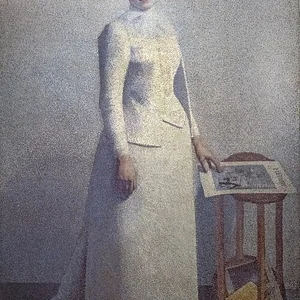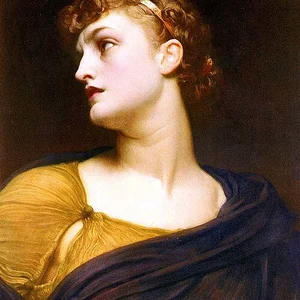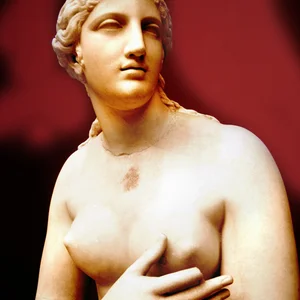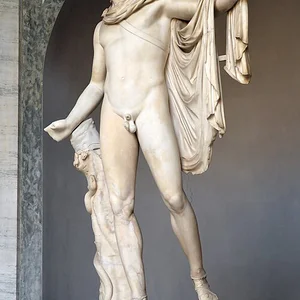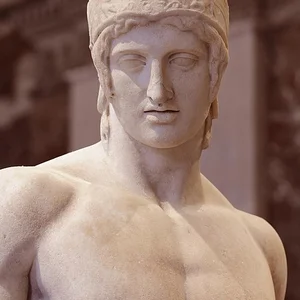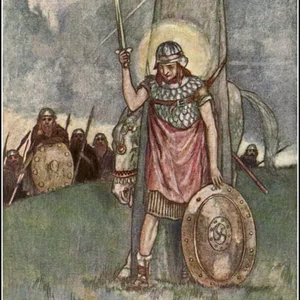

A mythological hero of the Irish tradition, Cúchulainn is the protagonist of the Ulster Cycle, a collection of Celtic legends. A legendary warrior figure, he embodies the ideal of the Celtic hero through his superhuman strength and code of honor.
Cúchulainn
Cúchulainn
8 min read
Frequently asked questions
Key Facts
- Protagonist of the Ulster Cycle, a collection of epic tales from Irish mythology
- Known for his battle frenzy (riastradh), a warrior transformation that grants him superhuman strength in combat
- Single-handedly defends Ulster against the army of Queen Medb in the epic Táin Bó Cúailnge (The Cattle Raid of Cooley)
- A legendary figure whose exploits were passed down through Gaelic oral tradition, compiled from the 7th century onward
- Embodies the ideal of the Celtic warrior through his adherence to a code of honor and his heroic deeds
Works & Achievements
Cúchulainn single-handedly faces the warriors of Queen Medb during the invasion of Ulster, displaying his courage and superhuman strength. This episode embodies the Celtic warrior code of honor and forms the heart of the Táin Bó Cúailnge (The Cattle Raid of Cooley).
Cúchulainn travels to Scotland to learn the art of combat from the warrior woman Scáthach, mistress of martial arts. There he acquires his superhuman techniques and forges a close friendship with Fer Diad, who will later become his legendary adversary.
Cúchulainn possesses the power to transform into a monstrous, unstoppable warrior when overcome by battle fury. This transformation marks the hero's passage into a superhuman state, a symbol of Celtic magical power.
An epic duel between Cúchulainn and his former companion-in-arms Fer Diad, who has joined Queen Medb's army. This battle carries an intense emotional weight and illustrates the tragedy at the heart of the Celtic hero.
Cúchulainn single-handedly defends his territory against the invasion of Queen Medb and her allies, saving Ulster. This feat cements his reputation as protector of his people and as an unconquerable hero.
His marriage to Emer represents the union of the hero with both the supernatural and the human world. This story explores the romantic and domestic dimensions of the character, rounding out his portrait as a warrior.
Anecdotes
Cúchulainn appears as the central hero of the Táin Bó Cúailnge (The Cattle Raid of Cooley), the major epic of the Ulster Cycle transcribed in the 7th century in the manuscript known as the Book of Kells. In this tale, the young warrior single-handedly defends Ulster against the army of Queen Medb of Connacht by accepting a series of single combats. This story illustrates the importance of honorable dueling and solitary courage in Irish Celtic culture.
According to the legends of the Ulster Cycle, Cúchulainn possessed a terrifying battle transformation called the riastrad, in which his body became distorted and his strength multiplied many times over during combat. This mythological description reflects the battle-trance behaviors observed among historical Celtic warriors, as mentioned by Greco-Roman writers such as Diodorus of Sicily.
The account of his childhood, known as Longes mac nUislenn (The Exile of the Sons of Uisneach), shows Cúchulainn receiving both fierce and honorable warrior training from the warrior woman Scáthach. This motif of heroic apprenticeship was central to Celtic tradition and appears in several epics of the Ulster Cycle.
Cúchulainn is described in ancient texts as small in stature but of prodigious strength, with striking looks and blazing hair. These contrasting physical details, preserved in medieval Irish manuscripts, show how the Celts conceived of heroism as something that went far beyond mere physical characteristics.
Primary Sources
Then Cúchulainn rose and took up his arms. He was magnificent to behold: upon his head, a golden crown; around his neck, four interwoven golden chains; in his right hand, his sword with its hilt of gold and precious stones.
Cúchulainn stood above them all. His body was covered in scars, but his valor was unmatched, and the men of Ulster recognized him as their supreme champion.
Cúchulainn, the great warrior of Ulster, was sent to stop the fugitives. His honor and duty commanded him to pursue them without rest.
And Cúchulainn, the legendary warrior whose strength was that of a hundred men, took part in this great battle.
Key Places
The capital of Ulster in Irish mythology and the royal seat of King Conchobar mac Nessa. It is the heart of the Ulster Cycle, where Cúchulainn grew up and became the court's champion warrior.
A region of Ulster associated with Cúchulainn, where he established his stronghold and carried out his role as defender. This is the territory he protects during the epic Cattle Raid of Cooley (Táin Bó Cúailnge).
A peninsular region in County Louth, Ireland, at the heart of the Ulster Cycle's greatest epic. It is here that Cúchulainn single-handedly faces the army of Queen Medb in the Ford combat.
The legendary fortress of Cúchulainn, generally located in the north of Ireland. It represents his primary home and the seat of his power as defender of Ulster.
A legendary memorial site marking the hero's death according to Irish tradition. It is a site of commemoration for the Celtic warrior in medieval Irish mythology.
The province neighboring Ulster that opposes Cúchulainn during the Táin Bó Cúailnge. Queen Medb of Connacht leads an army against Ulster, making this region the stage for his greatest warrior exploits.
Typical Objects

The legendary weapon of Cúchulainn, this magical sword is renowned for its sharp and indestructible blade. It symbolizes the warrior might of the Celtic hero and his status as an invincible champion.

Cúchulainn's magical spear, capable of splintering into barbs inside an enemy's body. It represents the hero's mastery of combat technique and his supernatural powers.

A two-horse combat vehicle pulling a light chariot, used by aristocratic Celtic warriors. Cúchulainn rides it into battle, a symbol of his high status and warrior role.

Typical warrior protection from the Celtic Iron Age, made of assembled bronze plates. It characterizes the martial equipment of Celtic heroes of Antiquity.

A rigid twisted collar of gold or bronze, worn as a mark of rank and prestige among the Celts. Cúchulainn wears it as a symbol of his status as champion and his warrior honor.

A round or oblong shield of wood and leather reinforced with metal, used in close combat. It represents the personal defense and warrior craft of the heroes of the Ulster Cycle.

Precious adornments and ornaments of gold and silver, reflecting the wealth and prestige of Celtic warriors. They mark Cúchulainn's social standing and recognition of his great deeds.

A Celtic ritual object associated with the legends of the Ulster Cycle, symbolizing abundance and regeneration. It evokes the mythological and spiritual world in which the hero moves.
School Curriculum
Vocabulary & Tags
Key Vocabulary
Tags
Mythologie
Daily Life
Morning
Cúchulainn wakes in the fort (dún) of Emain Macha, the royal seat of Celtic Ulster. He begins his day with intensive warrior training, honing his combat skills with weapons — sword, spear, and chariot — alongside other warriors of the Celtic aristocracy.
Afternoon
The afternoon is devoted to continued martial activities: sparring, participation in noble hunts, or military expeditions. Cúchulainn may also attend war councils or help plan defensive strategies to protect the kingdom against outside threats.
Evening
In the evening, Cúchulainn joins the king's feast in the great banqueting hall, where the warrior elite gathers. These banquets are occasions for storytelling, epic tales, poetry, and the reinforcement of hierarchical bonds — vital rituals of Celtic aristocratic society.
Food
As an elite warrior, Cúchulainn's diet centers on meat — pork, beef, and game — prestigious foods reserved for Celtic nobles. Bread, ale, and mead round out this meat-heavy diet, reflecting his high social standing and the resources available to aristocratic warriors.
Clothing
Cúchulainn wears the garb of a noble warrior: a woolen tunic and a brooch-fastened cloak secured with a bronze fibula. His warrior appearance is enhanced by bronze armlets, richly decorated weapons, and possibly a torque (Celtic neck ring) — all symbols of prestige and rank.
Housing
Cúchulainn resides at Emain Macha, the royal seat of Ulster, within a fortified stronghold typical of the Celtic elite. His quarters form part of the prestigious buildings of the royal dún, a reflection of his status as an elite warrior in the king's service.
Historical Timeline
Period Vocabulary
Visual Style
Un style visuel mêlant l'art celtique ancien aux codes guerriers d'Irlande mythologique, caractérisé par des motifs géométriques complexes, une lumière dramatique et dorée évoquant les feux de camp, et une atmosphère épique chargée de spiritualité celtique.
Sound Ambience
Une atmosphère sonore épique mêlant les bruits guerriers du monde celtique ancien aux éléments mystiques et surnaturels, évoquant la grandeur légendaire de Cúchulainn et l'aura magique du Cycle d'Ulster.
Liens externes & ressources
Références
Œuvres
Le Combat singulier du Táin
VIIe-VIe siècle av. J.-C. (contexte mythologique)
L'Apprentissage chez Scáthach
VIIe-VIe siècle av. J.-C. (contexte mythologique)
La Riastrad (Transformation héroïque)
VIIe-VIe siècle av. J.-C. (contexte mythologique)
Le Combat avec Fer Diad
VIIe-VIe siècle av. J.-C. (contexte mythologique)
La Défense du Ulster
VIIe-VIe siècle av. J.-C. (contexte mythologique)
L'Amour de Cúchulainn et d'Emer
VIIe-VIe siècle av. J.-C. (contexte mythologique)