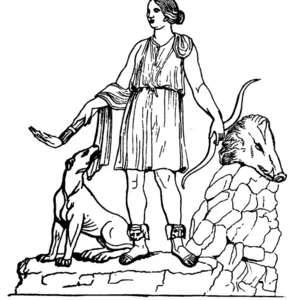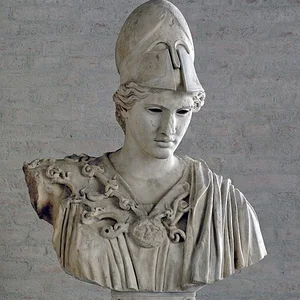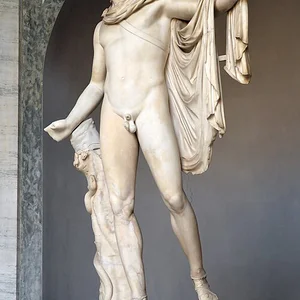

Greek god of music, poetry, the sun, and prophecy, Apollo is one of the most important deities in Greek mythology. Son of Zeus and Leto, he embodies harmony, beauty, and knowledge. His cult spread throughout the ancient Greek world, most notably at Delphi, where his famous oracle was located.
Apollo
Apollo
8 min read
Frequently asked questions
Key Facts
- Mythological birth on the island of Delos, son of Zeus and Leto
- Establishment of the sanctuary and oracle of Apollo at Delphi, a major religious center of ancient Greece
- Attribution of the lyre, a musical instrument symbolizing harmony and poetry
- Cult celebrated during the Pythian Games, the Panhellenic games dedicated to Apollo at Delphi
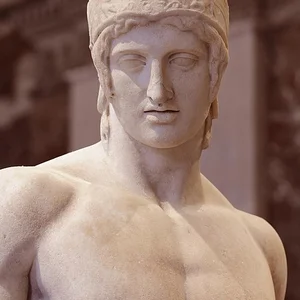
- Iconographic representation as a handsome young man, often depicted with a lyre and bow
Works & Achievements
Apollo is the patron deity of the sanctuary of Delphi, where the Pythia delivered her oracles in the god's name. It was one of the most important sites of worship and consultation in the ancient Greek world, shaping political and religious decisions.
Apollo is the god of music and the legendary inventor of the seven-stringed lyre, an instrument he gifted to Hermes. This instrument became a symbol of Apollonian harmony and artistic mastery.
Apollo was venerated as the god of medicine and healing, particularly on the island of Cos, where his cult was closely tied to the medical tradition. His son Asclepius later became the god of medicine in his own right.
The Greek epics celebrate Apollo's exploits, most notably his victory over the serpent Python and his miraculous birth on the island of Delos. These texts helped establish and spread Apollonian theology and worship throughout Greek culture.
Apollo presided over religious mysteries and prophetic rituals throughout the Greek world. His religious influence extended to ritual purification, the atonement of crimes, and initiation rites.
According to legend, Apollo slew the serpent Python, which had guarded the sanctuary of Delphi, thereby establishing his divine authority over the site. This mythological event symbolizes the triumph of order and light over chaos.
Anecdotes
The Temple of Apollo at Delphi was the most important religious sanctuary in ancient Greece. Greeks consulted Apollo's oracle there — a priestess known as the Pythia — to learn the god's will on major political and military decisions. This temple served as a center of spiritual power for over a thousand years, from the 8th century BC through the Roman era.
Apollo was revered as the god of music and poetry, and according to mythology, he played the lyre so perfectly that even the gods listened in admiration. The ancient Greeks held musical competitions in his honor called the Pythian Games, which rivaled the Olympic Games in prestige and drew artists from across the Greek world.
The worship of Apollo as a sun god intensified during the Hellenistic period, particularly in Egypt where he merged with the Egyptian god Ra. The Romans later adopted this cult, and Emperor Augustus presented himself as a special protégé of Apollo, helping to make the god one of the most important deities of the Roman Empire.
Apollo's sanctuaries, known as Apollonia, were scattered throughout the Greek and Mediterranean world. The most famous in southern Italy was the Temple of Apollo at Corinth, whose ruins still stand today and bear witness to the importance of the Apollonian cult in Greek colonies.
Primary Sources
I will sing of Apollo of the silver bow, whom Leto of the lovely hair bore. He was born on rocky Delos, and from there he ruled over all mortals and immortal gods.
Apollo, god of light and music, pursued the nymph Daphne who, fleeing his advances, was transformed into a laurel tree. That is why the laurel remains the god's sacred tree.
The oracle of Apollo at Delphi was consulted by kings and Greek city-states who came seeking guidance before making their most important decisions.
Apollo, son of Zeus and Leto, was born on Delos and became the most radiant of the twelve Olympians, master of music, prophecy, and healing.
Apollo, the god of Delphi's golden temple, was venerated as the protector of Greek cities and the inspirer of prophetesses and poets.
Key Places
The mythological birthplace of Apollo according to Greek tradition. This island in the Cyclades was Apollo's principal sanctuary, home to a great temple and the Delian Games held in his honor.
The most important Panhellenic sanctuary dedicated to Apollo, renowned for its prophetic oracle. The Temple of Apollo at Delphi was one of the most influential religious sites in the ancient Greek world.
A major Greek city-state featuring an important Temple of Apollo built in the 6th century BCE. This sanctuary reflects the significance of the Apollonian cult in the great Greek trading cities.
A religious site in Ionia (Asia Minor) home to a sanctuary of Apollo with a renowned oracle. This site illustrates the spread of the Apollonian cult throughout the Greek colonies of Asia Minor.
A city in Thrace founded, according to mythology, by Heracles in memory of Abderus, a companion of Apollo. The city had an important cult of Apollo and bears witness to his veneration across the northern Mediterranean.
A coastal sanctuary in Epirus where Apollo was venerated. A strategic site of naval battle and a center of worship, it illustrates Apollo's religious importance during the Hellenistic and Roman periods.
Liens externes & ressources
Références
Œuvres
L'Oracle de Delphes
VIIIe siècle av. J.-C. - IVe siècle ap. J.-C.
La Lyre à sept cordes
Mythologie intemporelle
Le Sanctuaire d'Apollon Hypocratos à Cos
Période hellénistique
Les Hymnes Homériques à Apollon
VIIe-VIe siècle av. J.-C.
Le Culte des Pythies et des Mystères
VIIIe siècle av. J.-C. - époque romaine
La Victoire sur Python
Mythologie intemporelle