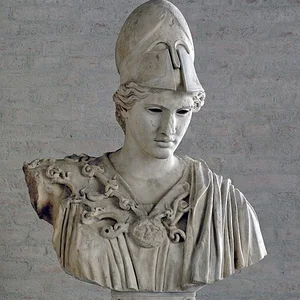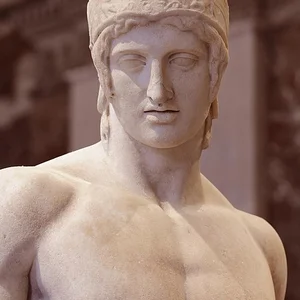

Ares is the god of war in ancient Greek mythology. Son of Zeus and Hera, he embodies violence, chaos, and the brutality of battle. He is one of the twelve major deities of Mount Olympus.
Ares
Ares
7 min read
Frequently asked questions
Key Facts
- Ares is one of the twelve major gods of Olympus in Greek mythology
- He is the son of Zeus and Hera, the sovereign deities
- Unlike Athena, who represents strategic wisdom in war, Ares embodies the violence and chaos of combat
- His Roman equivalent is Mars, the god of war
- He appears in several ancient myths, notably Homer's Iliad, where he intervenes during the Trojan War
Works & Achievements
Ares takes part in the great battle of the gods against the Giants alongside Zeus and the other Olympians. This confrontation symbolizes the triumph of divine order over primordial chaos.
Ares intervenes heavily in the Trojan War by supporting the Trojans, embodying the raw violence of the conflict as described in Homer's Iliad. His martial role is central to the Greek epics.
Ares intervenes in numerous divine and heroic conflicts, notably supporting various factions during the mythological wars. He symbolizes the destructive and chaotic aspect of war, in contrast to Athena, who represents strategy.
Ares embodies brutality, blind violence, and the chaos of combat in the Greek religious consciousness. His cult and artistic representations reflect the Greek ambivalence toward war.
Ares is one of the twelve major deities of Mount Olympus, making him a central figure in the Greek pantheon and in classical ancient literature.
Anecdotes
In Homer's Iliad (8th century BCE), Ares is wounded by the hero Diomedes during the Trojan War. Far from his image as an invincible god, he lets out a cry of pain so powerful it is heard across the entire battlefield. This scene shows that even the gods are not all-powerful and can suffer just like mortals.
The ancient Greeks portrayed Ares as brutal and impulsive, very different from Athena, who represents military wisdom. While Athena aids strategic heroes, Ares embodies the blind rage of combat. This distinction between two forms of warfare reflects Greek thinking on the difference between chaotic violence and organized war.
According to attested myths, Ares is one of the few gods to be imprisoned. In the Iliad, the giants known as the Aloadae capture him and keep him locked in a bronze jar for thirteen months. This humiliating ordeal for the god of war illustrates how Greek mythology never portrays the gods as completely invulnerable.
The Greeks associated Ares with the owl and the boar, while Athena was also linked to the owl, creating distinct symbolism between them. Ancient sources (Pausanias, Apollodorus) show that Ares was less widely worshipped than other major gods, reflecting a certain Greek skepticism toward brute violence.
In Thrace, a region to the north of Greece, Ares was far more respected and revered than elsewhere in the Greek world. The Thracians saw him as a noble and powerful deity, while Athenians and other Greeks often portrayed him in a ridiculous or negative light in their theatrical works.
Primary Sources
Ares, the glaring god of war, most hateful of all the immortal gods, who forever changes his mind and never holds to the same feeling. He seemed to have forgotten that he had promised Thetis to make the Trojans triumphant.
Hera bore without union of love a fearsome son equal to herself in strength, Ares, the fierce warrior, the god of brutal combat who fills hearts with the fury of battle.
Ares, relentless in battle, who takes pleasure in slaughter and carnage, unlike Athena who embodies wisdom and military strategy.
Ares, god of carnage, invincible warrior, with burning eyes, terrible and swift in combat, you who reign over war and the violence of men.
Key Places
The divine residence of Ares according to Greek mythology. It is on this mountain that Zeus and the twelve major gods, including Ares, were said to dwell and rule over the universe.
A region closely associated with Ares as the god of war. Located to the north of ancient Greece, Thrace was renowned for its fierce warriors and martial traditions, which mirrored the warlike nature of Ares.
The Greek capital where Ares was worshipped despite a religious preference for Athena, goddess of strategic warfare. Ares embodied the brutal, chaotic side of war, in contrast to Athena's emphasis on skill and strategy.
The warrior city-state of ancient Greece where Ares was deeply venerated. The Spartans, a people built around military excellence, saw in Ares the embodiment of their values of combat and martial courage.
The mythological site where Ares intervenes according to Homer's Iliad. The god of war takes an active part in the legendary Trojan War, fighting alongside both Trojans and Greeks at different points.
A sanctuary dedicated to Ares within the city of Athens, serving as a place of worship and veneration for the god of war. This temple reflects the religious significance of Ares in ancient Greek civic life.
Typical Objects

A bronze helm covering the entire face and neck, typical of Greek warriors. Ares is often depicted wearing this helmet, a symbol of his martial dominance and divine protection in battle.

The primary weapon of Greek hoplites, the spear was Ares' foremost martial attribute. It represents the destructive power and raw violence that the god embodies in combat.

A bronze cuirass protecting the torso of the Greek warrior. Ares is constantly shown wearing gleaming armor, symbolizing his role as protector of fighters and his warrior invulnerability.

A circular shield made of bronze and leather, often decorated with martial symbols. It is a key part of Ares' equipment, representing the defensive and authoritative power of the god of war.

A close-combat weapon used by Greek hoplites. Ares wields the sword in direct combat, embodying the fury and brutality of hand-to-hand fighting.

A horse-drawn vehicle used in battle in ancient Greece. Ares is often depicted riding his divine chariot, from which he dominates the battlefield.

A warrior's draped garment made of wool or linen, worn by Greek fighters. Ares wears a distinctive martial costume reflecting his status as god of armies and war.

An animal sacrificed to Ares in ancient Greek rituals. The rooster symbolizes aggression, combat, and the warrior virility associated with the god of war.
School Curriculum
Vocabulary & Tags
Key Vocabulary
Daily Life
Morning
Ares wakes in his palace on Mount Olympus, eager to involve himself in the affairs of mortals. He quickly dons his gleaming bronze armor and weapons of war, then prepares to intervene in the earthly conflicts that await him.
Afternoon
The god spends the afternoon watching battlefields from Olympus or descending directly onto them to inspire battle fury in the combatants. He revels in the chaos, violence, and bravery of warriors, encouraging the bloodiest clashes.
Evening
At the end of the day, Ares returns to the Olympian palace to feast with the other gods. He proudly recounts the battles in which he took part and mingles with his peers, though he is often mocked for his brutal and impulsive nature.
Food
Like all the gods of Olympus, Ares feeds on ambrosia and nectar, the divine foods that confer immortality. During animal sacrifices made in his honor, he receives offerings of burnt meat, consuming their spiritual essence.
Clothing
Ares wears a full suit of gilded bronze armor, a plumed helmet, and greaves — symbols of his role as god of war. He is often depicted with winged sandals and a scarlet red cape billowing behind him, embodying martial power and dominance.
Housing
Ares resides in a magnificent palace on Mount Olympus, home of the twelve major deities. His quarters are decorated with weapons of war, battle trophies, and warrior symbols, reflecting his martial nature and passion for conflict.
Historical Timeline
Period Vocabulary
Visual Style
Un style inspiré de la céramique grecque antique et de la sculpture classique, mêlant la puissance brute du dieu guerrier à l'élégance des œuvres du monde grec. L'ambiance est dramatique et chaotique, dominée par des tonalités chaudes et des ombres profondes qui renforcent le caractère violent et impétueux d'Arès.
Sound Ambience
Une ambiance sonore chaotique et guerrière dominée par le fracas des armes, les roulements de tambours de guerre profonds et les cris de bataille, évoquant la présence divine et brutale d'Arès sur le champ de combat antique.
Liens externes & ressources
Références
Œuvres
La Gigantomachie
mythologie intemporelle
La Troade (Guerre de Troie)
mythologie intemporelle (tradition épique du VIIIe-VIe siècle av. J.-C.)
Conflits olympiens et interventions divines
mythologie intemporelle
Représentation symbolique du chaos martial
mythologie intemporelle (tradition grecque du VIIIe siècle av. J.-C. onwards)
Les douze Olympiens
mythologie intemporelle