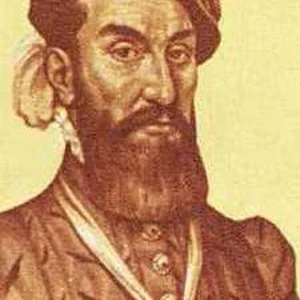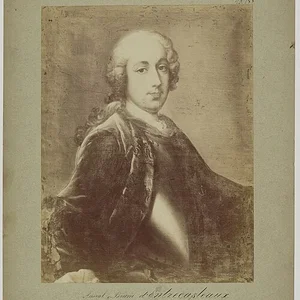

French navigator and admiral (1737–1793), d'Entrecasteaux was sent in 1791 to search for the lost expedition of La Pérouse. He explored the coasts of Australia, New Caledonia, and Tasmania before dying at sea without having found La Pérouse.
d'Entrecasteaux
Antoine Raymond Joseph de Bruni d'Entrecasteaux
9 min read
Frequently asked questions
Key Facts
- 1737: born in Aix-en-Provence into a Provençal noble family
- 1787–1789: Governor-General of French establishments in India
- 1791: departure from Brest in command of two frigates (La Recherche and L'Espérance) to find La Pérouse
- 1792: exploration of the southern coasts of Australia and Tasmania, charting of numerous Pacific islands
- 1793: death at sea near Java without having found La Pérouse
Works & Achievements
A complete account of the expedition in search of La Pérouse, published fifteen years after d'Entrecasteaux's death. This major work of scientific travel literature contains the ships' logs, scientific observations, and charts by Beautemps-Beaupré.
A collection of exceptionally accurate nautical charts drawn by hydrographer Charles-François Beautemps-Beaupré during the expedition. These charts of the Australian and New Caledonian coastlines served as authoritative references for several decades and established Beautemps-Beaupré's reputation as the father of modern hydrography.
An administrative and diplomatic mission carried out by d'Entrecasteaux in the Indian Ocean, during which he improved the defenses and commercial organization of the French colonies. This governorship demonstrates his abilities as an administrator, beyond his talents as a navigator alone.
Cartographic work carried out during a mission to Southeast Asia, improving navigation in regions of strategic importance to French maritime trade. This work preceded the southern expedition and revealed d'Entrecasteaux's skills as a hydrographer.
The expedition's naturalists published several volumes describing hundreds of new species collected in Tasmania, New Caledonia, and the Pacific islands. These publications were landmarks in the history of natural science and represent the expedition's lasting scientific legacy.
Anecdotes
During his stopover in Tasmania in 1792, d'Entrecasteaux and his naturalists discovered plant and animal species unknown to Europeans. The expedition's scientists collected hundreds of plants, including the famous Huon pine, an ancient tree that still bears the name of his second-in-command, Huon de Kermadec. This remarkable botanical harvest made the expedition one of the most scientifically fruitful of the 18th century.
In 1793, as the expedition sailed toward the Solomon Islands, a Dutch brig brought news of the execution of Louis XVI. The crew immediately split between royalists loyal to d'Entrecasteaux and republicans who sided with the Revolution, creating dramatic tension aboard both ships in the middle of the Pacific Ocean. This political crisis at sea illustrates how profoundly the French Revolution shook even the most distant expeditions.
D'Entrecasteaux died on July 20, 1793, taken by scurvy, without having found La Pérouse. His body was cast into the sea off the coast of Java, and his republican officers had the royalist crew members arrested upon arrival in Surabaya by Dutch authorities. A tragic end for a man who had devoted his final two years to a mission of hope.
The wreck of La Pérouse's ships was not found until 1828 at Vanikoro, in the Solomon Islands — a place that d'Entrecasteaux's expedition had passed close to without knowing it. The island's inhabitants had indeed witnessed a shipwreck forty years earlier, but the language barrier had prevented any exchange. D'Entrecasteaux had come within days of solving the mystery that had motivated his entire mission.
Before he died, d'Entrecasteaux entrusted his logbooks to his hydrographer Beautemps-Beaupré, with the hope that they would be published. This wish was granted in 1808: the posthumous publication of the voyage account, enriched with Beautemps-Beaupré's nautical charts, became one of the masterpieces of French cartography and laid the foundations of modern scientific hydrography.
Primary Sources
On 21 April 1792, we sighted a great low-lying land which we judged to be the southern coast of New Holland. Nautical observations were conducted with the utmost rigour, in order to fix with precision the position of these waters, still imperfectly known.
His Majesty, moved by the fate of M. de la Pérouse and those who accompanied him, has resolved to send two frigates in search of him in the Southern Seas. The commander of the expedition shall take care to inquire, at each port of call, for any information that might yield news of the missing expedition.
This morning a freshening south-westerly wind compelled us to reduce sail. The breeze was strong and the sea heavy; we hove to in order to wait for more favourable conditions. The number of sick stands at twelve, several of whom show alarming signs of scurvy.
The surveys carried out along the coasts of Van Diemen's Land and New Caledonia are the most complete and accurate yet made in these waters. The chronometers were checked daily and the latitude and longitude observations compared with meticulous care.
I am resolved to pursue the search for M. de la Pérouse with all the ardour of which I am capable. The intelligence gathered at the Admiralty Islands gives hope that some members of his expedition may have survived on those shores.
Key Places
Birthplace of d'Entrecasteaux in 1737, capital of Provence and a city of parliamentarians. He grew up here in a family of the noblesse de robe before choosing a naval career.
France's principal military port and royal naval base from which d'Entrecasteaux set sail in September 1791 aboard *La Recherche* and *L'Espérance*. Brest was the traditional departure point for all the great French maritime expeditions of the 18th century.
A major anchorage for the expedition in 1792 and 1793, where d'Entrecasteaux established a scientific camp for several weeks. This bay, renamed in his honour, allowed the naturalists to study the fauna, flora, and Aboriginal peoples of Tasmania.
The strait between the Bruny Peninsula and the Tasmanian mainland, charted and named by the expedition in 1792. This waterway still bears the admiral's name today, a testament to the precision and lasting value of his hydrographic work.
A Pacific archipelago explored by d'Entrecasteaux in 1792–1793, where he searched among the islands for traces of La Pérouse. His cartographic surveys of the Caledonian coastline were the most detailed ever produced by Europeans in the region.
The Dutch port where the expedition's ships put in after d'Entrecasteaux's death in July 1793. It was here that the two frigates were detained by the Dutch authorities and that the royalist officers were imprisoned by their own republican crews.
Typical Objects

Navigation instrument used to measure the angle between a celestial body and the horizon in order to calculate latitude. D'Entrecasteaux and his hydrographer Beautemps-Beaupré used it daily to produce charts of remarkable precision for the era.

An exceptionally precise clock, indispensable for calculating longitude at sea. The expedition carried several chronometers whose discrepancies were carefully recorded each day in the ship's log — a technical revolution of the 18th century.

A daily register recording the ship's position, weather conditions, and events occurring on board. Kept until D'Entrecasteaux's death, this log is the primary source on the expedition and was published in 1808.

A case containing absorbent paper and presses for preserving and transporting plants collected during stopovers. The naturalists La Billardière and Deschamps filled hundreds of specimens, including many species new to European science.

A portable telescope used to observe celestial bodies and take coastal bearings. Aboard La Recherche, it also served to scan the shorelines for distress signals or traces of the La Pérouse expedition.

A blue coat with white lapels and gold embroidery, tricorn hat and dress sword: the regulation attire of senior officers of the Royal French Navy under Louis XVI. D'Entrecasteaux wore it during official ceremonies and port calls in foreign harbors to assert France's diplomatic presence.

Cartographic documents depicting coastlines, water depths, and navigation hazards. The charts produced by D'Entrecasteaux's expedition for the Australian and New Caledonian coasts were so accurate that navigators continued to rely on them for several more decades.
School Curriculum
Vocabulary & Tags
Key Vocabulary
Tags
Daily Life
Morning
At dawn, the captain is roused by the officer of the watch. He goes up on deck to inspect the ship's condition and review the position readings taken during the night. By six o'clock, he holds a meeting with his officers to set the day's course, analyze the morning's astronomical observations, and assess the crew's health.
Afternoon
Afternoons are devoted to cartographic surveys when sailing along an unknown coastline: officers sketch the outlines from the deck while longboats are lowered to take depth soundings. On the open sea, d'Entrecasteaux writes up his notes, receives reports from the naturalists, and consults existing charts to plan the next ports of call.
Evening
In the evening, after dinner with his officers in the great cabin, d'Entrecasteaux would carefully write up his ship's log, recording the route covered, notable observations, and his thoughts on the mission. He would often end with a sextant reading of the stars, essential for confirming the longitude before handing over to the next watch.
Food
On board, the officers ate better than the sailors: ship's biscuits, salt or dried meats, dried vegetables, cheese, and a few stores of wine brought from France. During port calls, the crew stocked up on fresh fruit, fish, and fresh water to ward off scurvy, the dreaded disease that claimed d'Entrecasteaux himself in 1793.
Clothing
D'Entrecasteaux wore the regulation uniform of admirals of the royal navy: a blue coat with white facings and gold braid, white breeches, silk stockings, and a tricorn hat. At sea in bad weather, he would put on a heavy wool cloak over it to protect himself from the spray and the cold of the southern latitudes.
Housing
Aboard La Recherche, d'Entrecasteaux had the great cabin at the stern, a cramped but partitioned space that afforded him relative privacy. The room served as office, dining room for the officers, and sleeping quarters all in one: a built-in bunk, a chart table, and a few trunks holding books, scientific instruments, and the mission's official documents.
Historical Timeline
Period Vocabulary
Liens externes & ressources
Références
Œuvres
Voyage de Découvertes aux Terres Australes
1808 (posthume, publié par Rossel)
Atlas des cartes hydrographiques de l'expédition (Beautemps-Beaupré)
1808 (posthume)
Gouvernement des îles de France (Maurice) et de Bourbon (La Réunion)
1787-1789
Levés hydrographiques des détroits de Malacca et de la mer de Chine
1785-1787
Collections botaniques et zoologiques de l'expédition (La Billardière, Deschamps)
1804-1806 (posthumes)