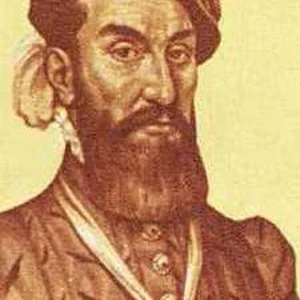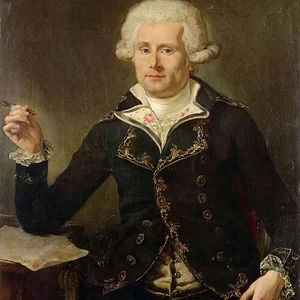

French navigator and naval officer (1729–1811), he completed the first French circumnavigation of the globe (1766–1769), bringing back accounts of Tahiti that fuelled the myth of the noble savage. He was also a mathematician and played a role in the Seven Years' War.
Louis-Antoine de Bougainville(1729 — 1811)
Louis-Antoine de Bougainville
France
8 min read
Frequently asked questions
Famous Quotes
« The sea is vast, but the man who knows how to read it will always find his way.»
« I have sailed the most beautiful ocean in the world.»
Key Facts
- 1729: born in Paris
- 1766–1769: first French circumnavigation of the globe aboard *La Boudeuse* and *L'Étoile*
- 1771: publication of *Voyage autour du monde*, the account of his expedition
- 1798: elected member of the Institut de France
- 1811: died in Paris, interred in the Panthéon
Works & Achievements
A two-volume mathematical work that earned Bougainville election as a Fellow of the Royal Society of London at the age of 25. It demonstrates his remarkable intellectual abilities long before his maritime career.
Bougainville organized and personally funded a French colony on the Falkland Islands, seeking to establish a strategic base in the South Atlantic following the loss of Canada under the Treaty of Paris.
The first French circumnavigation of the globe, conducted aboard the frigate La Boudeuse and the storeship L'Étoile. The expedition carried scientists on board and gathered geographical, botanical, and ethnographic data of great value.
An account of his circumnavigation published in Paris, which met with enormous success in France and across Europe. Translated into several languages, it helped shape the image of Tahiti as an earthly paradise and fuelled reflection among Enlightenment philosophers.
Anecdotes
Among Bougainville's crew was Jeanne Barret, disguised as a man under the name Jean Barret to board the Étoile. A chambermaid and assistant to botanist Philibert Commerson, she was unmasked during the stopover in Tahiti. She thus became the first woman to circumnavigate the globe — a distinction that was not officially recognized until long after her death.
It is to botanist Commerson that we owe the name of the ornamental plant 'bougainvillea', named in homage to his commander during the voyage. This climbing vine with its vivid flowers, first observed in South America, today adorns gardens around the world and keeps the memory of the French navigator alive in the history of botany.
Before becoming a sailor, Bougainville was a brilliant mathematician: at twenty-five, he published a 'Treatise on Integral Calculus' that earned him election as a Fellow of the Royal Society of London. This unusual path — from equations to Atlantic storms — made him one of the most cultured officers in the French Royal Navy.
During the Siege of Quebec in 1759, Bougainville commanded a corps of troops stationed upstream of the city to watch for a possible enemy maneuver. On the morning of the Battle of the Plains of Abraham, he could not reach Montcalm in time: his men arrived too late, and the marquis, mortally wounded, died a few hours later. That day marked the end of New France.
Bougainville's description of Tahiti, presented as a paradise of gentleness and natural innocence, inspired the philosopher Diderot to write his 'Supplement to Bougainville's Voyage', composed around 1772. This philosophical dialogue used the island as a critical mirror of European civilization and colonialism, fueling the great Enlightenment debate on the 'noble savage'.
Primary Sources
No sooner had we anchored than we were surrounded by canoes full of islanders. They all offered us fruits, chickens and women, the latter with such artlessness as seemed far removed from any notion of vice or shame.
The principal object of this Treatise is to provide general methods for integrating all manner of differential quantities, whether algebraic or transcendental, and to apply them to the principal problems of Geometry and Mechanics.
The position of the Falkland Islands, at the entrance to the Strait of Magellan, makes them a post of capital importance for trade and navigation in the southern seas. France cannot afford to take no interest in this archipelago without surrendering all influence in these waters.
I have the honour to inform Your Excellency of my arrival at Saint-Malo, after a voyage of two years and four months. The frigate La Boudeuse and the store-ship L'Étoile have completed their circumnavigation of the globe; we lost only seven men in all, of whom just one died of illness.
Key Places
Bougainville's birthplace, where he was born in 1729 and died in 1811. It was here that he received his intellectual education, moved in Enlightenment philosophical circles, and published his major works.
The great Breton naval port from which Bougainville set sail on 5 December 1766 for his circumnavigation of the globe. It was the main port of the French Royal Navy, a hub for the training and outfitting of expeditions.
The city where Bougainville served as aide-de-camp to the Marquis de Montcalm during the Seven Years' War. He witnessed the fall of the city and the death of Montcalm at the Battle of the Plains of Abraham in 1759.
The South Pacific island where Bougainville made a stopover in April 1768. His enthusiastic descriptions of the ease and gentleness of Tahitian life profoundly influenced Enlightenment philosophy and the European imagination.
The South Atlantic archipelago where Bougainville established the first permanent French settlement, Port Louis, in 1764. He was compelled to hand it over to Spain in 1767 in exchange for reimbursement of the settlement costs.
Typical Objects

A navigation instrument used to measure the altitude of celestial bodies in order to determine latitude at sea. Bougainville and his officers used it every morning to calculate their position during the circumnavigation.

A high-precision timepiece essential for calculating longitude at sea. Its reliability was critical during the long ocean crossings — with no landmarks in sight — that could last for weeks on end.

The official record in which Bougainville noted the ship's position, weather conditions, events, and observations every day. This document formed the basis of his celebrated *Voyage autour du monde*.

Seafaring maps showing coastlines, reefs, and maritime routes. Bougainville supplemented and corrected them as the voyage progressed, contributing to the advancement of world cartography.

An optical instrument used on board to observe stars at night and fix the ship's position, as well as to spot coastlines and any enemy vessels on the horizon.

The regulation weapon worn by officers of the French Royal Navy, a symbol of their rank and authority aboard ship. Bougainville wore it during ceremonies and official receptions in foreign ports.
School Curriculum
Vocabulary & Tags
Key Vocabulary
Daily Life
Morning
At dawn, Bougainville would climb to the deck of La Boudeuse to review the night's navigational readings. He would confer with the pilot about the route to follow, check the state of the wind and sails, then oversee the morning astronomical measurements — taking the sun's altitude with a sextant — which allowed him to calculate latitude and adjust their heading.
Afternoon
The afternoon was devoted to inspecting the crew, resolving matters of discipline and supplies, and meeting with the scientists on board (botanists, astronomers). During port calls, Bougainville personally led shore excursions, meeting local populations, overseeing trade exchanges, and taking note of everything he observed.
Evening
In the evening, in his cabin at the ship's stern, Bougainville carefully wrote up his logbook, noting the distance covered, the day's observations, and his reflections on the peoples encountered. He often dined with his officers and the expedition's scholars, leading discussions on philosophy, science, and politics.
Food
At sea, the crew ate hardtack, salted meat and fish, dried legumes, and aged cheese. During port calls, they supplemented their provisions with fresh fruit, poultry, and pork — essential for warding off scurvy. As captain, Bougainville had access to a better-stocked table than the ordinary sailors.
Clothing
Bougainville wore the blue uniform with white facings and gold braid of the Royal Navy, with his regulation sword at his side. In rough weather at sea, he adopted more practical attire. At official receptions in ports and at court, he wore his full dress uniform complete with his decorations and powdered wig, in keeping with 18th-century etiquette.
Housing
On board, Bougainville occupied the great cabin at the stern of La Boudeuse — the only truly private space worthy of the name on the ship. Furnished simply with a desk, a bunk, and chests for instruments and documents, it served as both his office and his sitting room. In Paris, he lived in a private mansion in the city center, frequenting the literary salons and learned circles of the capital.
Historical Timeline
Period Vocabulary
Liens externes & ressources
Références
Œuvres
Traité du calcul intégral
1754-1756
Expédition aux îles Malouines
1763-1767
Premier tour du monde français (La Boudeuse / L'Étoile)
1766-1769
Voyage autour du monde
1771