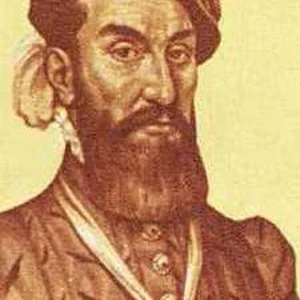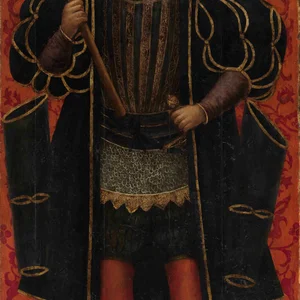

A French navigator and explorer, Samuel de Champlain founded the city of Quebec in 1608 and is known as the Father of New France. He mapped much of Canada and established lasting alliances with Indigenous peoples.
Samuel de Champlain(1567 — 1635)
Samuel de Champlain
Royaume de France
8 min read
Frequently asked questions
Famous Quotes
« I have never found a more beautiful land than New France.»
Key Facts
- Around 1567: born in Brouage (Saintonge)
- 1603: first voyage to Canada, sailing up the St. Lawrence River
- 1608: founding of the city of Quebec
- 1609: exploration of the lake that bears his name (Lake Champlain) and alliance with the Huron and Algonquin peoples
- 1635: died in Quebec on December 25
Works & Achievements
An account of his first voyage to Canada, published in Paris. It is Champlain's earliest text, describing the Indigenous peoples and the riches of the St. Lawrence with a gaze that is both curious and strategic.
An illustrated account of his voyages from 1604 to 1612, accompanied by a map of New France. This work established his reputation as a cartographer and persuaded the French Court to support colonization.
An account of his explorations as far as the Great Lakes and the Huron territories (1615–1616). In it he argues for an ambitious colonial policy grounded in alliances with Indigenous peoples.
His masterwork, published after the restitution of Quebec by the English. It stands as a synthesis of thirty years of exploration, enriched with maps and invaluable ethnographic descriptions.
A concrete and founding achievement: the construction of a fortified trading post at Quebec, the first lasting settlement that would become the capital of New France.
A remarkably precise map of the St. Lawrence, the Atlantic coastline, and part of the continental interior. It remained the definitive cartographic reference for New France for several decades.
Anecdotes
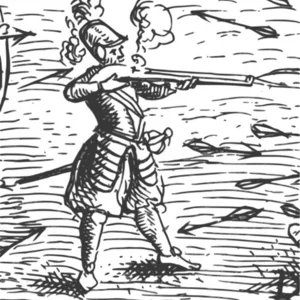
In July 1609, Champlain accompanied his Huron and Algonquin allies against the Iroquois on the shores of the lake that would bear his name. When the two armies faced each other, he raised his arquebus — a weapon unknown to the Iroquois — and brought down two chiefs with a single shot. The shock was total: the Iroquois warriors fled. This episode forged a lasting alliance with the Hurons, but also a deep enmity with the Iroquois Confederacy that would endure for a century.
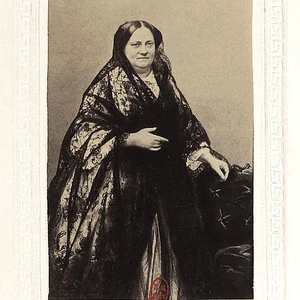
Champlain married Hélène Boullé on December 30, 1610: she was only 12 years old, he was around 43. Following the customs of the time and the contract signed with her family, the marriage was at first platonic. Hélène eventually joined her husband in Quebec in 1620 and remained there for four years. Captivated by the Indigenous peoples, she showed them her pocket mirror — they believed they could see their ancestors in it and venerated her as a sacred figure.
In the summer of 1629, three English ships commanded by the Kirke brothers blockaded the St. Lawrence. Quebec was starving, without supplies for months. Champlain, who had fewer than a hundred people in the settlement with barely fifty pounds of gunpowder, was forced to surrender. He negotiated his capitulation with dignity and was taken to England. It would take the Treaty of Saint-Germain-en-Laye in 1632 for France to recover New France.
Champlain was a cartographer of remarkable precision for his era. His maps of the St. Lawrence, the Great Lakes, and the Atlantic coast — drawn with compass and astrolabe over the course of his voyages — remained authoritative references for more than a century. An astrolabe discovered in 1867 near the Ottawa River is traditionally attributed to Champlain, who is thought to have lost it during his 1613 expedition.
During the first winter at Quebec in 1608–1609, only 8 of the 24 colonists survived scurvy, cold, and disease. Champlain drew a hard lesson from this catastrophe: he learned from Indigenous peoples to consume local plants rich in vitamin C, particularly annedda (white cedar), and developed a policy of alliances and knowledge exchange with the Amerindian nations he considered essential to the colony's survival.
Primary Sources
On the 27th of that month, we arrived at Tadoussac, where there were many savages who had come to trade furs with the French.
On July 3, 1608, I sought a suitable place for our settlement, but could find none more convenient or better situated than the point of Quebec, so named by the savages.
Our purpose is to establish the Christian faith among a vast multitude of savages who live without knowledge of God, without religion, without law, without civil society.
Quebec is situated at forty-six degrees and some minutes of latitude, at a place where the river begins to narrow and where there rises a high point of rock.
Key Places
Champlain's presumed birthplace, a thriving salt-trading port in the 16th century. A birthplace house and museum are dedicated to him there today.
Champlain founded his settlement there on July 3, 1608, on a rocky promontory overlooking the St. Lawrence River. He spent most of his American life there and died on December 25, 1635.
Discovered by Champlain in July 1609, he fought his first battle there alongside the Huron and Algonquin against the Iroquois. The lake bears his name in memory of this founding episode.
The first permanent French settlement in North America, co-founded by Champlain in 1604. He experimented with the first winter stays in America there and established the Order of Good Cheer.
A site visited by Champlain during his explorations of the St. Lawrence River. He recognized the strategic importance of this location at the confluence of several waterways, laying the groundwork for the future city of Montreal.
Typical Objects

An angle-measuring instrument used to determine latitude by observing the height of the sun or stars. Champlain used it on every expedition to produce maps of remarkable accuracy.

Indispensable for navigation at sea and through forests, it accompanied Champlain on all his voyages. Combined with his astronomical observations, it allowed him to produce reliable cartographic surveys.

A portable firearm used by Champlain at the Battle of Lake Champlain in 1609. Its devastating effect on Iroquois warriors, who had no knowledge of gunpowder, proved decisive.

A light and agile Indigenous watercraft that Champlain quickly adopted for exploring Canada's rivers and lakes. He openly acknowledged its superiority over European boats in freshwater.

Champlain recorded his geographical, ethnographic, and natural observations daily. These notes formed the raw material for his four published works and his many maps.

The foremost diplomatic object among Iroquoian and Algonquian nations, wampum sealed alliances and treaties. Champlain learned to use these conventions to negotiate with Indigenous leaders.
School Curriculum
Vocabulary & Tags
Key Vocabulary
Daily Life
Morning
In the field or at sea, Champlain rises at dawn to observe the rising sun with his astrolabe and record the ship's latitude in his journal. He holds a council with his lieutenants to plan the day: the route to follow, diplomatic meetings with Indigenous chiefs, or fortification work at Quebec.
Afternoon
The afternoon is devoted to exploration, negotiation, or colony administration. Champlain draws his cartographic surveys, questions his interpreters — the truchements — about local languages and customs, and oversees the construction or repair of buildings at the habitation.
Evening
In the evening, by candlelight, he writes his logbook with meticulous care, annotating his geographical, ethnographic, and natural observations. At Port-Royal, he established the Order of Good Cheer to maintain colonists' morale through festive meals in good company.
Food
At sea, the daily ration consists of hardtack, salted pork or beef, dried vegetables, and a meager supply of water or watered-down wine. In New France, Champlain gradually adopts Indigenous foods: corn, squash, smoked fish, game, and wild berries, which contributes to the colony's survival.
Clothing
Champlain wears the typical dress of a military gentleman of the early 17th century: a cloth doublet, breeches, leather boots, and a cape. On forest expeditions, he adapts his equipment by adopting moccasins and more practical clothing, observing and drawing inspiration from his Indigenous guides.
Housing
In Quebec, Champlain lives in the habitation he designed himself: a complex of wooden buildings surrounded by ditches and a palisade, with storerooms, a kitchen, a forge, and living quarters. In France, during his stays in Paris or at Court, he lodges at inns or with noble patrons, tirelessly lobbying for funding for his colony.
Historical Timeline
Period Vocabulary
Liens externes & ressources
Références
Œuvres
Des Sauvages
1603
Les Voyages du sieur de Champlain Xaintongeois
1613
Voyages et découvertures faites en la Nouvelle France
1619
Les Voyages de la Nouvelle France occidentale, dicte Canada
1632
Fondation de l'habitation de Québec
1608
Carte géographique de la Nouvelle France
1612