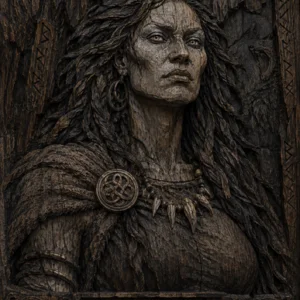

An enchanting figure from medieval Arthurian legend, the Lady of the Lake is a fairy who presents the sword Excalibur to King Arthur and raises Lancelot. She embodies magic and the bond between the mortal world and the fairy realm.
Lady of the Lake
The Lady of the Lake
8 min read
Frequently asked questions
Key Facts
- She presents the sword Excalibur to King Arthur, a symbol of his royal legitimacy
- She raises Lancelot of the Lake, the greatest knight of the Round Table
- She is associated with the island of Avalon, a magical place beyond time
- First mentioned in the 12th century in the romances of Chrétien de Troyes
- She receives Arthur's body after the Battle of Camlann
Works & Achievements
The founding act of the legend: the Lady of the Lake rises from the waters and presents the sword Excalibur to King Arthur, granting him his royal legitimacy and dominion over Britain.
She raises Lancelot, an orphan, in her underwater palace and shapes him into the greatest knight in the world — serving both as adoptive mother and magical guardian.
She turns Merlin's own magic against him to imprison him forever, bringing the great enchanter's reign to an end and asserting her own magical sovereignty.
She intervenes on several occasions to protect Queen Guinevere and certain knights from the plots of the court, revealing her role as a guardian of the Arthurian order.
After the battle of Camlann, she guides the funeral barge to the isle of Avalon — a pivotal figure in the closing of the Arthurian cycle and the ultimate keeper of the king's fate.
Anecdotes
The Lady of the Lake has no single name in medieval texts: she is variously called Viviane, Niniane, or Nymue depending on the version. In the thirteenth-century Arthurian Vulgate Cycle, it is under the name Niniane that she raises the young Lancelot in the depths of her magic lake, teaching him the chivalric arts throughout his childhood — hence his epithet 'Lancelot of the Lake'.
It is the Lady of the Lake who gives the sword Excalibur to King Arthur, according to most medieval versions. In Thomas Malory's tale (Le Morte d'Arthur, 1485), she rises from the waters brandishing the sword toward Arthur and Merlin, who have come to the lakeside. She explains that Excalibur belongs to her and agrees to lend it to the king in exchange for a promise — a way of underscoring the contractual and magical nature of this royal gift.
In the Suite du Merlin (13th century), the Lady of the Lake ultimately imprisons Merlin himself. The old wizard, smitten with her, teaches her all his secrets. She then turns his own art against him, trapping him for eternity in an invisible glass tower or, according to other versions, in an enchanted cave. This reversal is one of the most celebrated paradoxes in Arthurian literature.
At the end of the legend, when Arthur is mortally wounded after the Battle of Camlann, it is the Lady of the Lake who guides the barge toward the isle of Avalon to tend to his wounds. She thus appears at both the beginning and the end of the Arthurian cycle — a guardian of royal destiny. This image has inspired countless artists, from Tennyson to modern film adaptations.
Primary Sources
The sword Caliburn, finest of all swords, was forged on the isle of Avalon. Arthur received it to wage his battles against the Saxons and the invaders of the kingdom of Britain.
The Lady of the Lake took the child in her arms and sank with him into the waters of the lake, which closed over them. There she raised him as her own son, teaching him everything a knight must know.
Niniane, having learned from Merlin all the enchantments she desired, imprisoned him in a beautiful invisible keep that no one could see or find. And Merlin never left it.
In the midst of the lake, Arthur saw an arm clothed in white samite, holding a fair sword. The Lady of the Lake said to him: this sword is mine. Ask it of me with courtesy, and I shall give it to you.
Key Places
The Lady of the Lake's main dwelling — an invisible fairy palace beneath the surface of the water. It is here that she raises Lancelot and keeps Excalibur before presenting it to Arthur.
An enchanted island beyond the seas where the Lady of the Lake leads Arthur after the Battle of Camlann. A place of eternal rest and healing, sometimes associated with Glastonbury in England.
A Breton forest associated with Arthurian legends in the French tradition. It is said to be the site of Merlin's imprisonment by Nimue and of several appearances by the Lady of the Lake.
Arthur's royal city, where the Lady of the Lake sometimes intervenes to protect the Knights of the Round Table or warn them of danger. Its exact location remains legendary and disputed.