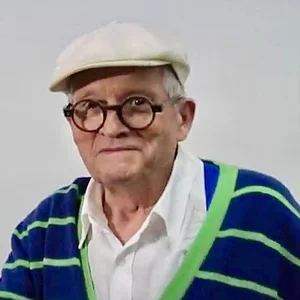

British painter born in 1937, a major figure of Pop Art and contemporary figurative painting. Known for his Californian swimming pools and portraits, he constantly explores new media, from photo-collage to the iPad.
David Hockney(1937 — ?)
David Hockney
Royaume-Uni
9 min read
Frequently asked questions
Famous Quotes
« Art must touch the heart.»
« Looking is an act of love.»
Key Facts
- Born on 9 July 1937 in Bradford, England
- Studied at the Royal College of Art in London in the 1960s
- Moved to Los Angeles in 1964, painted his famous series of swimming pools
- Invented the “joiners”, assemblages of Polaroid photos, in the 1980s
- Adopted the iPad as a creative tool from 2010
Works & Achievements
Acrylic on canvas depicting the splash of a dive into a Californian swimming pool. An icon of Pop Art, this painting captures the light and lightness of the American dream with an almost photographic precision.
A large double portrait of his friends, fashion designers Ossie Clark and Celia Birtwell, with their white cat Percy. This monumental work (213 × 305 cm) is one of the most visited paintings at Tate Britain in London.
A painting completed in forty-eight hours in a race against the clock before an exhibition. Sold in 2018 for 80 million dollars, it became the most expensive work by a living artist ever sold at auction at the time.
A photomontage composed of more than 700 Polaroid photographs assembled to depict a desert road in California. The work experiments with the multiplication of viewpoints, directly inspired by Picasso's Cubism.
A series of monumental Yorkshire landscapes painted across multiple joined canvases, some measuring more than nine metres long. Hockney returned to oil painting and worked outdoors in all weathers.
A fresco of 220 drawings made on an iPad during lockdown, assembled into a vast panoramic work presented at the Royal Academy in 2021. It celebrates the renewal of nature with a bright and joyful palette.
Anecdotes
When David Hockney first arrived in Los Angeles in 1964, he was immediately captivated by swimming pools — a luxury virtually nonexistent in England. He threw himself into painting water in motion, determined to capture what photographs could not: the light dancing on the surface. His painting *A Bigger Splash* (1967) was born from this sense of wonder; it took him two full weeks to paint the splash itself, while the rest of the canvas had taken only a few days.
In 1982, Hockney began gluing dozens of Polaroid photographs together to create what he called “joiners.” Dissatisfied with traditional photography, which captures only a single frozen moment, he layered dozens of shots taken from different angles to recreate the way the human eye truly perceives the world — moving, scanning, remembering. These works drew directly on Picasso’s Cubism, which he had admired since childhood.
Around 2009, Hockney received his first iPhone and immediately began drawing flowers on it with his thumb. He sent these small digital works to his friends each morning as a kind of daily postcard. When the iPad launched in 2010, it was a revelation: the touch screen became his canvas, and he painted hundreds of Yorkshire landscapes from his bed at sunrise. He would later declare it “the most significant development in drawing since the silverpoint of the Renaissance.”
In the 2000s, Hockney published *Secret Knowledge* (2001), an investigative book in which he argued that the great masters of the Renaissance and Baroque — Vermeer, Ingres, Van Eyck — had secretly used optical devices such as the *camera obscura* to achieve their strikingly precise compositions. This theory, known as the “Hockney-Falco thesis,” sparked passionate debate among art historians worldwide.
In 2018, his painting *Portrait of an Artist (Pool with Two Figures)* — dashed off in forty-eight hours in a race against the clock before a 1972 exhibition — sold at Christie’s for $80 million, making it the most expensive work by a living artist ever sold at auction at the time. Hockney himself had described the painting as “not entirely satisfying” — proof that artworks sometimes surpass their creator’s own intentions.
Primary Sources
I noticed that the drawings in Ingres' sketchbooks seemed to have a photographic quality. Could he have used a camera lucida? The more I looked, the more convinced I became that optical devices had been widely used by artists since the Renaissance.
I went to California for the first time in 1964 and immediately saw the swimming pools. In England we hardly had any. The way the water moves, the light cutting through — I absolutely had to paint that.
Drawing on the iPhone is like drawing on very small paper. When the iPad came out, it was much better. I could use my fingers. I draw every morning, often at dawn, and I send the pictures to friends. It feels very intimate, like sending a letter.
I went back to Yorkshire and rediscovered the landscape. The trees change all the time, the light changes. You can't paint that with a photograph — you have to be there, come back, look again.
Key Places
An industrial city in northern England where Hockney was born in 1937. He grew up here in a modest family and discovered his passion for drawing, first at the Bradford College of Art and then at the Contact Theatre.
Hockney studied here from 1959 to 1962 and won his year's gold medal. It was at this elite institution that he refined a personal style blending figuration, text, and bold cultural references.
Hockney settled here in 1964 and would spend long periods of his life in the city. The Californian light, swimming pools, and freedom of the West Coast radically transformed his painting and inspired his most celebrated works.
Hockney returned to his native Yorkshire in the early 2000s to paint the landscapes of the English countryside, the hedgerows and woods of Woldgate. This period gave rise to the monumental series *A Bigger Picture*.
Hockney settled here permanently from 2019. It is here that he painted on iPad his monumental series on the arrival of spring (2020), which became one of his most celebrated works of the 21st century.
Typical Objects

Hockney abandoned oil paint in favour of acrylics as early as the 1960s, drawn to their quick drying time and vivid colours suited to the Californian atmosphere. His large pool paintings were executed in acrylic on linen.

In the 1980s, Hockney used hundreds of Polaroid photographs to compose his "joiners" — cubist photomontages reconstructing a scene seen from multiple angles simultaneously. The camera became as much a painting tool as a documentation device.

From 2010 onwards, the iPad became Hockney's tool of choice for his daily digital drawings. He painted landscapes, flowers and portraits directly on the touchscreen, sending his creations to friends like messages.

This ancient optical instrument — a sealed box that projects an inverted image of the outside world — lies at the heart of Hockney's investigations in *Secret Knowledge* (2001). He used one himself to experiment and attempt to replicate the effects achieved by Flemish and Italian masters.

Hockney is also a prolific printmaker and lithographer. He produced series of prints from the 1960s onwards, notably around *A Rake's Progress* and the Brothers Grimm fairy tales, exploring visual storytelling through sequential images.

The swimming pool is less an object than an obsessive motif running through Hockney's work. It embodies the American dream, physical freedom, and the technical challenge of painting transparent water in motion. He painted dozens of variations on the theme throughout his career.
School Curriculum
Vocabulary & Tags
Key Vocabulary
Tags
Lieu
Daily Life
Morning
Hockney rises early, often at dawn, to make the most of natural light. Since adopting the iPad, he draws landscapes at sunrise, even before breakfast, and sends his creations to friends as digital postcards. He invariably begins his day by observing the ambient light.
Afternoon
Afternoons are devoted to painting in the studio or en plein air depending on the period. In California, he often worked outdoors around swimming pools; in Yorkshire, he would set up his equipment in fields and woodland in all weathers. He can paint on several canvases simultaneously to compose large panoramic works.
Evening
In the evenings, Hockney enjoys having friends over, going to restaurants, or attending the opera — for which he has designed sets and costumes for several productions. Despite significant hearing loss (he has been hard of hearing since the 1970s), he remains very sociable and endlessly curious.
Food
Hockney has long been known for his love of cigarettes, which he has publicly defended as a right. He enjoys simple, convivial food, both English and French since settling in Normandy. Coffee and tea mark the rhythm of his working days.
Clothing
Hockney sports a relaxed, colourful style that reflects his sunny character. He is frequently photographed wearing thick-framed glasses, patterned ties, and tweed jackets or colourful waistcoats — a look that is at once distinctly British and eccentric, and has become his visual signature.
Housing
In Los Angeles, Hockney lived in a villa with a swimming pool in the Hollywood Hills — a setting that directly inspired his paintings. In Yorkshire, he occupied a studio-house in Bridlington. In Normandy, he settled into a rural property surrounded by orchards, whose blossoming apple trees fed his spring iPad series.
Historical Timeline
Period Vocabulary
Liens externes & ressources
Références
Œuvres
Mr and Mrs Clark and Percy
1970-1971
Pearblossom Hwy, 11-18th April 1986 (Second Version)
1986