 flip
flipAsh Damper
Ash Damper
Why this dish? Damper was the daily bread at the Raukkan mission where Unaipon grew up. Made from the flour of rations distributed by missionaries, it was baked in the ashes of the campfire in the bush manner. This simple bread embodied Unaipon's hybrid food reality—colonial ingredient, Indigenous cooking technique.
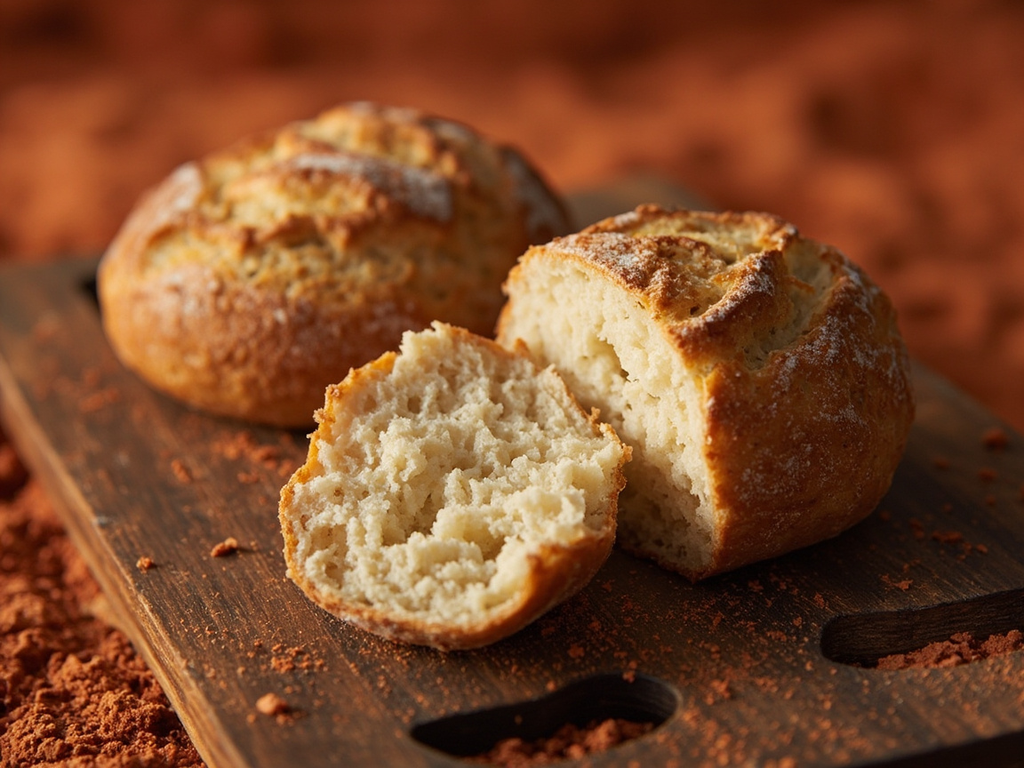
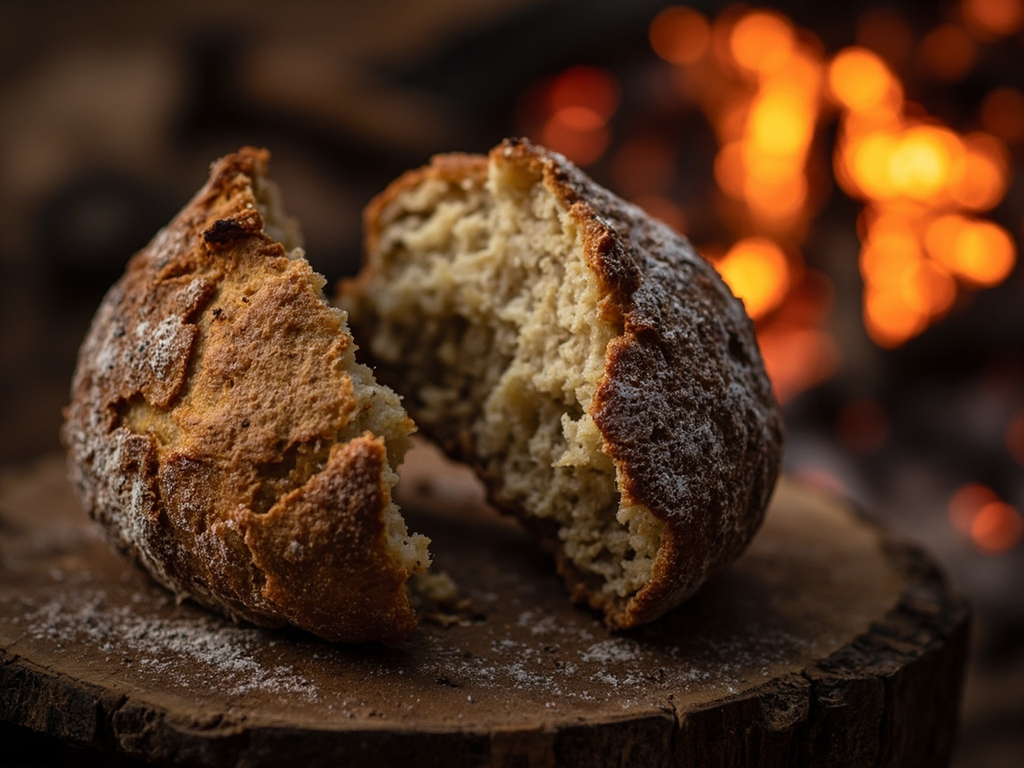
A round, dense bread baked directly in the hot ashes of a wood fire. Made from flour, water, and a pinch of salt, without yeast, it forms a crisp, ash-dusted crust around a soft crumb. Damper is the universal companion of any Australian bush meal.
At the mission, the flour arrived in large jute sacks, and it was our task to make something edible from it. My mother mixed the flour with well water and a little salt, formed a thick ball, and slid it into the gray ashes of the hearth. Patience was required—a virtue I have always advocated, whether for baking a damper or perfecting a mechanism. When you tapped the crust and it sounded hollow, it was ready. We broke the bread by hand, blew off the ash, and the inside was tender as cake. Simple, yes, but it is with this bread that I grew up, and it nourished me more surely than many refined meals.
- •Wheat flour (mission rations) — about 2 cups (base)
- •Water — enough to form a firm dough (binder)
- •Salt — a pinch (seasoning)
- •Hot wood fire ash — a good bed (cooking medium)
Ash Damper
A round, dense bread baked directly in the hot ashes of a wood fire. Made from flour, water, and a pinch of salt, without yeast, it forms a crisp, ash-dusted crust around a soft crumb. Damper is the universal companion of any Australian bush meal.
Why this dish? Damper was the daily bread at the Raukkan mission where Unaipon grew up. Made from the flour of rations distributed by missionaries, it was baked in the ashes of the campfire in the bush manner. This simple bread embodied Unaipon's hybrid food reality—colonial ingredient, Indigenous cooking technique.
At the mission, the flour arrived in large jute sacks, and it was our task to make something edible from it. My mother mixed the flour with well water and a little salt, formed a thick ball, and slid it into the gray ashes of the hearth. Patience was required—a virtue I have always advocated, whether for baking a damper or perfecting a mechanism. When you tapped the crust and it sounded hollow, it was ready. We broke the bread by hand, blew off the ash, and the inside was tender as cake. Simple, yes, but it is with this bread that I grew up, and it nourished me more surely than many refined meals.
Ingredients (period version)
- Wheat flour (mission rations) — about 2 cups (base)
- Water — enough to form a firm dough (binder)
- Salt — a pinch (seasoning)
- Hot wood fire ash — a good bed (cooking medium)
Ingredients
- Wholemeal flour (or T80 flour) — 300 g (base)
- Baking powder — 2 tsp (leavening (optional, for a lighter crumb))
- Salt — 1 tsp (seasoning)
- Warm water — about 180 ml (binder)
- Butter or lard — 30 g, optional (texture)
Method
- Mix the flour, baking powder, and salt in a bowl. If using butter, rub it in with your fingertips until the mixture resembles coarse sand.
- Add water gradually and mix until a soft, non-sticky dough forms. Do not overwork the dough.
- Shape into a thick disc about 4 cm high. Lightly dust the surface with flour.
- For oven baking: preheat to 200 °C, place the damper on a floured or parchment-lined baking sheet, and bake for 25–30 minutes until it sounds hollow when tapped on the bottom.
- For barbecue or campfire cooking: wrap in aluminum foil and place on warm (not live) embers for 30–35 minutes, turning halfway.
- Let cool for a few minutes, then break apart by hand to serve.
How it was made : Damper was born from the meeting of colonists' wheat flour and the Indigenous technique of baking in ashes. Aboriginal peoples had for millennia made flatbreads from ground seeds (notably native grasses like *Panicum*) cooked on hot stones or in ash. With the arrival of missions and flour rations, wheat damper became a ubiquitous staple in rural 19th-century Australia, shared by settlers and Indigenous people alike.
The contemporary twist : Add a handful of roasted wattleseed (acacia) to the dough for a nutty, coffee-like aroma typical of Australia, and serve with macadamia butter.
Sources : Richard Kimber, « Man from Arltunga: Walter Smith, Australian Bushman », Hesperian Press, 1986 · Jennifer Isaacs, « Bush Food: Aboriginal Food and Herbal Medicine », Weldons, 1987 · Michael Symons, « One Continuous Picnic: A Gastronomic History of Australia », Melbourne University Press, 2007
David Unaipon · Charactorium