
Dike is the Greek goddess of human justice and moral order. The daughter of Zeus and Themis, she is one of the Horae (Hours) and watches over the upholding of law among mortals, denouncing injustices to her father.
Dike
Dike (Δίκη)
7 min read
Frequently asked questions
Key Facts
- Daughter of Zeus and the Titaness Themis, goddess of divine law
- One of the three Horae (Hours) alongside Eunomia (order) and Eirene (peace)
- Mentioned by Hesiod in the Theogony and Works and Days (8th–7th c. BC)
- Denounces to Zeus the men who hand down unjust judgments
- Sometimes identified with the maiden Astraea, associated with the constellation Virgo
Works & Achievements
The central role of Dike: to watch over the respect of law among humans and to report transgressions to Zeus, the guarantor of moral order.
In the *Works and Days*, Dike embodies outraged justice, demanding that Zeus punish the leaders who hand down crooked judgments.
An emblematic scene from the Chest of Kypselos: Dike strikes and strangles Injustice, illustrating the triumph of right over wrong.
A myth handed down by Aratus and later Ovid: Dike/Astraea, disgusted by human corruption, rises to the sky and becomes the celestial Virgin.
Together with Eunomia and Eirene, Dike forms the triad that orders time, the seasons, and the smooth running of human societies.
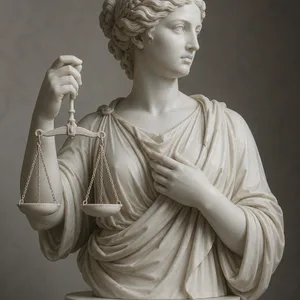
Dike, having become the Roman Iustitia, founded the Western iconography of Justice with her scales and sword, still found on courthouses today.
Anecdotes
In Greek mythology, Dike is one of the three Horae (Horai), along with her sisters Eunomia (Good Order) and Eirene (Peace). Hesiod tells us that they were born from the union of Zeus and Themis, the divine Law, which makes Dike the embodiment of justice placed closest to the king of the gods.
According to Hesiod in 'Works and Days', whenever a man tramples on justice, Dike goes to sit beside Zeus her father and denounces to him the unjust hearts of men, so that the people may pay for the excesses of their corrupt leaders.
The Greeks set Dike against her opposite Adikia, Injustice. On the famous Chest of Kypselos described by Pausanias, Dike was depicted as a beautiful woman strangling and beating with a stick an ugly and misshapen Adikia.
In the Greek imagination, Dike was sometimes associated with the constellation Virgo. The poet Aratus told how, in the Golden Age, she lived among men, but as their corruption grew she flew up to the heavens, becoming the celestial Virgin: this is the figure of Astraea.
Dike referred both to the goddess and to the Greek word for 'justice' or 'lawsuit'. In the courts of Athens, to render the dike meant to deliver a judgment: the goddess's name was thus present at the very heart of the city's judicial life.
Primary Sources
Next he married radiant Themis, who bore the Horae, Eunomia, Dike, and flourishing Eirene, who watch over the works of mortal men.
There is a virgin, Dike, daughter of Zeus, honored and revered by the gods who dwell on Olympus; and whenever anyone wrongs her with crooked contempt, at once she sits beside her father, the son of Cronos, and denounces to him the unjust hearts of men.
Beneath the feet of the Herdsman you can make out the Maiden, who carries in her hand the shining ear of grain. Whether she descends from Astraeus, or from some other origin, may she go in peace! Another tradition runs among men: that once she lived upon the earth and came to meet with mortals—she was Dike.
A beautiful woman is punishing an ugly one, whom she throttles with one hand and strikes with the other with a staff: this is Dike treating Adikia thus.
Justice, the virgin daughter of Zeus, has never kept company with nor shared the designs of a man wholly devoted to recklessness.
Key Places
Home of the gods where Dike, revered by the Olympians, sits beside Zeus her father to watch over the justice of mortals.
Panhellenic sanctuary that housed the Chest of Cypselus described by Pausanias, on which Dike was depicted punishing Adikia.
City of democracy and of the great law courts, where the word dikē meant a lawsuit and where justice lay at the heart of civic life.
Birthplace village of Hesiod, at the foot of Mount Helicon, from where the poet sang of Dike and denounced the corrupt judges of his day.
Celestial region where Dike, identified with Astraea, is said to have taken refuge after leaving the corrupted earth, according to Aratus and Ovid.
Typical Objects

Instrument symbolizing the weighing of actions and the balance of judgment. Associated with justice delivered impartially, it would become the enduring attribute of Justice down through the centuries.

A staff or scepter with which Dike chastises Adikia, Injustice, as Pausanias describes. It embodies the power to punish and to set wrongs right.

A luminous ear of grain held by the celestial Virgin with whom Dike/Astraea is identified in Aratus. It evokes the Golden Age, abundance, and the fertility of a world still just.

As a Hora (Horai), Dike is associated with the seasons and the ordered cycle of time. The crown or floral garlands mark her belonging to these divinities of good natural order.

A blade associated with Justice in later times to signify the power to carry out the sentence. It completes the scales: to judge, then to cut and to punish.

The place Dike occupies at the side of her father Zeus to denounce to him the injustices of men, according to Hesiod. It represents her role as intercessor and guardian of divine law.
School Curriculum
Vocabulary & Tags
Key Vocabulary
Daily Life
Morning
A divine figure, Dike has no human daily routine: her 'morning' is that of Olympus, where she stands among the gods and watches the world of mortals waking to their labors. She keeps watch over the first judgments handed down at the gates of the cities.
Afternoon
Throughout the day, in thought she roams the agoras and the tribunals of men, taking note of broken oaths and unjust verdicts. Wherever justice is flouted, she grieves and prepares her complaint.
Evening
When evening comes, she returns to sit beside Zeus her father and denounces to him the unjust hearts of men, so that the people may pay for the excess of their leaders.
Food
As a divinity, Dike feeds on the nectar and ambrosia of the Olympians, the foods of immortality. But her true symbolic 'nourishment' is mortals' respect for justice and oaths.
Clothing
Greek art depicts her as a beautiful woman draped in a long peplos, sometimes winged like a celestial divinity. Later, she appears adorned with the attributes of Justice: scales and a staff or sword.
Housing
Her dwelling is Olympus, the palace of the gods bathed in light. According to the myth of the Golden Age, she lived for a time among men before taking refuge in the sky, becoming the constellation Virgo.
Historical Timeline
Period Vocabulary
Liens externes & ressources
Références
Œuvres
Veiller sur la justice des mortels
intemporel
Dénonciation des juges corrompus (Hésiode)
VIIe s. av. J.-C.
Le châtiment d'Adikia
image archaïque
Le catastérisme en constellation de la Vierge
IIIe s. av. J.-C.
L'appartenance aux Heures (Horai)
VIIIe s. av. J.-C.
L'héritage de la Justice allégorique
période gréco-romaine et au-delà