Imaginary interview with Đinh Bộ Lĩnh
by Charactorium · Đinh Bộ Lĩnh (924 — 979) · Politics · Military · 6 min read

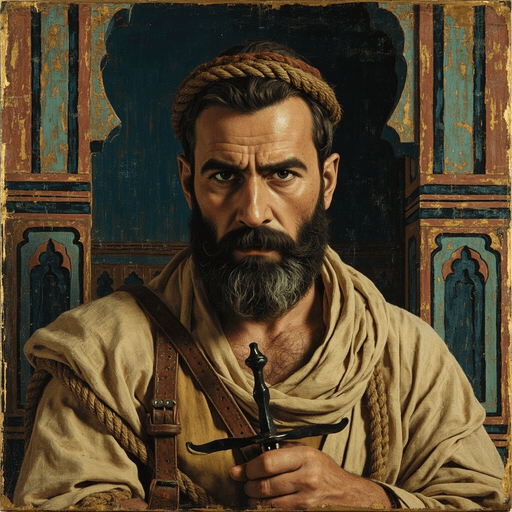
We are in the rugged valley of Hoa Lư, between limestone cliffs and slow rivers, where the first emperor of the reunified country holds his stone court. The man who was once a herdboy receives us without pomp, a dried reed stem still placed near him, like a memory one does not discard. He speaks softly, with the gravity of those who have seen order born from disorder.
—Do you remember the games of your childhood in the hills of Hoa Lư?
How could I forget them? We were buffalo herders, barefoot in the mud of the rice paddies, but in our minds we were already a court. I had Đinh Điền, Nguyễn Bặc, Lưu Cơ, and Trịnh Tú cross their arms to carry me like a sovereign on his palanquin, and the others brandished on either side cờ lau, those white reed flowers that grow everywhere by the water's edge. We imitated the procession of the Son of Heaven without knowing that Heaven was perhaps listening. Those who carried my childhood reeds later carried my war banners. I believe that nothing happens without fate first whispering it in a game.
Those who carried my childhood reeds later carried my war banners.
—They tell of omens surrounding your birth. What do you say to that?
I am not the keeper of those stories, but I respect them as one respects the Ancients. They say that my mother, before my coming, dreamed of a man bearing the imperial seal, the ấn vua, who came asking her to recognize him as a son; then she conceived me. They also say that one day while fishing I found a pearl whose glow at night made a monk declare that my destiny would be high. Are these truths or embroideries of pious old men? I do not know. But when a child who led the buffalo at Đại Hoàng ends up on a throne, men look for a sign that foretold it, and Heaven, in its wisdom, does not contradict them.
When a herdboy ends up on a throne, men look for the sign that foretold it.
—How did the country come to be broken into twelve pieces?
After Ngô Quyền's victory over the Chinese at Bạch Đằng, we believed the country was finally delivered from a thousand years of Bắc thuộc. But a kingdom without a firm sovereign is like a dike without earth: water eventually washes everything away. At the death of the last Ngô, each provincial chief became a sứ quân, a lord in his own corner, and twelve of them fought over the rice paddies and rivers. This calamity was called the loạn 12 sứ quân, the war of the Twelve Seigneurs. From my fortified valley of Hoa Lư, I saw villages burn over boundary disputes. A divided country belongs to no one but the crows. That is when I resolved to sew back together what had been torn apart.
A kingdom without a firm sovereign is like a dike without earth: water eventually washes everything away.
—What did Lord Trần Minh Công at Bố Hải Khẩu represent for you?
He was like a second father to me. I went to him at the river port of Bố Hải Khẩu with my son Liễn, when I was only a chieftain without enough land. That wise man saw in me not a rival but an adopted son, and he entrusted me with command of his troops. When he died, I did not scatter his warriors: I brought them back to Hoa Lư, where the most feared fighters of the region gathered around me. They were later called the seven heroes of Giao Châu. To receive an army from the hands of a dying father is to receive a duty, not a spoils. I have always thought that a man is judged by how he honors what has been entrusted to him.
To receive an army from a dying father is to receive a duty, not a spoils.
—Let us speak of your son Đinh Liễn, offered as a hostage. How did you endure that ordeal?
That is the wound I speak of least. Refusing to bow before the Ngô kings, I had sent my own son Đinh Liễn to their court as a pledge of my good faith. But a man who bends once bends always; so, when they suspended him from the end of a pole and threatened to pierce him, I commanded my archers to draw their nỏ, their crossbows, and shoot at my child rather than see me crawl. It was not hardness of heart—a father bleeds inside. It was that the fate of an entire people weighed more than a single son, even mine. Stunned that a man could not be held even by his own blood, they gave up killing him. Heaven, that day, returned my son to me.
The fate of an entire people weighed more than a single son, even mine.

—Did you never regret such a gesture toward your own child?
Regret is a luxury of peacetime. In those days, any weakness shown to the Ngô kings would have cost a hundred villages. A leader who can be bent by twisting his son's arm is no longer a leader: he is an open door that everyone will cross. I preferred to pass for a man without entrails rather than give the rival lords proof that I could yield. My son Liễn understood, I think, for he fought at my side afterwards to subdue the twelve seigneurs. I was given the title of Vạn Thắng Vương, the king of ten thousand victories; but none of those victories cost me as much as that moment when I had to pretend not to love.
Regret is a luxury of peacetime.
—How did you succeed, where so many others had failed, in reuniting the twelve seigneuries?
Not by a thunderclap, but one by one, patiently, as one untangles a knotted net. From 966 to 968, surrounded by Liễn, Lê Hoàn, Đinh Điền, and Nguyễn Bặc, I subdued each sứ quân, sometimes by arms, sometimes by welcoming those who rallied. My strength came from Hoa Lư: that valley ringed by rocks was a fortress built by nature itself, where my enemies shattered and from which my horsemen burst forth. I did not defeat twelve men; I extinguished twelve hearths of discord to relight only one, the hearth of the kingdom. To reunite, you see, is a hundred times longer than to divide—but it is the only work worth a man spending his life on.
I did not defeat twelve men; I extinguished twelve hearths of discord to relight only one.
—In 968, you took a title that no sovereign of the country had dared to bear. Why?
Because a people that calls itself vassal ends up believing itself slave. Our former sovereigns contented themselves with titles that China granted them—tiết độ sứ, governor, thứ sử, prefect—as if our land were merely a march of the Northern Empire. I, at Hoa Lư, took the title of hoàng đế, emperor, the same word that the Middle Kingdom adorns itself with. It was not pride, but a declaration: after a thousand years of Bắc thuộc, this kingdom now had its own Heaven. I named the state Đại Cồ Việt, the Great Việt, so that the name itself would speak our greatness. A title is not a word; it is a border drawn in the souls of men, beyond which no foreigner commands anymore.
A people that calls itself vassal ends up believing itself slave.
—Why did you choose that narrow valley of Hoa Lư as the capital, rather than a great plain?
Because I was building a new kingdom, still unsteady, and a newborn child is laid in a cradle with high sides. Hoa Lư is that cradle of stone: mountains for ramparts, rivers for moats, narrow passes that a handful of men can hold. Plains are beautiful for kingdoms assured of their strength; they are deadly for those that still doubt. I had grown up there, I had gathered my first warriors there, I had resisted there when the whole country was tearing itself apart—it was only right that power take root where I myself had taken root. From that valley, I made the heart of Đại Cồ Việt, a heart beating safe within the rocks.
A newborn kingdom is laid in a cradle with high sides.
—What remains, in the emperor, of the little herdboy with the reed flowers?
Everything, perhaps. People think the throne erases childhood; it only crowns it. When I look at the silk banners of my court, I see again the cờ lau, the white reeds my comrades brandished by the river. When I command my armies, I still hear the laughter of the buffalo herders who carried me on their crossed arms. Heaven did not make me an emperor in a day: it first made a child who played at being one, as if to accustom him to it. I do not despise what I was. The humble valley, the buffalo, the mud of the rice paddies—it is from that earth that I drew the strength to raise a fallen kingdom.
People think the throne erases childhood; it only crowns it.

This imaginary interview was generated by artificial intelligence from sources documented in Đinh Bộ Lĩnh's profile. It dramatises what the figure might have said based on what we know about them, but does not constitute attested historical testimony. For primary sources and factual documentation, refer to the full profile.