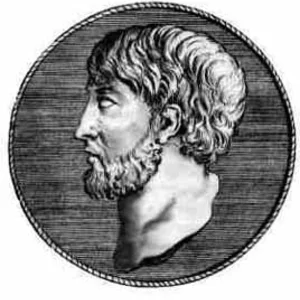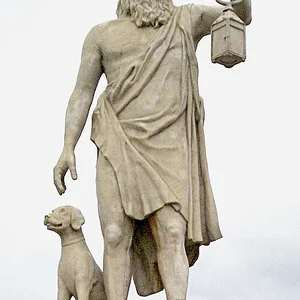

Greek philosopher of the 4th century BC and founder of the Cynic school. He advocated the rejection of social conventions and lived in voluntary poverty, sleeping in a large jar. He is famous for his verbal sparring with Alexander the Great.
Diogenes of Sinope(399 av. J.-C. — 322 av. J.-C.)
Diogenes of Sinope
Sinope
7 min read
Frequently asked questions
Famous Quotes
« Stand out of my light.»
« I am looking for a man.»
« The hand is the best cup.»
Key Facts
- Born around 413 BC in Sinope, on the shores of the Black Sea
- Exiled from Sinope for debasing coins with his father, he settled in Athens
- A student of Antisthenes, the founder of Cynicism, he radicalized his teacher's doctrine
- Legendary encounter with Alexander the Great, who offered him any wish he desired — Diogenes replied: 'Stand out of my light'
- Died around 323 BC, the same year as Alexander the Great, in Corinth
Works & Achievements
Diogenes Laërtius attributes to Diogenes of Sinope a series of dialogues and tragedies, none of which have survived in their original form. Their very existence is disputed by some historians.
A disciple of Antisthenes, Diogenes radicalized and embodied Cynic philosophy, turning it into a concrete way of life. His influence was felt directly on Crates of Thebes, who in turn passed Cynicism on to Zeno of Citium, the founder of Stoicism.
A theoretical work in which Diogenes reportedly outlined his vision of an ideal city without laws, borders, or currency. It is considered the first cosmopolitan text of antiquity.
A collection of short anecdotes and sharp witticisms attributed to Diogenes. These texts, preserved in the Lives of the Eminent Philosophers, form the primary source for his thought and teaching method.
Anecdotes
One day, Alexander the Great, conqueror of the known world, came to visit Diogenes, who was basking in the sun. He told him he could grant him any favor he wished. Diogenes simply replied: 'Stand out of my light.' Alexander, impressed, reportedly told his companions: 'If I were not Alexander, I would wish to be Diogenes.'
Diogenes walked through the streets of Athens in broad daylight carrying a lit lantern. When asked why, he would answer: 'I am looking for an honest man.' With this provocation, he expressed his contempt for his fellow citizens, whom he considered corrupted by social conventions and pretense.
Plato had defined man as 'a featherless biped.' Diogenes caught a rooster, plucked its feathers, and presented it to the Academy, declaring: 'Here is Plato's man!' Plato was then forced to revise his definition by adding 'with flat nails.'
Diogenes lived in a large ceramic jar (pithos) he had found in a temple. According to Theophrastus, when a mouse ran over him one night, he reflected and realized he could simplify his life even further. He threw away his bowl after watching a child drink water from cupped hands.
At a banquet, the guests threw bones at him as they would to a dog, to mock him. Diogenes approached them and urinated on them, in the manner of a dog. He actually embraced the nickname 'dog' (kyon), from which the word 'cynic' derives, claiming that he barked at the wicked and fawned upon the good.
Primary Sources
He used to say that the goal of life was to act in accordance with nature, not with laws; he lived the same life as Heracles, preferring nothing to freedom.
I live as the gods live: I need nothing, and everything men think they need is merely superfluity added on top of nature.
Diogenes mocked those who prided themselves on noble birth, wealth, or power, saying that all such things were empty vanity compared to virtue.
When Alexander approached him and said, 'I am Alexander, the great king,' Diogenes replied, 'And I am Diogenes, the Dog.'
Key Places
Greek city on the Black Sea where Diogenes was born around 399 BC. He was banished from it following the scandal of his father's currency counterfeiting.
Diogenes settled in Athens, frequenting the agora for his verbal and philosophical sparring. The Cynosarges gymnasium, home of the Cynic school founded by Antisthenes, was his first base.
The city where Diogenes was sold into slavery and where he spent much of his life. It was here that his famous encounter with Alexander the Great took place during the Isthmian Games.
According to tradition, Diogenes died at the gates of Corinth around 323 BC, on the very same day as Alexander the Great — a coincidence the ancients considered deeply symbolic.
Typical Objects

A large ceramic jar that served as Diogenes' home, symbolizing his rejection of all property. It represents the voluntary poverty at the heart of Cynic philosophy.

A knotted staff that Diogenes carried at all times during his wanderings through Athens and Corinth. He used it to emphasize his arguments or drive away unwanted company.

A small bag of leather or rough cloth containing all of Diogenes' meager possessions. A typical attribute of the Cynic philosopher, it symbolized self-sufficiency and freedom.

An oil lamp that Diogenes carried in broad daylight while 'searching for an honest man.' This object has become his most famous iconographic attribute in Western art.

Diogenes owned a bowl for eating and drinking. He threw it away when he saw a child drinking from cupped hands, realizing he had been carrying a needless object.

A coarse wool cloak, folded to serve as both garment and blanket. Diogenes wore it summer and winter alike, refusing any unnecessary comfort.
School Curriculum
Vocabulary & Tags
Key Vocabulary
Tags
Daily Life
Morning
Diogenes woke at dawn, lying in his jar near the entrance of a temple or gymnasium. He began his day with physical exercise — the Cynics valued bodily endurance — before heading to the agora to philosophize and provoke passersby.
Afternoon
In the afternoons, Diogenes roamed the agora or the gymnasium, confronting noblemen, merchants, and fellow philosophers. He improvised speeches or engaged in verbal sparring matches (chriai) with anyone willing to debate, practicing a street philosophy with no school and no building.
Evening
In the evenings, Diogenes would beg for his meal or accept whatever was offered, then return to his jar. When the weather allowed, he slept under the open sky, claiming to sleep better than kings in their palaces. He refused any dinner invitation from men too attached to luxury.
Food
Diogenes ate frugally: raw or cooked legumes, figs, olives, barley bread, and whatever he could beg on the agora. He sometimes ate in public — considered indecent in Greek society — to demonstrate that shame is nothing but a social convention.
Clothing
Diogenes wore a simple coarse woolen cloak (tribôn), folded in two to serve as both a daytime garment and a blanket at night. He went barefoot in all seasons and refused any additional tunic, even in winter, to harden his body.
Housing
Diogenes lived in a large ceramic jar (pithos), most likely found near a temple of Cybele in Athens. This symbolic dwelling was his most eloquent philosophical act: proof that a person needs nothing beyond what nature already provides.
Historical Timeline
Period Vocabulary
Visual Style
Style pictural réaliste inspiré de la céramique grecque à figures rouges et de la sculpture hellénistique, avec des tons terreux méditerranéens, une lumière égéenne contrastée et une atmosphère d'austérité volontaire.
Sound Ambience
L'ambiance sonore de l'agora d'Athènes et de Corinthe au IVe siècle av. J.-C. : brouhaha des marchés, discussions philosophiques animées, aboiements de chiens errants et bruits du port méditerranéen.
Liens externes & ressources
Références
Œuvres
Dialogues philosophiques (perdus)
IVe siècle av. J.-C.
Fondation de l'école cynique athénienne
Vers 360-350 av. J.-C.
La République (politeia cynique, perdue)
IVe siècle av. J.-C.
Apophtegmes et chriai (recueillis par Diogène Laërce)
Transmis au IIIe siècle apr. J.-C.