 flip
flipWajik Ketan
Wajik Ketan
Why this dish? Wajik — a compact diamond of glutinous rice with palm sugar and coconut — is the quintessential travel snack in Java: dense, energy-rich, it keeps for days wrapped in leaves. During the five years of the Java War, Diponegoro and his troops constantly moved through the mountains and forests of central Java. Wajik, which every peasant knew how to prepare, was an ideal ration for these mobile fighters.
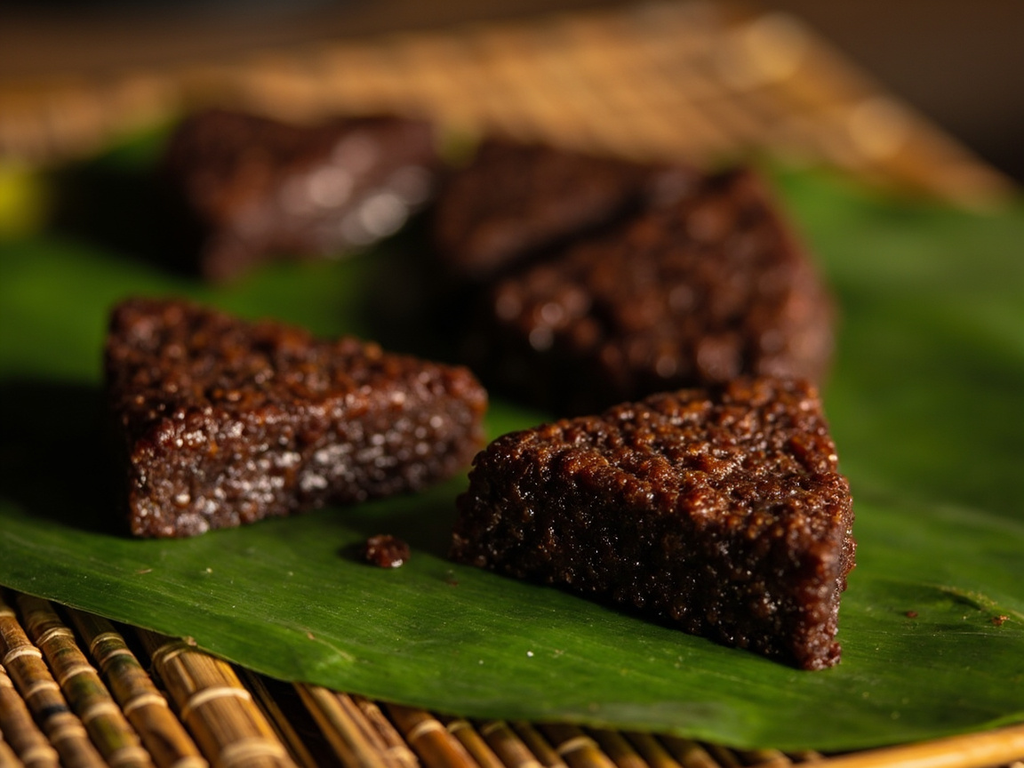
Diamonds of glutinous rice steamed, then candied in palm sugar and coconut milk until a caramelized, dense, and shiny mass is obtained. Cut into diamonds, it is a sweet snack that sticks to the ribs and travels well, traditional throughout the island of Java.
In the mountains of Selarong, when we moved by night to escape Dutch patrols, my men carried wajik wrapped in banana leaves, tucked into their batik belts. No need for fire, no need for water — you bite into it and your belly is held for the march. The taste of gula Jawa and kelapa is the taste of our land that the kafir want to take from us. The women of the villages we passed would prepare whole baskets of it for us, and this generosity of the people confirmed that our cause was just before Allah.
- •Glutinous rice (ketan) — A generous measure (Base)
- •Gula Jawa (palm sugar) — A good block (Caramelization and flavor)
- •Coconut milk (santan kental) — Thick, from one coconut (Creaminess and binder)
- •Pandan leaves — A few leaves, tied (Fragrance)
- •Salt — A pinch (Enhancer)
- •Banana leaves — For wrapping (Preservation and transport)
Wajik Ketan
Diamonds of glutinous rice steamed, then candied in palm sugar and coconut milk until a caramelized, dense, and shiny mass is obtained. Cut into diamonds, it is a sweet snack that sticks to the ribs and travels well, traditional throughout the island of Java.
Why this dish? Wajik — a compact diamond of glutinous rice with palm sugar and coconut — is the quintessential travel snack in Java: dense, energy-rich, it keeps for days wrapped in leaves. During the five years of the Java War, Diponegoro and his troops constantly moved through the mountains and forests of central Java. Wajik, which every peasant knew how to prepare, was an ideal ration for these mobile fighters.
In the mountains of Selarong, when we moved by night to escape Dutch patrols, my men carried wajik wrapped in banana leaves, tucked into their batik belts. No need for fire, no need for water — you bite into it and your belly is held for the march. The taste of gula Jawa and kelapa is the taste of our land that the kafir want to take from us. The women of the villages we passed would prepare whole baskets of it for us, and this generosity of the people confirmed that our cause was just before Allah.
Ingredients (period version)
- Glutinous rice (ketan) — A generous measure (Base)
- Gula Jawa (palm sugar) — A good block (Caramelization and flavor)
- Coconut milk (santan kental) — Thick, from one coconut (Creaminess and binder)
- Pandan leaves — A few leaves, tied (Fragrance)
- Salt — A pinch (Enhancer)
- Banana leaves — For wrapping (Preservation and transport)
Ingredients
- Glutinous rice (sticky rice) — 400 g (Base)
- Palm sugar (gula Jawa) or coconut sugar — 200 g, grated (Caramelization)
- Thick coconut milk — 400 ml (Creaminess)
- Pandan leaves (or extract) — 3 leaves tied or 1/2 tsp extract (Fragrance)
- Salt — 1/4 tsp (Enhancer)
- Square mold (20 cm) — 1, greased (Shaping)
Method
- Soak the glutinous rice in cold water for at least 4 hours or overnight.
- Drain and steam the rice for 30 minutes, until translucent and sticky.
- Meanwhile, in a large pan or wok, melt the grated palm sugar with coconut milk and pandan leaves over medium heat, stirring constantly.
- When the mixture forms a thick, brown caramel, add the pinch of salt.
- Pour the cooked glutinous rice into the coconut caramel. Stir vigorously with a wooden spatula for 15 to 20 minutes over low heat, until the rice has absorbed all the liquid and forms a compact, shiny mass.
- Pour into the greased mold, press firmly with the back of a wet spatula to obtain a well-packed layer about 2 cm thick.
- Let cool completely (at least 2 hours), then cut into diamonds.
- Keeps for 3 to 4 days at room temperature, wrapped in plastic wrap or, traditionally, in banana leaves.
How it was made : Wajik is an ancient Javanese jajanan, whose diamond shape is linked to batik patterns and Javanese symbolism. Easy to produce in large quantities and very stable thanks to the high sugar content, it naturally served as marching rations. During the Java War, Diponegoro's fighters often lived on the support of rural populations, who supplied rice, wajik, and other provisions. Palm sugar, locally produced, was far more accessible than the refined cane sugar of colonial plantations.
The contemporary twist : Cut the wajik into small regular diamonds and arrange them on a banana leaf like geometric tiles, echoing Yogyakarta's batik patterns. A pinch of Madura fleur de sel on top highlights the caramel.
Sources : Sri Owen, “The Food of Indonesia”, 2015 — traditional Javanese jajanan · Murdijati Gardjito et al., “Makanan Tradisional Indonesia”, UGM Press, 2017
Diponegoro · Charactorium