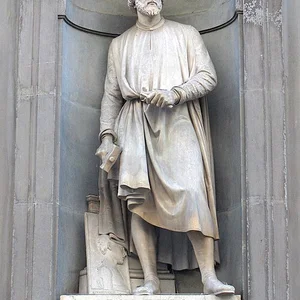

Donato di Niccolò di Betto Bardi, known as Donatello, was a Florentine sculptor of the 15th century, considered one of the founding fathers of Renaissance sculpture. He revolutionized the art of sculpture by rediscovering ancient naturalism and mastering perspective in low relief.
Donatello(1386 — 1466)
Donatello
République florentine
8 min read
Frequently asked questions
Key Facts
- Born around 1386 in Florence, into a family of Tuscan craftsmen
- Created the bronze David (c. 1440–1450), the first freestanding nude statue since Antiquity
- Invented schiacciato, a very shallow relief technique that creates a striking illusion of depth
- Worked for the Medici, Florence's great patronage family
- Died in 1466 in Florence, leaving a landmark body of work for the European Renaissance
Works & Achievements
Marble statue created for Orsanmichele in Florence. It marks the emergence of a new type of hero with a determined, focused gaze, embodying the Renaissance ideal of human dignity.
Marble bas-relief at the base of the Saint George niche, the earliest known application of schiacciato. Donatello creates an illusion of spatial depth through minute variations in the surface.
The first freestanding nude statue since antiquity, commissioned by the Medici. Sensuous and naturalistic, it symbolizes Florentine freedom and represents a radical break from medieval art.
The first large bronze equestrian statue of the Renaissance, erected in Padua in honor of the condottiere Erasmo da Narni. Inspired by the ancient Marcus Aurelius, it established a monumental canon imitated across Europe.
Marble gallery created for Florence Cathedral, adorned with bas-relief dancing putti of exuberant vitality. It showcases Donatello's genius for breathing movement into stone.
A polychrome wooden statue of striking realism, depicting a gaunt Magdalene ravaged by penitence. A complete break from idealized representations, it anticipates expressionism.
Donatello's final major work, left unfinished at his death. These pulpits, with their tormented reliefs depicting the Passion of Christ, convey a dramatic tension and formal freedom that foreshadow the Baroque.
Anecdotes
Donatello and Brunelleschi were friends and rivals. Legend has it that when Brunelleschi saw the wooden crucifix Donatello had carved for Santa Croce, he told him he had portrayed 'a peasant on the cross.' Stung by the criticism, Donatello challenged him to do better. Brunelleschi then carved his own crucifix for Santa Maria Novella, which Donatello acknowledged as superior, admiring its ideal perfection.
Donatello's bronze David, commissioned by Cosimo de' Medici around 1440, was the first freestanding sculpture of a male nude created since Antiquity. This bold work shocked and fascinated his contemporaries with its sensuality and naturalism. It stood in the courtyard of the Medici Palace as a symbol of Florentine freedom against tyranny.
Donatello invented a revolutionary technique he called 'schiacciato' (flattened or compressed relief). By carving marble to an extremely shallow depth — sometimes just a few millimeters — he created the illusion of vast perspectival space, like a true painted scene rendered in stone. This technique had a profound influence on all of Western sculpture.
Late in life, Donatello was so ill and impoverished that Cosimo de' Medici offered him a farm to ensure he had a steady income. But the artist quickly returned it, complaining that the peasants pestered him with their problems and kept him from his work. He preferred to receive a regular pension instead, a testament to his complete devotion to his art until the very end.
Donatello was among the first Renaissance artists to study ancient sculptures in situ. Together with Brunelleschi, he traveled to Rome to measure, draw, and analyze ancient ruins — a journey his Florentine contemporaries mockingly called 'the treasure hunters' trip.' This deep immersion in Antiquity shaped his entire body of work.
Primary Sources
Donatello was so excellent in this art that one can truly say he stands above all other modern sculptors, not only for having surpassed his own age, but because even in our day scarcely anyone can be found to equal him.
Donato, Florentine sculptor, who with the greatest industry and the greatest dedication devoted himself to the art of sculpture and, to a considerable degree, to painting as well.
In sculpture and painting there are at this time artists of singular excellence: Donatello the sculptor and Masaccio the painter, whose memorable works speak for themselves.
Donatello is one of those craftsmen who have brought glory to Florence and to our family. He must be cared for as one would care for a wise old father.
Key Places
Donatello's birthplace and main city of activity. In the 15th century, Florence was the intellectual and artistic heart of the Renaissance, driven by the patronage of the Medici family and the wealth of the merchant guilds.
A combined religious and commercial building for which Donatello sculpted several monumental statues, including the famous Saint George (1416), a symbol of the Renaissance's new heroic naturalism.
Donatello worked here from 1443 to 1453, creating a monumental altar in bronze and marble. This stay in Padua spread his revolutionary style throughout northern Italy.
The square in front of the basilica where the equestrian statue of Gattamelata (1453) stands, commissioned in honor of the condottiere Erasmo da Narni. The first great equestrian statue in bronze of the Renaissance, it draws direct inspiration from the ancient Marcus Aurelius statue in Rome.
A city Donatello visited with Brunelleschi in the early 15th century to study ancient sculptures and monuments. This formative journey shaped his entire naturalistic approach and his rediscovery of the classical ideal.
The Medici family church for which Donatello created two bronze pulpits late in his life. He was buried here in 1466, beside his patron Cosimo de' Medici — an exceptional honor for an artist.
Typical Objects

Fundamental tools of the fifteenth-century Florentine sculptor, forged from iron. Donatello wielded them with extraordinary virtuosity to carve hard marble, bronze, and wood alike.

Donatello created his bronze sculptures using the lost-wax casting technique, first preparing finely worked wax models. These maquettes allowed him to visualize the final result and prepare the molds.

Like other Renaissance artists, Donatello observed and drew ancient sculptures during his trips to Rome. These sketchbooks served as a repertoire of forms and visual references for his work.

Essential tools for mastering proportions inspired by Antiquity and applying the rules of linear perspective, which Donatello employed in a groundbreaking way in his schiacciato reliefs.

Used for direct carving work, lighter than the metal mallet. Donatello alternated between tools depending on the precision required, using the wooden mallet for the final delicate finishing touches.

A craft furnace used for casting bronze in his workshop. Mastery of metallurgy was essential to achieve a fluid alloy and avoid air bubbles — technical challenges that Donatello overcame with genius in his large statues.
School Curriculum
Vocabulary & Tags
Key Vocabulary
Daily Life
Morning
Donatello rose early, at dawn, guided by the cathedral bells. He would begin by inspecting the ongoing work in his workshop, checking his apprentices' progress and adjusting compositions. The morning was devoted to the most demanding carving work, when the natural light was at its best.
Afternoon
In the afternoons, Donatello received his patrons — merchants, guilds, or members of the Medici family — to discuss ongoing projects. He supervised the bronze casting and finishing work, personally correcting the essential details that no apprentice could handle in his place.
Evening
In the evenings, Donatello would gather with other artists and humanists in Florentine intellectual circles, discussing philosophy, Antiquity, and art. A bachelor with little concern for material comfort, he lived simply, spending his earnings on materials and the upkeep of his workshop.
Food
His diet was that of a prosperous Florentine craftsman: wheat bread, fresh vegetables from the market, olive oil, Tuscan cheeses, and poultry. On feast days, the Medici would invite him to their table, offering him the refined dishes and fine Tuscan wines reserved for the elite.
Clothing
Donatello wore a rough linen work tunic, stained with marble dust and traces of bronze, covered by a thick leather apron during castings. For his rare public appearances or visits to the Medici, he wore a doublet of Florentine wool cloth and a plain cloak, without the ostentation of the richly dressed merchants.
Housing
Donatello lived and worked in a large workshop in the San Lorenzo district of Florence, not far from the church that would become his burial place. The space was cluttered with marble blocks, terracotta molds, tools hanging on the walls, and wax models. Toward the end of his life, the Medici ensured he had comfortable lodgings close to their palace.
Historical Timeline
Period Vocabulary
Visual Style
Un univers visuel dominé par la chaleur du bronze doré, la blancheur du marbre de Carrare et les ocres chauds des ateliers florentins du XVe siècle, baignés d'une lumière naturelle rasante qui révèle chaque détail sculptural.
Sound Ambience
L'atelier de Donatello résonne du bruit rythmique du ciseau sur le marbre, du souffle des soufflets alimentant le four à bronze, et du tintement des cloches du Dôme de Florence scandant la journée de travail.
Liens externes & ressources
Références
Œuvres
Saint Georges
vers 1416-1417
Relief du Saint Georges et le dragon (schiacciato)
vers 1416-1417
David en bronze
vers 1440-1443
Statue équestre du Gattamelata
1443-1453
Chaire de la Nativité (Cantoria)
1433-1439
Marie-Madeleine pénitente
vers 1453-1455
Chaires en bronze de San Lorenzo
vers 1460-1466