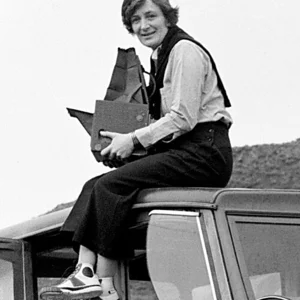

Dorothea Lange (1895-1965) was an American documentary photographer, famous for her images of the Great Depression. Her photograph “Migrant Mother” (1936) became a worldwide icon of social hardship in the United States.
Dorothea Lange(1895 — 1965)
Dorothea Lange
États-Unis
6 min read
Frequently asked questions
Famous Quotes
« Photography takes an instant out of time, altering life by holding it still.»
Key Facts
- Born in 1895 in Hoboken (New Jersey) and died in 1965 in San Francisco
- Created “Migrant Mother” in 1936, an emblematic photograph of the Great Depression
- Worked for the Farm Security Administration (FSA) to document rural poverty under the New Deal
- Photographed the internment of Japanese Americans in 1942 after Pearl Harbor
- Received a Guggenheim Fellowship in 1941, the first woman to be awarded one in photography
Works & Achievements
Portrait of Florence Owens Thompson and her children in a California camp. The most famous image of the Great Depression and an icon of documentary photography.
Photograph of a line of unemployed men waiting for a soup kitchen in San Francisco. The first major shot that steered Lange toward social photography.
A book created with the economist Paul Taylor, blending photographs and texts about the exodus of ruined farmers. A model of socially engaged documentary work.
A vast photographic campaign on rural poverty commissioned by the New Deal government. It helped raise awareness of the plight of migrant workers.
Reportage on relocation camps such as Manzanar. A censored testimony that quietly condemned this internment policy.
Humanist reportage on justice and everyday American life. Here Lange continues her attentive eye for ordinary people.
Anecdotes
In 1936, while driving home after a month of fieldwork, Dorothea Lange spotted a sign reading “pea-pickers camp.” She turned around, approached a mother of seven hungry children, and in just a few minutes took a handful of shots: one of them, “Migrant Mother,” became the most famous image of the Great Depression.
At the age of seven, Dorothea Lange contracted polio, which left her with a lifelong limp in her right leg. She said this disability had made her more unobtrusive and taught her how to make her subjects forget she was there: “It formed me, guided me, instructed me, helped me, and humiliated me.”
Lange decided to become a photographer before she even owned a camera or knew how to use one. She left New York at the age of twenty-three to travel around the world, but had all her money stolen in San Francisco: she settled there and opened a portrait studio.
During the Second World War, the U.S. government hired her to photograph the internment of Japanese Americans. Her images were so critical of the policy that the army confiscated them and kept them under lock and key for decades.
Lange pinned to the door of her darkroom a quotation from the philosopher Francis Bacon about contemplating things “as they are, without substitution or imposture.” That was her working rule: to show reality without disguising it.
Primary Sources
I saw and approached this hungry and desperate mother, as if drawn by a magnet. She told me her age, thirty-two. She said that they had been living on frozen vegetables from the surrounding fields and birds that the children killed.
I did not ask her name or her history. She told me her age, that she had just sold the tires off her car to buy food.
This land is barren. The dust has covered everything. We left because there was nothing left to do but go.
Americans of Japanese ancestry under armed guard, waiting for the bus that will take them to the relocation center.
Key Places
Dorothea Lange's birthplace, across from New York on the Hudson River. She grew up here before her family moved to New York.
The city where Lange opened her portrait studio in 1918 and where she died in 1965. She spent most of her adult life here.
The pea-pickers' camp where Lange photographed “Migrant Mother” in March 1936. A place that became emblematic of the Great Depression.
The internment camp for Japanese Americans that Lange photographed in 1942. Her critical images were censored for many years.
The city where Lange studied photography under Clarence White and worked in a studio in her youth. The starting point of her calling.
Typical Objects

A plate reflex camera that Lange held at waist height, looking down into the viewfinder. This discreet posture let her capture her subjects without intimidating them.

Large light-sensitive supports that produced highly detailed negatives. They demanded slow, thoughtful work, the very opposite of snapshot photography.

A small notebook in which Lange jotted down the words, age, and circumstances of the people she photographed. These notes accompanied the images to give them the weight of testimony.

A black-and-white photograph that became the symbol of the Great Depression. Reproduced millions of times, it embodies dignity in the face of poverty.

A three-legged support that steadied the heavy camera during long exposures. Essential for sharp portraits in natural light out in the field.

The car that Lange and her husband Paul Taylor used to roam the roads of the American West. It allowed them to reach isolated migrant camps.
School Curriculum
Vocabulary & Tags
Key Vocabulary
Daily Life
Morning
On her field trips, Lange set out early on California's dusty roads, her camera and notebook within reach. She would spot the migrant camps and watch for a long while before taking a single photograph.
Afternoon
Her afternoons were spent approaching families, earning their trust, and writing down their words. Her slow gait, caused by her weakened leg, made her seem less threatening to her subjects.
Evening
In the evening, she sometimes developed her plates or sorted her negatives by lamplight. Back in San Francisco, she catalogued her images and wrote the captions intended for the government agency.
Food
While traveling, Lange ate simply, often sharing the frugal daily fare of the families she photographed. At home, meals were modest but regular, far from the hunger that struck her subjects.
Clothing
She wore practical, plain clothing suited to the field: simple dresses, flat shoes, and a hat against the sun. This unobtrusive outfit helped her blend into the camps.
Housing
Lange lived in a house in San Francisco with her husband Paul Taylor, dividing her time between family life and work. In the field, she stayed in modest motels or slept in her car.
Historical Timeline
Period Vocabulary
Liens externes & ressources
Références
Œuvres
Mère migrante (Migrant Mother)
1936
White Angel Breadline
1933
An American Exodus: A Record of Human Erosion
1939
Séries pour la Farm Security Administration
1935-1939
Photographies de l'internement japonais-américain
1942
The Public Defender / projets tardifs pour Life
1950s