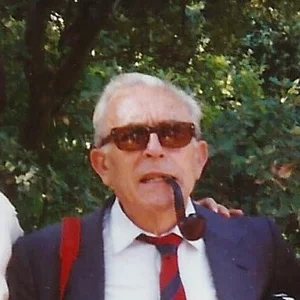

Jacques Faizant (1918-2006) was a French press cartoonist and political caricaturist. Long featured on the front page of *Le Figaro*, he is famous for his chatty little old ladies and his depictions of Marianne symbolizing the Republic.
Jacques Faizant(1918 — 2006)
Jacques Faizant
France
5 min read
Frequently asked questions
Key Facts
- Born in 1918 in Laroquebrou (Cantal), died in 2006 in Suresnes
- Published his cartoons on the front page of *Le Figaro* starting in 1967 for nearly forty years
- Made famous the recurring characters of the “little old ladies” commenting on current events
- Regularly depicted Marianne to embody France and the Republic
- Also the author of novels and humorous stories
Works & Achievements
Front-page drawing in *Le Figaro* upon the death of De Gaulle, an image of mourning that became an emblem of French press cartooning.
A series of recurring characters commenting on current events, Faizant's trademark and a tender mirror of popular opinion.
A news sketch published every day on the front page for more than thirty years, an exceptional run in the press.
A humorous novel showcasing Faizant's talent as a writer, alongside his work as a cartoonist.
Collections gathering his press cartoons, which extended his work and brought it to a wider audience.
Anecdotes
Jacques Faizant is best known for his “little old ladies,” two chatty elderly women who commented on political current events with mischief. These recurring characters allowed him to speak sharp truths about the powerful while keeping a tender, down-to-earth tone.
When General de Gaulle died in November 1970, Faizant drew on the front page of *Le Figaro* a distraught Marianne in tears, her head resting against a pillar. This caption-less drawing, of great restraint, deeply moved readers and remains one of the most famous images in French press cartooning.
Faizant published a daily cartoon on the front page of *Le Figaro* for more than thirty years, an exceptional longevity for a press cartoonist. Every morning, hundreds of thousands of readers first discovered his sketch before even reading the articles.
Before becoming a cartoonist, Jacques Faizant was also a passionate aviator and a writer: he published several novels and stories, including humorous works that met with success. Drawing was not his only talent, but it was through it that he became a familiar figure to the French.
Faizant often worked under pressure: he had to react to the day's news and deliver his drawing in time for the paper's deadline. This daily constraint required both a solid grounding in politics and an ability to find the right idea in just a few hours.
Primary Sources
A weeping Marianne, with no caption, published the day after the announcement of Charles de Gaulle's death, which became an iconic image of national mourning.
Annual volumes gathering the drawings that appeared in Le Figaro, featuring the “little old ladies” and French political life.
A humorous literary work showing that Faizant was also a writer, both before and during his career as a cartoonist.
Key Places
Village in the Cantal region where Jacques Faizant was born in 1918. His rural roots fed his fondness for ordinary, working-class figures.
A major national daily newspaper for which Faizant drew the front-page cartoon for more than thirty years. This is where he made his name.
The capital where French press and political life were concentrated, at the heart of Faizant's daily work.
A town in the Ardèche where Jacques Faizant died in 2006. He spent his final years there.
Typical Objects

The press cartoonist's basic tools, allowing a clean, expressive line that reproduces well in print. Faizant wielded the pen with great economy of means.

The work surface on which the cartoonist composed his daily sketches. It stood at the centre of his studio.

The front page of the daily newspaper where his topical cartoon appeared every day. This rare placement gave his work national visibility.

The personification of the French Republic, which Faizant frequently drew to embody the nation in the face of events. His weeping Marianne remains famous.

Recurring characters in his cartoons, two chatty elderly women commenting on politics. They were the mischievous mouthpiece of popular common sense.

A printed collection gathering his cartoons published over the year. These books extended the fleeting life of the daily press cartoon.
School Curriculum
Vocabulary & Tags
Key Vocabulary
Daily Life
Morning
Faizant's morning was paced by the news: he read the papers, listened to the news, and searched for the idea that would become his cartoon of the day. He had to react quickly to whatever political event had just broken.
Afternoon
The afternoon was devoted to working on the drawing board: sketches, then finishing in pen and ink. The pressure of the paper's deadline imposed a steady, disciplined rhythm.
Evening
In the evening, the cartoon had to be delivered in time for printing. Faizant could then step away from the burning news of the day, before starting again the next morning with a fresh subject.
Food
A man of the 20th century attached to his rural roots in the Cantal, he enjoyed traditional French cooking. His diet was that of a Frenchman of his time, without any particular eccentricity.
Clothing
Faizant wore the ordinary city attire of a mid-20th-century Parisian press man: suit, shirt, and tie — plain clothes suited to his profession.
Housing
His professional life unfolded in Paris, close to the newsrooms; he divided his existence between the capital and the provinces, notably the Ardèche, where he ended his days.
Historical Timeline
Period Vocabulary
Liens externes & ressources
Références
Œuvres
La Marianne en larmes
1970
Les « petites vieilles »
années 1960-2000
Dessin quotidien de une du Figaro
1965-2006
Ni d'Ève ni d'Adam
1957
Albums annuels de dessins
années 1970-1990