
A warrior goddess of Hinduism, Durga embodies Shakti, the divine feminine energy and protective force of the universe. Venerated in the Hindu tradition since the Vedic era, she is the great goddess (Mahadevi) who vanquishes the forces of evil.
Frequently asked questions
Famous Quotes
« "I am the force that keeps the universe in balance" — words attributed to Durga by the Devi Mahatmya tradition»
« "Where no god can prevail, I am the one who is called" — traditional saying from the Puranic narratives»
Key Facts
- Durga appears in Vedic hymns (Rigveda, c. 1500–1200 BCE) in related forms, but her central myth is established in the Devi Mahatmya (c. 4th–6th century CE)
- According to Hindu oral and written tradition, she was born from the combined wrath of all the gods to defeat the buffalo demon Mahishasura, whom no male god could vanquish
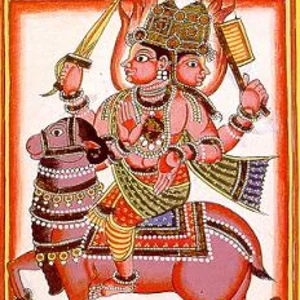
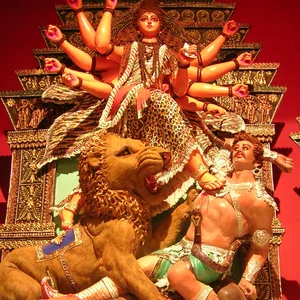
- She is depicted with ten arms, riding a lion or tiger, bearing weapons gifted to her by each god of the tradition
- The festival of Durga Puja, celebrated each autumn (particularly in Bengal), is one of the major Hindu festivals still widely observed today
- She is associated with many forms of the great goddess — Kali, Parvati, Ambika — understood in the Shakta tradition as expressions of a single universal feminine energy
Works & Achievements
A foundational text of 700 verses embedded in the Markandeya Purana, it recounts Durga's exploits in defeating the demons Mahishasura, Shumbha, and Nishumbha. It is the central scripture of the Shakta tradition, recited daily in temples around the world.
A Vedic hymn in which the primordial goddess affirms her cosmic identity in the first person. It is the earliest text in Indian literature in which a female deity claims absolute and universal power.
One of the eighteen Mahapuranas, this vast text places the Goddess (Devi/Durga) at the pinnacle of the divine hierarchy, above even Brahma, Vishnu, and Shiva. It forms the theological cornerstone of Shakta Shaivism.
A compilation of seven hundred verses drawn from the Devi Mahatmya, recited during the nine days of Navaratri. This oral tradition, passed down in temples for centuries, remains alive and is practiced daily.
A hymn of twenty-one stanzas celebrating Durga's victory over the buffalo demon Mahishasura. This Sanskrit poem, remarkable for its rhythmic beauty, is sung every morning in many Hindu households.
The corpus of sculptural representations of Durga slaying Mahishasura, ranging from the bas-reliefs of Mathura to the masterworks of the Chalukya and Pallava temples. These sculptures form the first monumental iconographic body of work dedicated to the goddess.
Anecdotes
Durga was born from the combined fury of all the gods of Hinduism. When the buffalo demon Mahishasura threatened to destroy the cosmos, no god could defeat him alone. They merged their energies to create an invincible warrior goddess, Durga, whose name means 'she who is difficult to reach.'
In the Devi Mahatmya, a foundational text from the 5th–6th century, Durga battles the demon Mahishasura for nine days and nine nights. This titanic struggle is commemorated each year by the festival of Navaratri ('nine nights'), one of the most important Hindu celebrations, still observed by hundreds of millions of people.
Durga is depicted with eight to eighteen arms, each holding a weapon given by a different god: Shiva's trident, Vishnu's discus, Indra's bow, Vayu's thunderbolt. This striking iconography symbolizes that she concentrates the divine power of the entire Hindu pantheon.
During the Durga Puja festival, celebrated in autumn especially in Bengal, enormous clay statues of the goddess are built, venerated for several days, and then immersed in a river or the sea. This living tradition dates back at least to the 16th century and today draws millions of devotees in Kolkata.
Durga rides a lion or tiger, a royal animal symbolizing controlled power. This iconographic detail is far from incidental: unlike the demons she fights, Durga masters raw animal force, signifying that divine wisdom transcends blind violence.
Primary Sources
Then all the gods, led by Indra, emitted from their bodies a blazing energy. This unified energy, radiant as a thousand suns, took the form of a woman who illuminated the three worlds.
The Great Goddess said: 'I am the primordial Shakti. I am the consciousness that pervades all things. It is by my will that Brahma creates, that Vishnu preserves, and that Shiva destroys.'
I am the queen, the bestower of treasures, she whom the gods worship. I spread through all the worlds and touch the sky with my crown.
Chanted during Navaratri rites, this compilation of seven hundred verses recounts Durga's three great victories over demonic forces, transmitted orally from master to disciple in temples.
Arjuna paid homage to Durga before the battle of Kurukshetra: 'O thousand-eyed goddess, warrior of the universe, grant me victory and protect me in this combat.'
Key Places
A holy city of Hinduism on the banks of the Ganges, Varanasi is home to important temples dedicated to Durga, including the Durga Temple (Monkey Temple). It is one of the great pilgrimage centers for devotees of the goddess.
The world capital of the Durga Puja festival, Kolkata transforms each autumn into a vast religious and artistic spectacle. Thousands of pandals (temporary structures) house statues of the goddess, drawing millions of pilgrims and tourists.
Perched atop Chamundi Hill, this temple is one of the oldest and most revered shrines to Durga (worshipped here as Chamundeshwari) in southern India. The city of Mysore takes its name from the demon Mahishasura, whom the goddess defeated at this mythic site.
A cave shrine nestled in the foothills of the Himalayas, Vaishno Devi is one of the most visited pilgrimage sites in India. Each year, millions of devotees come to venerate the goddess in her form as Shakti.
A major temple dedicated to Durga built in the 16th century, its architecture echoes that of the nearby Sikh Golden Temple. It stands as a testament to the enduring importance of Durga worship in northern India across the centuries.
Typical Objects

Durga's iconic weapon, gifted to her by Shiva, the trident symbolizes her mastery over the three planes of existence: creation, preservation, and destruction. It also represents her power to strike down evil forces with sovereign precision.

Given by Vishnu, the chakra is a rotating disc used as a thrown weapon. In Durga's hands, it symbolizes the cycle of time and her ability to cut through the illusion (maya) that blinds all beings.

A ritual instrument blown during Hindu ceremonies, the conch shell announces the divine presence and drives away evil spirits. Durga holds it in one of her many hands as a sign of her celestial nature.

A symbol of purity and divine beauty rising from the mud, the lotus is a reminder that Durga, despite her warrior nature, also embodies grace and compassion. Its red color evokes vital energy and fertility.

Close-combat weapons that Durga wields in her battles against demons. They symbolize her role as protector: she defends the cosmic order (dharma) against any force that seeks to destroy it.

A sacred vessel filled with water, mango leaves, and a coconut, placed before Durga's statue during rites. It represents the abundance and divine blessings poured upon the faithful.
School Curriculum
Vocabulary & Tags
Key Vocabulary
Tags
Daily Life
Morning
In Hindu cosmology, Durga is an eternal deity who never sleeps: at sunrise, priests ritually awaken her by blowing into a conch shell and waving oil lamps (aarti) before her image. The early hours are devoted to the ritual bathing of the statue, which is then dressed in fresh silks and adorned with lotus flowers and marigolds.
Afternoon
In the afternoon, the temple resounds with Brahmin recitations of the Devi Mahatmya. Pilgrims lay offerings of fruit, red flowers, and coconuts. During Navaratri, ritual dances (Garba, Dandiya) are held in temple courtyards, celebrating the goddess's warrior energy.
Evening
Sunset marks the most solemn moment of worship: the evening aarti, a grand ceremony of light in which dozens of lamps are rotated before the statue in a circular motion, to the sound of drums and bells. Devotees remain in meditation, silently reciting the names of the goddess (mantra-japa).
Food
As a warrior goddess, Durga accepts non-vegetarian offerings in certain traditions — goats sacrificed during major festivals — unlike vegetarian deities such as Vishnu. However, everyday offerings consist of sweet fruits (bananas, coconuts), confections (kheer, laddu), and flowers. The blood of ritual sacrifices symbolizes the gift of vital life force to the goddess.
Clothing
Durga is depicted wearing a sari of bright red or saffron silk, the color of energy, fire, and fertility. She wears a crown adorned with a crescent moon, heavy gold necklaces, bracelets on each arm, and earrings. Her ten arms are covered in gold armlets, emphasizing her nature as both royalty and warrior.
Housing
Durga dwells in wild, inaccessible regions — the peaks of the Himalayas, deep forests, the banks of sacred rivers — reflecting her transcendent nature and the difficulty of approaching her (the very meaning of her name). Her temples (mandirs) are built on hilltops or at cosmic crossroads, often within natural caves symbolizing the womb of the earth mother.
Historical Timeline
Period Vocabulary
Visual Style
Style inspiré de l'art sacré indien classique (dynasties Gupta et Pallava) : déesse aux multiples bras vêtue de rouge et d'or, montant un lion, baignée d'une lumière divine sur fond de ciel de mousson. Palette chaude et intense aux tons de safran, vermillon et or.
Sound Ambience
Atmosphère sonore d'un temple hindou lors d'une cérémonie en l'honneur de Durga : tambours rituels, conques, récitations sanskrites et cloches sacrées. Un fond de tonnerre évoque la puissance cosmique de la déesse guerrière.
Liens externes & ressources
Références
Œuvres
Devi Mahatmya (Gloire de la Déesse)
Ve–VIe siècle apr. J.-C.
Devi Sukta (Rigveda X.125)
c. 1200 av. J.-C.
Devi Bhagavata Purana
IXe–XIIe siècle apr. J.-C.
Durga Saptashati (récitation rituelle)
Tradition codifiée entre le IVe et VIe siècle
Mahishasura Mardini Stotra
c. VIIIe siècle apr. J.-C., attribué à Shankaracharya
Iconographie sculptée de Durga Mahishasuramardini
IIe–VIIe siècle apr. J.-C.