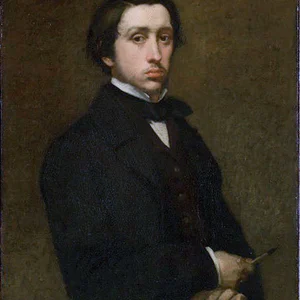

French painter and sculptor (1834–1917), Degas is one of the founders of Impressionism. He is celebrated for his depictions of dancers at the Paris Opera and scenes of modern life.
Edgar Degas(1834 — 1917)
Edgar Degas
France
8 min read
Frequently asked questions
Famous Quotes
« Art is not what you see, but what you make others see.»
« One must have a high idea, not of what one does, but of what one may do one day.»
Key Facts
- Born in Paris in 1834, died in 1917
- Participated in seven of the eight Impressionist exhibitions between 1874 and 1886
- Created more than 1,500 works depicting dancers
- Developed pastel as a major medium from the 1880s onward
- Sculptor of the celebrated Little Dancer Aged Fourteen (1881)
Works & Achievements
Oil on canvas (Musée d'Orsay, Paris). This iconic work shows a dance lesson led by the master Jules Perrot. It illustrates Degas's ability to capture fleeting moments and the everyday life of a group in an enclosed space.
Oil on canvas (Musée d'Orsay, Paris). This painting depicts two silent figures — the actress Ellen Andrée and the painter Marcellin Desboutin — seated at the Café de la Nouvelle-Athènes. Considered a masterpiece of social realism, it was sharply criticized for its supposedly degrading portrayal when exhibited in London.
Wax sculpture (original held at the National Gallery of Art, Washington), with numerous posthumous bronze casts. Displayed with a real tutu, real hair, and a real ribbon, it caused a scandal at the 6th Impressionist exhibition. It is the only sculpture exhibited by Degas during his lifetime.
Oil on canvas (Musée des Beaux-Arts de Pau). Painted during a family stay in Louisiana, this work depicts members of his family in their cotton trading office. It was the first work by Degas to be acquired by a museum during his lifetime.
Oil on canvas (Musée d'Orsay, Paris). Two laundresses, one yawning from exhaustion, the other still at work. This painting reflects Degas's interest in the trades of modernity and the working conditions of women in late nineteenth-century Paris.
A series of pastels presented at the 8th and final Impressionist exhibition (1886). These nudes of women seen from behind or in profile, in intimate everyday poses, revolutionized the representation of the female body by depicting it in its genuine privacy rather than for the viewer's gaze.
Anecdotes
Edgar Degas suffered from an eye disease that began affecting him in the 1870s. As his sight progressively deteriorated, he was forced to abandon oil painting in favor of pastel with its broader strokes, then sculpture, which he could work by touch. By the end of his life, he wandered nearly blind through the streets of Paris.
Passionate about dance, Degas obtained permanent access to the backstage areas and rehearsal rooms of the Paris Opéra. He spent years observing the dancers during rehearsals, sketchbook in hand, sometimes for hours at a time, before returning to his studio to work from memory. Contrary to the romantic legend, he rarely depicted the dancers in the full light of the stage, but rather in the exhausting intimacy of rehearsal.
In 1881, Degas exhibited at the sixth Impressionist exhibition a life-size wax sculpture: the *Little Dancer Aged Fourteen*. She wore a real gauze tutu, real hair, and a real ribbon. The scandal was immediate: critics called her a 'gutter flower.' Today cast in bronze in numerous copies, she is one of the most celebrated sculptures of the nineteenth century.
In 1894, the Dreyfus Affair permanently shattered his circle of friends. A fervent anti-Dreyfusard, Degas broke with Camille Pissarro and his lifelong friend Ludovic Halévy. This episode reveals the darker side of the painter, renowned for his caustic temperament and uncompromising opinions, who spent his final years in near-total isolation.
Degas was one of the first artists to use photography as a working tool. In the years 1895–1896, he himself took numerous photographs — portraits of friends in artificial light, nude studies — not to exhibit them, but to study the effects of light and the poses he would then transpose into his pastels.
Primary Sources
"One must have a high idea of art. We owe it to ourselves to have concerns that go beyond mere craft."
"I am grinding away like a cab horse. I work from morning to night, alone, and my eyesight gives me serious cause for concern."
"Sculpture is decidedly a very difficult thing to do, and one is very little capable of it. Once you start touching it, you cannot get out of it."
"He often told us: drawing is not form, it is the way of seeing form."
Key Places
Edgar Degas was born on July 19, 1834, in this building in the 9th arrondissement of Paris. He spent nearly his entire life in Paris, becoming one of its most attentive chroniclers of modernity.
Degas enjoyed permanent access to the backstage areas and rehearsal rooms of the Paris Opéra. This venue was his primary source of inspiration for more than thirty years, giving rise to several hundred works on the theme of dance.
From 1856 to 1860, Degas spent extended periods in Italy, training himself by copying the Old Masters in museums and churches. This formative stay cemented his taste for classical draughtsmanship and rigorous composition.
In 1872–1873, Degas stayed with his maternal family in Louisiana. There he painted *The Cotton Office in New Orleans* (1873), one of the few works acquired by a museum during his lifetime.
Degas was a regular visitor to Parisian racecourses, where he studied horses and jockeys. These racing scenes form a second major theme in his work, alongside his ballet dancers.
Typical Objects

Degas adopted pastel as his primary medium from the 1870s onward, as his failing eyesight allowed him to work with broad strokes and intense color without the constraints of oil painting. His pastel works depicting dancers are among the most celebrated in the history of art.

Degas filled sketchbooks with rapid drawings made while observing at the Opéra, racetracks, and cafés. His notebooks, preserved at the Bibliothèque nationale de France, bear witness to his tireless work of observation and his memorization of poses and movements.

Degas obtained permanent access to the wings and rehearsal rooms of the Opéra, allowing him to observe the dancers in their daily working lives. This rare privilege inspired several hundred works on the theme of dance.

Degas sculpted in colored wax to study volumes and movements in three dimensions. Wax allowed him to correct and reshape endlessly; most of his sculptures were only cast in bronze after his death.

In 1895–1896, Degas used a camera to capture poses and study the effects of artificial light. These photographs, never intended for sale, reveal his interest in new tools for representing movement.

Degas regularly attended the Opéra as a spectator and used opera glasses to observe details of costumes, expressions, and the gestures of dancers from the auditorium. This viewpoint is often reflected in his compositions, rendered from high or low angles.
School Curriculum
Vocabulary & Tags
Key Vocabulary
Daily Life
Morning
Degas rose early and devoted his mornings to drawing and painting in his studio in the 9th arrondissement (rue Victor-Massé until 1912, then boulevard de Clichy). He most often worked from memory rather than from life, drawing on the sketches he had accumulated during his observation outings.
Afternoon
In the afternoons, he frequently visited the Opéra to observe ballet rehearsals, sketchbook in hand, or went to the Longchamp and Auteuil racetracks to sketch horses and jockeys. He also visited museums to study the Old Masters, particularly at the Louvre.
Evening
In the evenings, Degas was a regular at dinners held by Parisian collectors and patrons, notably at the home of Henri Rouart and the Halévys. He also frequented the cafés of the Nouvelle-Athènes neighborhood in Pigalle, a gathering place for the artists and writers of his era.
Food
Born into the Parisian upper bourgeoisie, Degas appreciated fine French cuisine and attended dinners at his collector friends' homes. He was never part of the bohemian artists living in poverty, even though the family fortune declined after his father's death in 1874.
Clothing
Degas dressed as a distinguished Parisian bourgeois: dark suit, top hat, and cane — an appearance befitting his social milieu. His contemporaries described him as well-groomed, sometimes stiff in his dress, in striking contrast to the freedom of his pictorial compositions.
Housing
Degas spent his entire life in the 9th arrondissement of Paris, close to the Opéra and the artistic community of Nouvelle-Athènes. His studio on rue Victor-Massé, where he worked from 1889 to 1912, was cluttered with canvases, sculptures in progress, and an important collection of works by his contemporaries (Gauguin, Pissarro, Cézanne, Ingres).
Historical Timeline
Period Vocabulary
Liens externes & ressources
Références
Œuvres
La Classe de danse
1874
Les Repasseuses
1884–1886
Série de nus (Femmes à leur toilette)
1884–1886