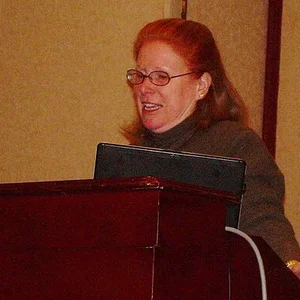

First woman to earn an electrical engineering degree from MIT (1919) and the first professionally employed female electrical engineer in the United States. She invented the Clarke graphical calculator, which greatly simplified electrical power transmission calculations.
Edith Clarke(1883 — 1959)
Edith Clarke
États-Unis
8 min read
Frequently asked questions
Key Facts
- 1919: first woman to earn an electrical engineering degree from MIT
- 1921: invents the Clarke graphical calculator, patented in 1925
- 1922: first woman professionally employed as an electrical engineer in the United States, at General Electric
- 1947: first woman elected Fellow of the AIEE (American Institute of Electrical Engineers)
- 1956: receives the Achievement Award from the Society of Women Engineers
Works & Achievements
A celluloid graphical instrument for rapidly calculating the impedance, reactance, and resistance of electrical transmission lines. Widely adopted in industry, it represents her major technical contribution.
A landmark paper presented to the AIEE, the first text by a woman read in an official session before that institute. It established methods for calculating the stability of power transmission networks that remained in use for decades.
A paper in the AIEE Transactions developing simplified methods for analyzing complex three-phase circuits, a practical tool for power system engineers.
A reference textbook published by Wiley, synthesizing the analysis of alternating-current power systems. Adopted as a university textbook in many American engineering schools.
The second volume completing the first, covering symmetrical components and network faults. A major reference work for electrical power engineers throughout the second half of the twentieth century.
Anecdotes
After earning her degree from MIT in 1919 — the first woman to receive an electrical engineering degree there — Edith Clarke did not immediately find a position as an engineer. General Electric offered her… a job as a human “computer,” meaning a manual calculator. She accepted, patiently waiting for the opportunity to prove her true abilities.
In 1921, Clarke invented a graphical calculator that could solve equations about electrical lines in a matter of minutes — calculations that had previously taken hours by hand. She submitted the paper to the American Institute of Electrical Engineers, but it was initially rejected for publication… because she was a woman. It was not published until 1923.
Clarke filed the patent for her graphical calculator in 1921 and received it in 1925. The tool greatly simplified the calculation of impedance and reactance in electrical transmission lines, and was widely adopted by engineers in the American electrical industry for several decades.
In 1926, Edith Clarke became the first woman to deliver a paper before the American Institute of Electrical Engineers (AIEE) at an official conference. Her presentation focused on the stability of electrical transmission systems, a topic then crucial to the expansion of the American national power grid.
At 58, following her retirement from General Electric in 1945, Clarke embarked on a second career as a professor of electrical engineering at the University of Texas at Austin. In 1954, she received the Achievement Award from the Society of Women Engineers, honoring her entire pioneering career.
Primary Sources
A calculating device for use in determining electrical characteristics of alternating current circuits, comprising a chart having a plurality of curves representing different values of certain circuit constants.
The purpose of this paper is to derive formulas applicable to the steady-state stability of transmission systems and to present them in a form convenient for engineering use.
This book is intended as a reference and textbook for engineers engaged in the design and operation of electric power systems, as well as for graduate students in electrical engineering.
The methods of symmetrical components are applied to the analysis of unbalanced conditions in three-phase systems, with particular attention to practical engineering problems.
Miss Clarke joined the General Electric Company in 1922 as its first female professional engineer. During her career at GE she contributed substantially to the analysis of power systems and authored two major volumes on circuit analysis.
Key Places
Birthplace of Edith Clarke, born on February 10, 1883. An industrial Maryland town shaped by the rise of railroads and manufacturing in the 19th century.
Leading engineering school where Clarke earned her electrical engineering degree in 1919, becoming the first woman to complete that program there.
GE's main industrial site where Clarke worked from 1922 to 1945 as a research engineer, developing her methods for analyzing electrical power systems.
Prestigious women's college where Clarke earned her degree in mathematics and astronomy in 1908, the starting point of her scientific career.
Institution where Clarke taught electrical engineering from 1948 to 1956, passing on her expertise to new generations of engineers after her retirement from GE.
Typical Objects

A celluloid tool designed by Edith Clarke in 1921, capable of solving impedance and reactance equations for electrical transmission lines in just a few minutes. It replaced hours of manual computation.

The universal analog calculation instrument used by engineers in the early 20th century. Clarke relied on it before inventing her own specialized graphical calculator.

A large tilting desk on which engineers drafted circuit diagrams and electrical line schematics. It was the centerpiece of Clarke's workspace at GE in Schenectady.

An instrument that emerged in the 1920s for visualizing alternating current waveforms. Clarke used it in her research on the stability of transmission networks.

Printed books of logarithmic tables, essential before electronic calculators for performing the complex multiplications and divisions required in electrical engineering calculations.

A central component in Clarke's research on high-voltage power transmission. She studied transformer properties and behavior under overload conditions and short circuits.

The medium on which Clarke plotted her graphical curves characterizing electrical lines. The use of graphs was central to her simplified calculation method.
School Curriculum
Vocabulary & Tags
Key Vocabulary
Tags
Daily Life
Morning
Clarke arrives early at GE's laboratories in Schenectady, dressed in a strict dark suit — the attire imposed on the rare women engineers who wanted to be taken seriously. She begins by reviewing the results of the previous day's calculations and planning the day's simulations on transmission lines.
Afternoon
She spends her afternoons at her drafting table, plotting curves on graph paper and solving complex equations with the help of her graphical calculator and slide rule. She collaborates with her male colleagues, often the only ones to recognize the value of her innovative methods.
Evening
In the evenings, Clarke writes her technical papers or works on formatting her results for publication in the AIEE Transactions. A lifelong single woman, she devotes much of her leisure time to scientific reading and correspondence with other researchers.
Food
Typical diet of the American professional middle class of the 1920s–1940s: hearty breakfasts (eggs, white bread, coffee), lunches taken in the GE factory canteen with her fellow engineers, simple dinners at her home in Schenectady.
Clothing
Clarke invariably wears mid-length dark wool skirt suits (black, grey, or navy), a white blouse with a closed collar, and plain low-heeled shoes. This formal, austere dress is a deliberate choice to assert herself in an exclusively male environment and be judged on her competence.
Housing
Clarke lives in a modest apartment or house in Schenectady, near the GE factories. Single and financially independent, she maintains a personal workspace stocked with technical books, scientific journals, and calculation materials — a reflection of a woman entirely devoted to her career.
Historical Timeline
Period Vocabulary
Visual Style
Esthétique industrielle américaine du début du XXe siècle : grandes salles de dessin technique en brique et acier, lumière naturelle sur des tables à dessin en bois, instruments en laiton et bakélite, plans électriques au mur.
Sound Ambience
L'ambiance sonore du laboratoire de recherche de GE à Schenectady dans les années 1920-1940 : bourdonnement des générateurs, cliquetis des instruments de calcul mécaniques et rumeur des machines industrielles en arrière-plan.
Liens externes & ressources
Références
Œuvres
Calculatrice graphique Clarke (Clarke Calculator)
1921 (brevet 1925)
Steady-State Stability in Transmission Systems
1926
Three-Phase Multiple-Conductor Circuits
1932
Circuit Analysis of A-C Power Systems, Volume I
1943
Circuit Analysis of A-C Power Systems, Volume II
1950