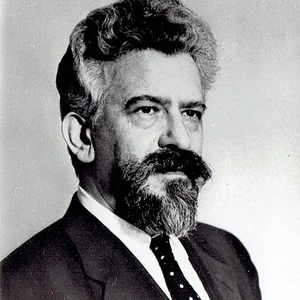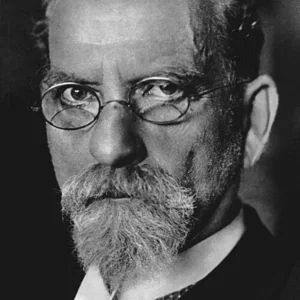

Edmund Husserl (1859-1938) was a German philosopher and mathematician, the founder of phenomenology. His thought profoundly shaped twentieth-century continental philosophy, influencing Heidegger, Sartre, and Merleau-Ponty.
Edmund Husserl(1859 — 1938)
Edmund Husserl
empire d'Autriche, Reich allemand
6 min read
Frequently asked questions
Famous Quotes
« All consciousness is consciousness of something.»
Key Facts
- Born in 1859 in Proßnitz, Moravia (Austrian Empire)
- Publishes the 'Logical Investigations' (1900-1901), the founding work of phenomenology
- Publishes 'Ideas for a Pure Phenomenology' (1913), setting out the phenomenological reduction
- Professor at the University of Freiburg im Breisgau from 1916, where Heidegger was his assistant
- Dies in 1938 in Freiburg, removed from the university because of his Jewish origins under the Nazi regime
Works & Achievements
Husserl's first major book, still close to mathematics, in which he analyzes the origin of the concept of number.
The founding work of phenomenology, which criticizes psychologism and launches the rallying cry “To the things themselves!”.
A manifesto-like article in which Husserl defends the idea that philosophy can attain a rigor comparable to that of the sciences.
A systematic account of the phenomenological method, featuring the notions of epoché (bracketing) and reduction.
Drawn from his Sorbonne lectures, this text presents transcendental phenomenology and the question of others (intersubjectivity).
His last great work, in which Husserl introduces the notion of the “life-world” (Lebenswelt) and voices his concern about the crisis of European culture.
Anecdotes
Before becoming a philosopher, Husserl was a brilliant mathematician: he defended a thesis on the calculus of variations in Vienna in 1883. It was while attending the lectures of the philosopher Franz Brentano that he shifted toward philosophy, fascinated by the question of how our mind grasps numbers and truths.
Husserl had a habit of thinking through writing: he left behind some 40,000 pages of notes written in shorthand (a fast form of writing based on abbreviated signs). After his death, a young Belgian Franciscan, Herman Van Breda, managed to save these manuscripts from the Nazi regime by smuggling them into Belgium, where they founded the Husserl Archives in Leuven.
Husserl was of Jewish origin and had converted to Protestantism in 1886. This did not protect him from Nazism: in 1933, the antisemitic laws stripped him of his rights as professor emeritus at the University of Freiburg. His former student Martin Heidegger, who had become rector and a member of the Nazi party, offered him no support, which deeply wounded Husserl.
Husserl summed up his method with a famous watchword: “Zu den Sachen selbst!” (“To the things themselves!”). He urged people to describe what they truly perceive, setting aside our prejudices and theories, as if looking at the world for the first time.
At the end of his life, ill and isolated, Husserl wrote that his mission as a philosopher was not finished and that he would have wished to “die worthy of philosophy.” When he died in 1938, almost no German academic dared attend his funeral, for fear of the regime.
Primary Sources
We want to go back to the “things themselves.” It is from fully developed intuitions that we want to derive the evidence that what is given here, in actual abstractions, truly and genuinely corresponds to the meanings of the words.
Every lived experience of consciousness is consciousness of something; consciousness is always consciousness of.
The life-world (Lebenswelt) is the forgotten ground of all the sciences, the world as it is given to us in everyday experience, prior to any scholarly idealization.
One must lose the world through the epoché in order to regain it through a universal self-examination.
Key Places
Husserl's birthplace, then part of the Austrian Empire, today in the Czech Republic.
Husserl earned his doctorate in mathematics here and discovered philosophy through the lectures of Franz Brentano.
Husserl taught here from 1901 to 1916 and wrote his *Ideas*; a circle of students formed around him.
Husserl was a professor here from 1916 until his retirement and spent the end of his life here; this is where he died in 1938.
In 1929, Husserl delivered the lectures here that became the foundation of his *Cartesian Meditations*, marking his influence in France.
Husserl's first teaching post (1887), where he began to develop his thinking on logic.
Typical Objects

Husserl wrote down most of his thinking in Gabelsberger shorthand, a fast script using abbreviated signs. He left behind nearly 40,000 pages of these handwritten notes.

The everyday writing tools of a German academic of the period, used to compose lectures and manuscripts.

The desk where Husserl wrote for hours on end, surrounded by his books and manuscripts, the central place of his work as a thinker.

Husserl wore small round-rimmed glasses, typical of German intellectuals of the late nineteenth and early twentieth centuries.

Before philosophy, Husserl worked on arithmetic and calculation; his earliest works dealt with the philosophy of numbers.

Husserl taught for decades in German universities, passing on his method to many students from the lectern.
School Curriculum
Vocabulary & Tags
Key Vocabulary
Daily Life
Morning
Husserl rose early and devoted his mornings to intellectual work, the time when he felt most clear-headed. He would settle at his desk to write, filling entire pages with shorthand as his meditations unfolded.
Afternoon
The afternoon was often reserved for teaching at the university or preparing his lectures. Husserl also received students and disciples with whom he discussed phenomenology passionately.
Evening
In the evening, Husserl continued his reading and reflection, or talked with his family and close friends. He liked to go back over the day's notes to deepen them.
Food
Husserl led the modest life of a late-19th-century German professor, with simple Central European cooking: bread, soups, meats and vegetables. Meals held little importance in a life devoted to study.
Clothing
He dressed with the plainness of a scholar of his time: a dark suit, a collared shirt, a tie or bow tie, and small round glasses. His neatly trimmed beard and moustache were typical of German scholars of the period.
Housing
Husserl lived in comfortable middle-class lodgings in the university towns where he taught, notably in Göttingen and then Freiburg. His home held a vast library and a study where his manuscripts piled up.
Historical Timeline
Period Vocabulary
Liens externes & ressources
Références
Œuvres
Philosophie de l'arithmétique
1891
Recherches logiques
1900-1901
La philosophie comme science rigoureuse
1911
Idées directrices pour une phénoménologie (Ideen I)
1913
Méditations cartésiennes
1931
La crise des sciences européennes et la phénoménologie transcendantale
1936