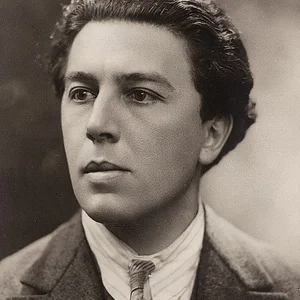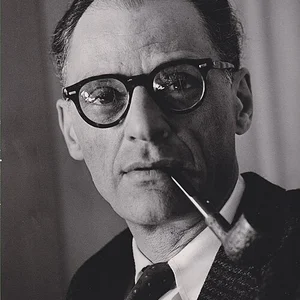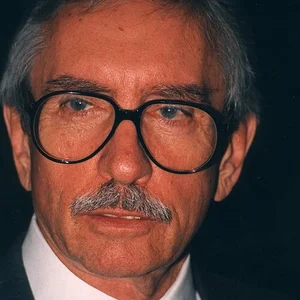

Major American playwright of the 20th century, a leading figure of the theatre of the absurd in the United States. He made his mark in 1962 with *Who's Afraid of Virginia Woolf?* and won the Pulitzer Prize for Drama three times.
Edward Albee(1928 — 2016)
Edward Albee
États-Unis
6 min read
Frequently asked questions
Key Facts
- Born in 1928 in Washington, adopted by a wealthy New York family
- 1959: first success with the one-act play *The Zoo Story*
- 1962: triumph of *Who's Afraid of Virginia Woolf?*, adapted into a film in 1966 with Elizabeth Taylor and Richard Burton
- Winner of three Pulitzer Prizes for Drama (1967, 1975, 1994)
- Died in 2016 in Montauk (New York State)
Works & Achievements
A one-act play that pits two men against each other on a Central Park bench. Albee's first success, it established him as a fresh new voice in American theater.
A scathing satire of the American family and its hollow ideals, written in the vein of the Theater of the Absurd.
His masterpiece: a night of ferocious verbal sparring between an academic couple and their guests. A Broadway triumph, adapted for the screen in 1966.
A family drama about fear and the bonds of blood that earned him his first **Pulitzer Prize** in 1967.
A play in which a human couple meets two lizard creatures emerging from the ocean on a beach; his second **Pulitzer Prize**.
A portrait of an elderly woman at three stages of her life, inspired by his adoptive mother; his third **Pulitzer Prize**, marking his great comeback.
A provocative tragedy about the limits of love and tolerance, awarded the **Tony Award** for Best Play.
Anecdotes
Edward Albee was adopted at just eighteen days old by an immensely wealthy couple: his adoptive grandfather, **Edward Franklin Albee II**, owned one of the largest vaudeville theater empires in the United States. The young Edward was given his name but grew up in conflict with his family, especially with his authoritarian and distant adoptive mother, **Frances**.
His first play, *The Zoo Story*, written for his thirtieth birthday, initially failed to find a single venue in New York. It was finally in Berlin, in **1959**, that it premiered — in German! — before returning to triumph off-Broadway. A career that began in reverse, traveling from Europe to America.
In **1963**, the Pulitzer Prize jury recommended *Who's Afraid of Virginia Woolf?* for the drama prize, but the advisory board refused, deeming the play too raw and shocking. As a result, no Pulitzer for drama was awarded that year, and two jurors resigned in protest. Albee would go on to win three of them later in his career.
The enigmatic title *Who's Afraid of Virginia Woolf?* is said to have come from a piece of graffiti: Albee recounted seeing the phrase written in soap on the mirror of a Greenwich Village bar. It is a play on the Disney song “Who's Afraid of the Big Bad Wolf?,” in which the “wolf” becomes the famous writer **Virginia Woolf**.
Before finding success, Albee worked a string of odd jobs in New York, including a stint as a messenger for the **Western Union** telegram company. These bohemian years in Greenwich Village, among penniless artists, would feed his sharp eye for the illusions and pretenses of American society.
Primary Sources
GEORGE (singing very softly): Who's afraid of Virginia Woolf... MARTHA: I... am... George... I... am.
I've been to the zoo. (Peter does not react) I said, I've been to the zoo. MISTER, I'VE BEEN TO THE ZOO!
The Theatre of the Absurd is an absorption-in-art of certain existentialist and post-existentialist philosophical concepts having to do, in the main, with man's attempts to make sense for himself out of his senseless position in a world which makes no sense.
Key Places
Edward Albee's birthplace in 1928, before his adoption by the Albee family.
An affluent Westchester County suburb where Albee grew up in the large family home, surrounded by nannies and tutors and beset by tensions with his adoptive mother.
A bohemian Manhattan neighborhood where the young Albee lived on odd jobs and mingled with the artistic scene of the 1950s, the breeding ground for his first plays.
The theater where *The Zoo Story* had its world premiere in 1959, in German, launching Albee's career from Europe.
The heart of American theater, where *Who's Afraid of Virginia Woolf?* triumphed in 1962 and established Albee as a major playwright.
The eastern tip of Long Island where Albee owned a house and ran the foundation that hosted artists; he died there in 2016.
Typical Objects

The playwright's daily working tool, on which he typed his dialogue. Albee tirelessly reworked his lines to sharpen their rhythm and their cruelty.

A typed manuscript of a play, the working document of directors and actors. Covered in annotations, it evolves from the read-through table all the way to the stage.

A booklet handed to theatergoers listing the cast, the author, and the director. It is also a keepsake for theater enthusiasts.

A brief message transmitted by wire and delivered to the door by a messenger — a job Albee himself held before fame. A symbol of mid-twentieth-century America's fast communication.

An ever-present prop in *Who's Afraid of Virginia Woolf?*, where the characters drink all night long. On stage, it becomes the symbol of the couple's illusions and self-destruction.

A prestigious American literary award, which Albee won three times for drama. It honors a major work and cements an author's recognition.
School Curriculum
Vocabulary & Tags
Key Vocabulary
Tags
Daily Life
Morning
Albee often devoted his mornings to writing, the time when he composed and reworked his dialogue. A heavy smoker, he loved quiet so he could let the music of his lines resonate within him before setting them down on paper.
Afternoon
The afternoon might be given over to rehearsals, where he assisted directors and actors, demanding precision in rhythm and intonation. A passionate art lover, he also visited galleries and studios to enrich his vast collection.
Evening
The evening drew him back to the theater, which he watched from the auditorium or the wings. Opening nights and New York soirées blended socializing, artistic debate, and encounters with fellow writers.
Food
His table reflected twentieth-century American urban life: restaurant meals, New York dinners, and alcohol often present at the gatherings of the theatrical world — a milieu he portrayed on stage with great lucidity.
Clothing
Albee wore elegant yet understated attire of the second half of the twentieth century: suits, shirts, and, later, turtlenecks — the look of a polished New York intellectual.
Housing
From his youthful apartment in Greenwich Village, he moved to a vast loft in lower Manhattan filled with modern and African art, and he owned a house in Montauk, on Long Island, where he welcomed artists.
Historical Timeline
Period Vocabulary
Liens externes & ressources
Références
Œuvres
The Zoo Story (Histoire du zoo)
1959
The American Dream (Le Rêve américain)
1961
Qui a peur de Virginia Woolf ? (Who's Afraid of Virginia Woolf?)
1962
A Delicate Balance (Délicate Balance)
1966
Seascape (Paysage marin)
1975
Three Tall Women (Trois femmes grandes)
1991
The Goat, or Who Is Sylvia? (La Chèvre)
2002