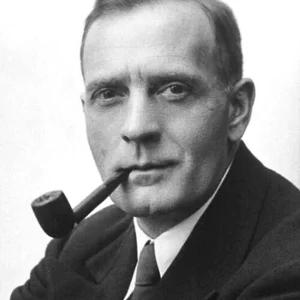

American astronomer (1889–1953), Edwin Hubble demonstrated that spiral nebulae are galaxies beyond the Milky Way. He established that the Universe is expanding, revolutionizing our understanding of the cosmos.
Edwin Hubble(1889 — 1953)
Edwin Hubble
États-Unis
7 min read
Frequently asked questions
Famous Quotes
« Equipped with his five senses, man explores the universe around him and calls the adventure Science.»
« The history of astronomy is a history of receding horizons.»
Key Facts
- 1924: demonstrates that the Andromeda Nebula is a galaxy distinct from the Milky Way, using Cepheid variable stars
- 1929: formulates Hubble's Law, establishing the relationship between the distance of galaxies and their recession velocity
- 1936: publishes *The Realm of the Nebulae*, a foundational work in observational cosmology
- Works at Mount Wilson (California) with the 100-inch Hooker Telescope, the largest of its era
- The Hubble Space Telescope, launched in 1990, is named in his honor
Works & Achievements
By identifying Cepheid variable stars in Andromeda, Hubble calculated a distance far beyond the boundaries of the Milky Way, proving that the nebula was in fact an independent galaxy and that the Universe is vastly larger than previously believed.
Hubble proposed a classification system for galaxies based on their shape (elliptical, lenticular, spiral, irregular), represented as a tuning-fork diagram, which is still used in astronomy today.
A landmark paper published in the Astrophysical Journal, in which Hubble demonstrates that spiral nebulae are independent galaxies, thereby defining the field of extragalactic astronomy.
The paper in which Hubble establishes the linear relationship between the distance of galaxies and their recession velocity — Hubble's Law — the first direct observational evidence for the expansion of the Universe.
A popular science book based on his Yale lectures, in which Hubble presents his discoveries about galaxies to a general audience. The book remains a classic of twentieth-century astronomical literature.
Anecdotes
Before dedicating himself to astronomy, Edwin Hubble had promised his dying father to study law. He did indeed earn a law degree at Oxford as a Rhodes Scholar (1910–1913), briefly practiced as a lawyer in Kentucky, then abandoned the bar for the stars, declaring that even a mediocre astronomer was worth more than a good lawyer.
In October 1923, Hubble pointed the 2.5-meter telescope at Mount Wilson toward the Andromeda Nebula. While examining his photographic plates, he recognized a Cepheid variable star. Measuring its pulsation period, he calculated that it lay approximately 900,000 light-years away — far beyond our Galaxy. Moved by the discovery, he scrawled the word “VAR!” on the photographic plate, forever changing our understanding of the Universe.
In January 1931, Albert Einstein visited the Mount Wilson Observatory and examined Hubble's data on the expansion of the Universe. He acknowledged that the “cosmological constant” he had introduced into his equations to obtain a static Universe had been a mistake. According to the account of astronomer George Gamow, Einstein reportedly called this artificial addition “the greatest blunder of my life.”
Hubble had hoped to receive the Nobel Prize in Physics and had even hired a representative in Stockholm to plead his case. But at the time, astronomy was not recognized as a discipline eligible for the Nobel Prize in Physics. He died in 1953 before the Nobel Committee considered modifying its criteria: the discovery of the expansion of the Universe was never rewarded during his lifetime.
Hubble was also an accomplished athlete: a track and field champion at the University of Chicago, he boxed at Oxford at a level that earned him offers of professional bouts. Yet he chose the stars over the ring, and kept distinctly British manners throughout his life — pipe, tweed jacket, a slightly “British” accent — which his American colleagues sometimes found affected.
Primary Sources
You will be interested to hear that I have found a Cepheid variable in the Andromeda Nebula. [...] I have a feeling that more variables will be found by careful examination of the plates.
The results establish a strong prima facie case for the island universe theory [...]. The data indicate distances of the order of 300 000 parsecs, placing the nebulae entirely beyond the limits of the galactic system.
A linear correlation has been found between distances and velocities of extra-galactic nebulae. [...] The outstanding feature is the possibility that the velocity-distance relation may represent the de Sitter effect.
The history of astronomy is a history of receding horizons. [...] We have penetrated far into space, farther into time. The observable region of the universe is a fair sample, and the differences between the samples will remain small.
Key Places
Birthplace of Edwin Hubble, born on November 20, 1889. His childhood in the Midwest nurtured his passion for gazing at the starry sky.
Hubble completed his undergraduate studies here (1906–1910) and pursued his doctorate in astronomy (1914–1917) at the Yerkes Observatory, affiliated with the university.
A Rhodes Scholar at Oxford (1910–1913), Hubble studied law, competed in boxing at a high level, and acquired the British manners that would characterize him for the rest of his life.
The site of all of Hubble's major discoveries (1919–1953). It was here that he identified Cepheid variables in Andromeda, classified galaxies, and established the law of the expanding Universe.
Hubble was among the first astronomers to use the 200-inch Hale Telescope at its inauguration in 1948, continuing his cosmological research until his death.
The city where Hubble lived with his wife Grace during the peak years of his career, and where he died on September 28, 1953.
Typical Objects

Installed at Mount Wilson, this telescope was the largest in the world when Hubble used it. With it, he discovered Cepheid variables in Andromeda and measured the expansion of the Universe.

Hubble worked with glass plates coated with light-sensitive emulsion. He examined thousands of them under a magnifying glass to identify variable stars or measure spectral shifts.

This instrument breaks down the light from galaxies into a spectrum to measure their recession velocity via the Doppler effect. It was central to establishing Hubble's Law.

Hubble devised this morphological classification scheme for galaxies (elliptical, lenticular, spiral, irregular) that bears his name and remains in use in astronomy today.

These graphs representing the variation in stellar brightness over time allowed Hubble to deduce their distances, providing the key evidence for the existence of external galaxies.

Hubble was rarely photographed without his pipe, a symbol of the refined manners he adopted during his time at Oxford. It was an integral part of his public image as an elegant man of science.
School Curriculum
Vocabulary & Tags
Key Vocabulary
Tags
Daily Life
Morning
After a night of telescope observation, Hubble would often sleep until late morning. Upon waking, he examined the photographic plates taken during the night through a magnifying glass, meticulously recording the positions and brightness of stars spotted in his observation notebooks.
Afternoon
His afternoons were devoted to calculations — spectral shift measurements, statistical analysis of galaxy velocities and distances — and to writing his scientific papers in his observatory office or at the nearby Huntington Library, close to his San Marino residence.
Evening
Observation evenings began at sunset. Hubble climbed into the dome of the Hooker telescope, dressed warmly (nights are cool at 1,700 m elevation on Mount Wilson), pipe in hand, and spent hours exposing photographic plates on distant galaxies.
Food
The Hubbles led a comfortable social life in San Marino, attending dinners among Los Angeles's intellectual and artistic elite — including Aldous Huxley and Charlie Chaplin. Classic American cooking dominated day-to-day meals, accompanied by fine wines at evening gatherings.
Clothing
At the observatory, Hubble wore warm, practical clothing for the long cool nights: thick sweaters and a tweed jacket. In society, he displayed a very British elegance — three-piece suit, bow tie — with his pipe as his signature accessory.
Housing
The Hubbles lived in a comfortable house in San Marino, an affluent residential suburb of Los Angeles close to the Huntington Library and Art Gallery. The house, surrounded by a well-kept garden, reflected their social standing and their taste for arts and letters.
Historical Timeline
Period Vocabulary
Liens externes & ressources
Références
Œuvres
Découverte des céphéides dans la nébuleuse d'Andromède
1923-1924
Classification morphologique des galaxies (séquence de Hubble)
1926
Extragalactic Nebulae
1926
A Relation between Distance and Radial Velocity among Extra-Galactic Nebulae
1929
The Realm of the Nebulae
1936