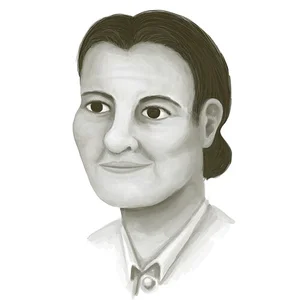

G. E. M. Anscombe (1919–2001) is one of the greatest analytic philosophers of the twentieth century. A student of Wittgenstein, she coined the term "consequentialism" and revolutionized the philosophy of action with her landmark work *Intention* (1957). A devout Catholic, she did not hesitate to publicly oppose the atomic bomb.
Elizabeth Anscombe(1919 — 2001)
G. E. M. Anscombe
Royaume-Uni
8 min read
Frequently asked questions
Famous Quotes
« By "consequentialism" I mean the doctrine that an act is right if and only if it produces the best available consequences.»
Key Facts
- Studies under Ludwig Wittgenstein at Cambridge in the 1940s and translates his major works into English
- Publishes *Intention* in 1957, a founding work in contemporary philosophy of action
- Coins the term "consequentialism" in her article *Modern Moral Philosophy* (1958), rejecting this doctrine in favor of virtue ethics
- Publicly opposes in 1956 the awarding of an honorary doctorate to Harry Truman by the University of Oxford, holding him responsible for the atomic bombings
- Succeeds Wittgenstein in the Chair of Philosophy at Cambridge in 1970, a post she holds until 1986
Works & Achievements
Her major work, foundational to modern philosophy of action. Anscombe analyzes the notion of intention, distinguishing intentional action from causally determined behavior, with considerable influence on analytic philosophy and ethics.
A short but revolutionary article in which Anscombe coins the term 'consequentialism', critiques modern moral theories, and calls for a return to Aristotelian virtue ethics, redefining the agenda of Anglophone moral philosophy.
A scholarly and rigorous introduction to Wittgenstein's Tractatus Logico-Philosophicus. This book remains one of the best entry points to the Austrian philosopher's work and attests to the depth of Anscombe's work as an interpreter.
English translation of Wittgenstein's major posthumous work, produced from his manuscripts. This titanic effort as editor and translator made Wittgenstein's ordinary language philosophy accessible to the English-speaking world.
A collection of all her philosophical articles, covering metaphysics, philosophy of action, ethics, and philosophy of mind. Constitutes the primary reference for studying Anscombe's thought in its entirety.
A pamphlet in which Anscombe justifies her vote against the honorary doctorate awarded to Harry Truman, on the grounds of just war doctrine. A short but powerfully argued text on the moral responsibility of political leaders.
Anecdotes
During a conference at Oxford in the 1950s, Anscombe publicly opposed the decision to award an honorary doctorate to Harry Truman, the American president who had ordered the atomic bombings of Hiroshima and Nagasaki. She was one of the rare academic voices to vote against it, arguing that honouring a man responsible for the deliberate killing of innocent civilians was morally unacceptable.
A student and close friend of Ludwig Wittgenstein, Anscombe was one of the few people the Austrian philosopher trusted entirely. Upon Wittgenstein's death in 1951, he named her one of his three literary executors, entrusting her with the immense task of translating and publishing his posthumous works, including the celebrated Philosophical Investigations.
Anscombe was known for her direct and uncompromising personality. She often wore a monocle and smoked cigars, which was particularly unusual for a woman of her era. In lectures, she did not hesitate to rebuke students who put forward arguments she deemed insufficiently rigorous, sometimes with a frankness that intimidated her interlocutors.
A devout and convinced Catholic, Anscombe firmly opposed artificial contraception and publicly defended the 1968 encyclical Humanae Vitae. This position earned her severe criticism, even in progressive Catholic circles. Mother of seven children, she believed her personal life should be consistent with her philosophical and moral convictions.
Her 1958 article 'Modern Moral Philosophy' is considered one of the founding texts of contemporary virtue ethics. In this essay, she coined the term 'consequentialism' to critique moral theories that justify acts solely by their outcomes, thereby opening a philosophical debate that still shapes the teaching of ethics in universities around the world today.
Primary Sources
The question 'why?' is not a request for causes; it is a request for reasons. When I ask why you did something, I am asking for your reason, not for a causal explanation of your behavior.
The concepts of obligation, and duty—moral obligation and moral duty, that is to say—and of what is morally right and wrong, and of the moral sense of 'ought', ought to be jettisoned if this is psychologically possible.
For men to choose to kill the innocent as a means to their ends is always murder, and murder is one of the worst of human actions. So that Mr. Truman's decision to use the atom bomb is objectively the decision of a mass murderer.
Causality is not the same thing as necessity. The discovery of a cause does not entail the discovery of a law-like necessity governing events.
Key Places
It was at Oxford that Anscombe completed her higher education and converted to Catholicism. There she developed the foundations of her philosophical thought and met the great analytical minds of her time.
Anscombe attended Wittgenstein's seminars at Cambridge in the 1940s and held a chair in philosophy there from 1970 to 1986, succeeding a long line of analytical thinkers. It was there that she died in 2001.
Anscombe travelled to Rome several times in connection with her reflections on Catholic ethics and her defence of Church teaching. Her engagement with Catholic intellectual circles was recognised as far as the Holy See.
Oxford's great library was an essential workplace for Anscombe during her research and her preparation of translations and editions of Wittgenstein's works.
Birthplace of Elizabeth Anscombe, born on 18 March 1919. Her Irish origins and Catholic upbringing lastingly shaped her relationship to tradition and morality.
Typical Objects

Anscombe frequently wore a monocle, an accessory that gave her a distinctive appearance in academic circles. This sartorial detail reflected her indifference to social conventions and her assertive character.

A heavy cigar smoker, Anscombe would regularly light one during her working sessions and philosophical discussions. This habit, highly unusual for a woman of her era, underscored her determination not to submit to gender-based social expectations.

As Wittgenstein's literary executor, Anscombe had access to the philosopher's unpublished notebooks and manuscripts. She spent years deciphering, translating, and preparing them for publication — a colossal work of scholarly editing.

A devout Catholic, Anscombe prayed daily and kept her rosary with her. Her faith was inseparable from her philosophical reflection on ethics, will, and moral intention.

Like most intellectuals of her generation, Anscombe wrote her articles and books on a typewriter. Her texts, often dense and technical, were the product of meticulous reworking and reformulation.

Her lectures, renowned for their rigour and density, were delivered in front of a blackboard on which she would break down her logical arguments. Her students described her as a demanding teacher of rare intellectual clarity.
School Curriculum
Vocabulary & Tags
Key Vocabulary
Tags
Daily Life
Morning
Anscombe began her day with daily Mass, a central spiritual practice in her life. She would then return home for a simple breakfast before immersing herself in her writing or translation work, usually at her typewriter, in the quiet of the morning.
Afternoon
Her afternoons were devoted to teaching and philosophical seminars at Oxford and then at Cambridge. She led intense discussions with her students and colleagues, never hesitating to challenge arguments she deemed insufficiently rigorous, sometimes for hours at a time.
Evening
In the evening, Anscombe rejoined her large family — she was the mother of seven children — sharing meals in an active domestic life. She would often continue reading and annotating philosophical texts late into the night, a cigar in hand.
Food
Anscombe had a simple diet with little concern for culinary refinement, typical of the post-war British intellectual class. She did not separate table matters from philosophical debates, often welcoming colleagues and students for dinner.
Clothing
She wore practical and understated outfits, often dark in colour, with little regard for fashion. Her monocle, an uncommon accessory for a woman, and her cigar were her most recognisable attributes, giving her a singular presence in British academic circles.
Housing
Anscombe lived in Victorian and Edwardian-style dwellings, typical of the residential neighbourhoods near the universities of Oxford and Cambridge. Her home was animated by her seven children and her husband, the philosopher Peter Geach, creating an atmosphere that was both intellectual and domestic.
Historical Timeline
Period Vocabulary
Visual Style
Atmosphère austère et intellectuelle des colleges britanniques des années 1940-1970 : architecture gothique en pierre, bibliothèques sombres, lumière froide sur des notes philosophiques manuscrites, contrastes forts en noir et blanc.
Sound Ambience
Sons feutrés des colleges d'Oxford et Cambridge : froissement de manuscrits, cliquetis de machine à écrire, craie sur tableau noir, discussions philosophiques en salles de séminaire, et carillon d'une horloge universitaire.
Liens externes & ressources
Références
Œuvres
Intention
1957
Modern Moral Philosophy
1958
An Introduction to Wittgenstein's Tractatus
1959
Traduction des Recherches philosophiques de Wittgenstein (Philosophical Investigations)
1953
Collected Philosophical Papers (3 volumes)
1981
Mr Truman's Degree
1958