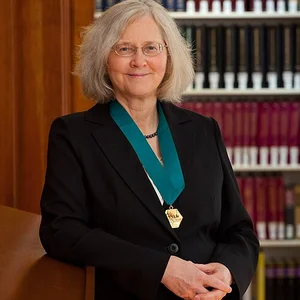

Elizabeth Blackburn is an Australian-American molecular biologist born in 1948 in Tasmania. She discovered telomerase, the enzyme that protects the ends of chromosomes, which earned her the Nobel Prize in Physiology or Medicine in 2009.
Elizabeth Blackburn(1948 — ?)
Elizabeth Blackburn
États-Unis, Australie
5 min read
Frequently asked questions
Key Facts
- Born on November 26, 1948, in Hobart, Tasmania (Australia)
- In the 1970s and 1980s, she studied telomeres, the protective ends of chromosomes
- In 1984, with Carol Greider, she discovered telomerase, the enzyme that rebuilds telomeres
- Received the Nobel Prize in Physiology or Medicine in 2009, shared with Carol Greider and Jack Szostak
- Her work opened major avenues for understanding cellular aging and cancer
Works & Achievements
First molecular description of the ends of chromosomes, showing that they are made of a short repeated DNA sequence.
Identification of the enzyme that lengthens and protects telomeres, explaining how chromosomes avoid degrading with each cell division.
A major prize often regarded as the antechamber to the Nobel, honoring her work on telomeres.
Awarded with Carol Greider and Jack Szostak for the discovery of how chromosomes are protected by telomeres and telomerase.
Popular-science book linking lifestyle, stress, and cellular aging to telomere length.
Anecdotes
To study the ends of chromosomes, Elizabeth Blackburn chose a microscopic organism living in ponds: the ciliate Tetrahymena. This tiny single-celled creature has thousands of mini-chromosomes, and therefore a huge quantity of telomeres to analyze, which made it an ideal subject of study.
In 1978, together with Joseph Gall, Blackburn discovered that the ends of Tetrahymena's chromosomes are made of a short DNA sequence repeated dozens of times (TTGGGG). No one yet understood what this curious repetition at the tips of chromosomes was for.
On December 25, 1984, her doctoral student Carol Greider developed a radioactive film in the laboratory and saw for the first time the trace of an unknown enzyme: telomerase. This scientific Christmas gift would earn the two researchers, along with Jack Szostak, the Nobel Prize in Medicine in 2009.
In 2004, Elizabeth Blackburn was removed from the U.S. President's Council on Bioethics after defending stem cell research. Many scientists protested, arguing that she was being dismissed for political rather than scientific reasons.
Later, Blackburn showed, together with psychologist Elissa Epel, that chronic stress appears to be linked to shorter telomeres: mothers worn down by years of caring for a seriously ill child showed accelerated cellular aging. It was an idea they popularized in a book for general readers.
Primary Sources
The researchers describe a short DNA sequence, tandemly repeated at the ends of Tetrahymena's ribosomal DNA molecules — the first molecular description of a telomere.
The paper reports the discovery of an enzyme activity able to add telomeric repeats to the ends of chromosomes: the future telomerase.
Blackburn retraces the discovery of telomeres and telomerase, and explains the protective role these structures play in genome stability.
A popular-science book in which the authors link telomere length, lifestyle, stress, and cellular aging.
Blackburn recounts her childhood in Tasmania, her early passion for animals and science, and her path from Melbourne to Cambridge and then to the United States.
Key Places
Elizabeth Blackburn's birthplace, where she grew up surrounded by animals and developed her scientific curiosity.
Where she studied biochemistry, earning her bachelor's and then master's degrees, before leaving for England.
Where she pursued her doctorate in the laboratory of Frederick Sanger, a two-time Nobel laureate in chemistry.
Blackburn's first American position, where she continued her work on the telomeres of Tetrahymena.
It was in her laboratory that telomerase was discovered in 1984 with Carol Greider.
Where she built her career as a professor and conducted her research on the links between telomeres, stress, and health.
Typical Objects

Essential instrument for observing Tetrahymena and the cells whose chromosomes she studied.

A gel slab run through by an electric current that separates DNA fragments according to their size, revealing the sequence of the telomeres.
A small precision instrument used to draw up and transfer tiny volumes of liquid — an everyday gesture for the molecular biologist.

A transparent container in which the micro-organisms under study are grown, here the telomere-rich ciliate.

A film sensitive to radioactive markers that made it possible to visualize the activity of telomerase, as during the Christmas 1984 discovery.

A representation of the molecule that carries heredity, whose ends (the telomeres) were the central focus of her research.
School Curriculum
Vocabulary & Tags
Key Vocabulary
Tags
Daily Life
Morning
Like many researchers, Elizabeth Blackburn often started early by reading the latest scientific papers and preparing the day's experiments. The morning was spent in the laboratory, organizing cell cultures and discussing results with her students.
Afternoon
The afternoon was devoted to the experiments themselves: preparing cell extracts, running DNA gels, analyzing data. Part of the time also went to mentoring doctoral students and writing papers.
Evening
In the evening, she might stay to monitor an ongoing experiment, or head home to be with her family. A large part of the evening was spent writing, revising publications, and preparing lectures.
Food
Living in 20th- and 21st-century Australia, England, and then California, her diet was that of a modern academic: varied meals, coffees, and quick lunches punctuating the long days in the laboratory.
Clothing
At work, her attire was that of a scientist: practical everyday clothes covered by a white lab coat, essential for safely handling chemicals and radioactive materials.
Housing
She lived in urban, academic settings, first in Cambridge and then in American cities such as New Haven and San Francisco, in housing typical of the 20th-century academic middle class.
Historical Timeline
Period Vocabulary
Liens externes & ressources
Références
Œuvres
Découverte de la séquence répétée des télomères (avec Joseph Gall)
1978
Découverte de la télomérase (avec Carol Greider)
1984-1985
Prix Lasker de la recherche médicale fondamentale
2006
Prix Nobel de physiologie ou médecine
2009
« The Telomere Effect » (avec Elissa Epel)
2017