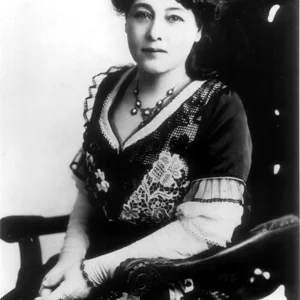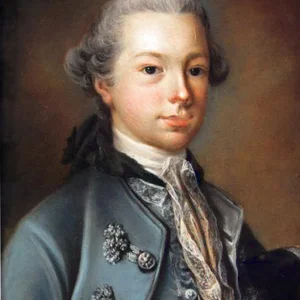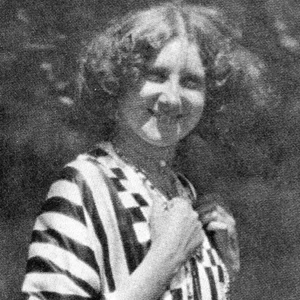

Austrian fashion designer and couturière (1874–1952), companion and muse of Gustav Klimt. She ran a haute couture salon in Vienna and contributed to the reform dress movement, championing clothing freed from the corset.
Emilie Flöge(1874 — 1952)
Emilie Flöge
Autriche
7 min read
Frequently asked questions
Key Facts
- 1874: born in Vienna
- 1904: opened the Schwestern Flöge fashion salon with her sisters in Vienna
- Long artistic and personal relationship with Gustav Klimt, who made her the subject of his painting The Kiss
- Pioneer of the reform dress (*Reformkleid*), a corset-free garment inspired by the ideas of the Wiener Werkstätte
- 1952: died in Vienna
Works & Achievements
A haute couture house founded with her sisters Helene and Pauline, with interiors designed by Josef Hoffmann. For thirty-four years, this salon was the primary space for creating and showcasing Emilie Flöge's reform dresses to Viennese bourgeois society.
A line of corset-free dresses with flowing, unrestricted silhouettes, made from patterned Wiener Werkstätte silks. These designs embodied an ideal of modern beauty — functional and emancipatory — in deliberate contrast to the mainstream fashion of the time.
Emilie Flöge contributed to the design of printed fabrics featuring geometric and floral patterns for the Viennese Workshops, helping to shape the visual identity of the Austrian Arts & Crafts movement.
The Schwestern Flöge salon and its creations were regularly featured in Secession exhibitions, where fashion, decorative arts, and fine arts came together under the banner of the *Gesamtkunstwerk*.
Anecdotes
Emilie Flöge and Gustav Klimt maintained an intimate and artistic relationship for nearly thirty years, documented by more than 400 postcards the painter sent her. These letters, often written in a coded language between the two confidants, bear witness to an intellectual and emotional bond of uncommon depth. Emilie burned much of this correspondence after the painter's death, feeling it belonged to the private sphere.
In 1904, Emilie and her sisters Helene and Pauline opened their haute couture salon 'Schwestern Flöge' at the Casa Piccola, on Mariahilfer Strasse in Vienna. The exhibition space was designed by Josef Hoffmann and Koloman Moser, two leading figures of the Wiener Werkstätte, making the salon as much a place of fashion as an artistic manifesto. This refined setting attracted the intellectual and artistic elite of the Austro-Hungarian capital.
Emilie Flöge was a pioneer of the 'reform dress', a movement that sought to free women from the corset, considered both harmful to health and a symbol of oppression. She herself wore her loose, flowing creations in the streets of Vienna, sometimes astonishing passersby accustomed to the corseted silhouette of the era. Her commitment to functional and liberating fashion was inseparable from her convictions about women's emancipation.
During their summers by Lake Attersee, Klimt painted landscapes while Emilie wore the long, flowing gowns she designed, immortalized in several photographs of the time. These images constitute one of the most precious visual records of Flöge's creations, of which almost no original dress has survived. In 1902, Klimt painted an official portrait of Emilie, today held at the Wien Museum, which remains the most famous image of the fashion designer.
When Klimt was struck down by a stroke in January 1918, his final act was to ask that 'Emilie' be notified. Although he had verbally bequeathed his possessions to her, the succession proved complex and was partly contested. After his death, Emilie continued to run her salon until the late 1930s, thereby asserting her professional independence beyond her role as the painter's companion.
Primary Sources
The correspondence between Klimt and Emilie Flöge, partly preserved at the Austrian National Library, reveals the depth of their relationship over nearly twenty years. Klimt discusses his artistic projects, his travels, and his state of mind, often signing with affection "Dein Gustav."
The journal *Ver Sacrum*, official organ of the Vienna Secession, published between 1898 and 1903 illustrations of dresses, textiles, and decorative objects in the spirit of *Jugendstil*, documenting the creative ferment of the circle in which Emilie Flöge moved.
Period photographs taken around 1904–1910 document the interior of the salon designed by Josef Hoffmann: geometric furniture, clear glazing, and displays of reform dresses all bear witness to the deliberate alliance between fashion and the decorative arts.
The catalogues of the Wiener Werkstätte record the collaborations of designers such as Emilie Flöge in the creation of printed textiles and jewellery, worn in harmony with the dresses of the Schwestern Flöge salon.
Key Places
Emilie Flöge's birthplace and the city where her entire professional life unfolded. She ran her haute couture salon here and was at the heart of the cultural ferment of the Vienna Secession.
Located in the Casa Piccola, this fashion salon founded in 1904 was the heart of Emilie's professional activity for more than thirty years. Decorated by Josef Hoffmann, it embodied the union of applied arts and fashion.
The summer retreat of Emilie Flöge and Gustav Klimt for many years. It was here that Klimt painted his landscapes and that Emilie was photographed wearing her reform dress designs.
This museum holds the portrait of Emilie Flöge painted by Klimt in 1902, along with documents relating to her life and salon. It is the principal site of remembrance dedicated to the fashion designer.
Typical Objects

A loose-fitting garment, free of corsetry, with fluid and flowing lines inspired by the hygienic and aesthetic ideals of Jugendstil. Emilie Flöge made it the signature of her salon, offering Viennese women an emancipatory alternative to the restrictive fashions of the era.

Silk or cotton textiles featuring stylized geometric or floral patterns, designed in collaboration with the Viennese Workshops. Emilie Flöge incorporated them into her most iconic creations, uniting fashion and the decorative arts.

An indispensable tool of the Schwestern Flöge atelier, the dressmaker's form allowed garments to be fitted to individual measurements and models to be presented to clients from Vienna's upper bourgeoisie.

Silver, enamel, and semi-precious stone ornaments in the spirit of Jugendstil, worn by Emilie Flöge to embody the unity she championed between fashion, jewelry, and the decorative arts.

Emilie Flöge recorded her designs in drawing books and patterns that served as the foundation for the one-of-a-kind garments produced at the salon.

Famous photographs show Emilie Flöge posing in her own creations on the shores of Lake Attersee, alongside Klimt, offering a precious visual record of her dresses and their shared world.
School Curriculum
Vocabulary & Tags
Key Vocabulary
Daily Life
Morning
Emilie started her day early, overseeing the salon workshop before it opened to clients. She reviewed the seamstresses' work in progress, discussed adjustments with her sisters, and corresponded with fabric suppliers — particularly those from the Wiener Werkstätte.
Afternoon
Afternoons were devoted to appointments with Vienna's bourgeois and aristocratic clientele. Emilie welcomed clients, took measurements, presented new designs, and managed special orders, combining business acumen with artistic standards.
Evening
Evenings often meant attending Viennese intellectual and artistic circles alongside Klimt and figures such as Josef Hoffmann or Arthur Schnitzler. These gatherings fed her inspiration and strengthened the salon's network.
Food
Like the Viennese middle class of her era, Emilie ate according to Austrian culinary traditions — Viennese coffee in the morning, a hearty midday meal with cold cuts, vegetables, and meat, and pastries at *Jause* (afternoon snack) time. Summers by Lake Attersee brought simpler fare, centered on lake fish and local produce.
Clothing
Emilie wore her own creations: long, flowing gowns in vivid colors, often adorned with geometric or floral patterns inspired by the Byzantine and Japanese art that influenced Klimt. She rejected the corset throughout her life, embodying in her own silhouette the very manifesto of reform dress.
Housing
Emilie lived in a middle-class apartment in Vienna's 4th district, close to the salon. The space was decorated in the spirit of the Wiener Werkstätte, blending functionality with careful aesthetics. Summers were spent on the shores of Lake Attersee, in a villa rented with Klimt and other artist friends.
Historical Timeline
Period Vocabulary
Liens externes & ressources
Références
Œuvres
Salon Schwestern Flöge (Sœurs Flöge)
1904-1938
Collection de robes réformes (Reformkleider)
1904-1938
Collaborations textiles avec la Wiener Werkstätte
1905-1930
Participation aux expositions de la Sécession viennoise
1898-1910