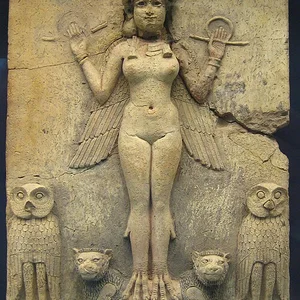

Sumerian queen of the Underworld in Mesopotamian mythology, Ereshkigal rules the kingdom of the dead known as Kur or Irkalla. Sister of the goddess Inanna, she embodies the relentless power of death and the underworld, as described in Sumerian cuneiform texts.
Ereshkigal
Ereshkigal
8 min read
Frequently asked questions
Key Facts
- Mentioned in Sumerian cuneiform texts as early as around 2500 BCE, she is one of the oldest known goddesses of the Underworld.
- She is central to the myth of the 'Descent of Inanna into the Underworld', preserved on Sumerian tablets discovered at Nippur and Ur.
- Her name means 'Great Lady of the Earth' or 'Lady of the Great Below' in Sumerian.
- In the myth of Inanna, Ereshkigal kills her sister who attempts to seize her throne, illustrating the inviolable boundary between the living and the dead.
- She also appears in the Akkadian myth of Nergal and Ereshkigal (c. 1400–1200 BCE), in which she marries Nergal, the god of war.
Works & Achievements
A Sumerian epic poem in which Ereshkigal plays the central role of unyielding ruler of the Underworld. This text is one of the oldest literary narratives in human history and constitutes the primary source on the goddess.
An Akkadian adaptation of the Sumerian myth, in which Ereshkigal retains her role and her name. Discovered on a tablet from Assur, this text illustrates how myths were transmitted and transformed across Mesopotamian cultures.
A Babylonian myth recounting how Nergal, the god of war, becomes Ereshkigal's husband, giving her a consort with whom to rule the Underworld. Preserved on tablets discovered at Amarna (Egypt) and Sultantepe (Turkey).
A collection of Sumerian liturgical compositions addressed to Ereshkigal, recited during funerary rites. These texts bear witness to the cult dedicated to the goddess in temples and during mourning ceremonies.
A canonical Babylonian catalogue listing and ranking the Mesopotamian deities. Ereshkigal appears as the undisputed sovereign of the underworld, attesting to her importance within the official pantheon.
Anecdotes
In the Sumerian myth 'The Descent of Inanna to the Underworld,' Ereshkigal orders that her sister Inanna be stripped of her adornments at each of the seven gates of the underworld. This episode symbolizes absolute submission to the laws of death, from which even the gods cannot escape.
According to the Akkadian myth 'The Descent of Ishtar to the Underworld,' Ereshkigal is seized by pains compared to those of a woman in labor when confronted with suffering — showing that the queen of the dead is not without feeling, but simply the sovereign of a relentless order.
In the myth of 'Nergal and Ereshkigal,' the war god Nergal descends to the Underworld and becomes Ereshkigal's husband following a tumultuous confrontation. This tale is one of the few Mesopotamian myths to describe a romantic relationship between underworld deities.
Ereshkigal possesses the power of the 'death gaze': her mere look can kill. When Inanna descends to the underworld, Ereshkigal strikes her down with this gaze and transforms her sister into a corpse hung on a hook — a striking image of death's absolute power over life.
The name Ereshkigal literally means 'Great Lady of the Earth' in Sumerian (ereš = lady/queen, ki = earth, gal = great). Her realm, known as 'Kur' or 'Irkalla,' was conceived as a dark underworld where the dead led a pale and dreary existence, drinking dust and never seeing the light.
Primary Sources
Inanna abandoned heaven, abandoned earth, descended to the underworld. [...] At the first gate, the great crown was removed from her head. [...] Ereshkigal looked at her with the eyes of death.
When Ishtar descended to the Land of No Return, the daughter of Sin turned her ear to the dark land [...]. Ereshkigal heard her and her face grew pale as a severed vine.
Ereshkigal opened her mouth and said to Nergal: 'You shall be my husband and I shall be your wife. I will give you kingship over the vast underworld.'
Ereshkigal, great lady of the underworld, whose decrees are unalterable, whose orders cannot be revoked, whose words are sacred.
Key Places
The main religious center of Sumer, where the most complete versions of the Ereshkigal myths were written and preserved. The archives of the Temple of Enlil at Nippur are the primary source of cuneiform texts relating to her.
The realm of the dead ruled by Ereshkigal in Sumerian cosmology, located beneath the earth and accessible only through guarded gates. This mythical place is described as dark, dusty, and from which no living being could return.
A great Sumerian city where the cult of chthonic deities was practiced. The Royal Tombs of Ur (c. 2600 BCE) bear witness to Mesopotamian beliefs about death and the passage into Ereshkigal's realm.
The repository of thousands of cuneiform tablets containing the myths of Ereshkigal in their Akkadian versions. Discovered in the 19th century, this library enabled the modern rediscovery of Mesopotamian mythology.
The sacred city of Inanna, Ereshkigal's sister, and the mythological and religious capital of Sumer. It is from Uruk that Inanna begins her descent into the Underworld to confront her sister in the foundational myth.
Typical Objects

The primary medium on which the myths of Ereshkigal were recorded by Sumerian scribes. These tablets inscribed in cuneiform script are the only written evidence of her existence and powers.

In mythological depictions, Ereshkigal sits upon a dark throne in her underworld palace. The black volcanic stone symbolizes the depths of the Underworld and the immutable nature of her authority.

The divine register on which the fates of mortals are written. Ereshkigal is the keeper of the decrees of death and holds authority over these tablets for all matters concerning the underworld.

A ritual object used in Mesopotamian funerary ceremonies to purify the deceased before their entry into Ereshkigal's realm. Priests used it during rites accompanying the dead on their journey.

In the myth of the Descent of Inanna, Ereshkigal hangs her sister's corpse on a hook — a terrifying symbol of her absolute power over the bodies of the dead and the condition of the deceased within her kingdom.

Upon Inanna's death, creatures weep alongside Ereshkigal, covering themselves in mourning garments as she does. These dark robes symbolize the perpetual grief that reigns throughout the underworld.
School Curriculum
Vocabulary & Tags
Key Vocabulary
Daily Life
Morning
In myth, Ereshkigal's 'day' begins in the permanent darkness of the underworld, where there is no sun and no natural cycle. She receives reports from her viziers and the gatekeepers of the seven gates about the souls of the dead who arrived during the night. From her obsidian throne, she issues her decrees — absolute and final, beyond any appeal.
Afternoon
Ereshkigal presides over the judgment of the dead: the tablets of destiny are consulted, and the souls of the deceased are assigned their place in the realm of the dead. She is assisted by demons and infernal creatures who maintain order in the Kur. No living being may enter her domain without her permission.
Evening
In the myth of Nergal and Ereshkigal, the goddess is found alone, bathing, revealing a deep loneliness at the heart of her absolute power. The symbolic evening of the underworld is one of perpetual mourning: Ereshkigal weeps for young men torn from their wives, for young women separated from their husbands — she feels the pain of the death she herself imposes.
Food
Like all Mesopotamian deities, Ereshkigal 'feeds' symbolically on the funerary offerings left by the living for their dead: barley bread, beer, oil, and incense burned during rituals. In the texts, the diet of the dead in her kingdom is described as dust and clay — a reminder that the living must honor their dead to avoid this fate.
Clothing
Ereshkigal is depicted wearing a horned crown (symbol of divine status in Mesopotamia), layered robes of wool dyed indigo-blue and black, adorned with golden embroidery and lapis lazuli beads. When Inanna enters her domain, she is gradually stripped of her ornaments at each gate — what Ereshkigal wears is therefore the only garment that remains in the Underworld.
Housing
Ereshkigal's palace, called 'Ganzer' in the texts, is a vast underground dwelling with walls of black stone, accessible through seven successive gates each guarded by a gatekeeper. It is described as the 'Great Land' or the 'Land of No Return' — a wide but lightless space, with no windows, lit only by oil lamps, where silence and dust hold sway.
Historical Timeline
Period Vocabulary
Visual Style
Esthétique sumérienne solennelle et sombre : déesse trônant dans un palais souterrain de pierre noire et de lapis-lazuli, inspirée des sceaux-cylindres et des stèles mésopotamiennes.
Sound Ambience
Ambiance du royaume souterrain d'Ereshkigal : silence profond des Enfers mésopotamiens, ponctué de lamentations lointaines, de portes de pierre qui grincent et de tambours funéraires sumériens.
Liens externes & ressources
Références
Œuvres
La Descente d'Inanna aux Enfers (Inanna kur-nu-gi-a)
vers 2000 av. J.-C. (tradition orale antérieure)
La Descente d'Ishtar aux Enfers (version akkadienne)
vers 1200 av. J.-C.
Nergal et Ereshkigal
vers 1400 av. J.-C.
Hymnes et prières à Ereshkigal
vers 2500-2000 av. J.-C.
Liste des dieux mésopotamiens (An = Anum)
vers 1800 av. J.-C.