
The Erinyes are three chthonic deities of Greek mythology tasked with punishing crimes against the natural order, especially perjury and the murder of kin. Alecto, Megaera, and Tisiphone relentlessly pursue the guilty, driving them to madness and torment.
Erinyes
Erinyes
9 min read
Frequently asked questions
Key Facts
- Born from the blood of Ouranos according to Hesiod (Theogony, 8th–7th century BCE)
- They pursue Orestes after the murder of his mother Clytemnestra (the myth of the House of Atreus)
- Aeschylus brings them to the stage in The Eumenides (458 BCE), where they are appeased by Athena
- Renamed the Eumenides ("the Kindly Ones") after their reconciliation with the Olympian order
- In Roman mythology, they are known as the Furies or Dirae
Works & Achievements
A masterpiece of Greek tragedy comprising Agamemnon, The Libation Bearers, and The Eumenides, this trilogy places the Erinyes at the heart of the conflict between archaic justice and civic justice. Their transformation into the Eumenides in the third play stands as one of the most profound metamorphoses in Greek mythology.
The first text to codify the birth of the Erinyes from the blood of Ouranos, establishing their chthonic nature and cosmogonic role. This poem is the canonical source of their origin for the entire subsequent Greek tradition.
A tragedy that makes the sanctuary of the Eumenides the site of Oedipus's peaceful death, showing that the goddesses can also grant their protection. The work illustrates the theological complexity of the Erinyes: terrifying to the guilty, yet benevolent toward sincere suppliants.
The Erinyes appear here as guardians of oaths and the natural order, punishing anyone who transgresses unwritten laws. These references attest to their fundamental role in Greek religion long before their dramatic staging in tragedy.
In Aeneas's descent into the Underworld (Book VI), Virgil depicts Tisiphone guarding the gates of Tartarus, transmitting the figure of the Erinyes / Furies to Roman culture and to the entire subsequent Western tradition.
Anecdotes
According to Hesiod, the Erinyes were born from drops of blood that fell to the earth when Cronus mutilated Uranus. This chthonic origin made them primordial powers, predating even the great Olympian gods, which explains their absolute authority over the laws of nature and blood.
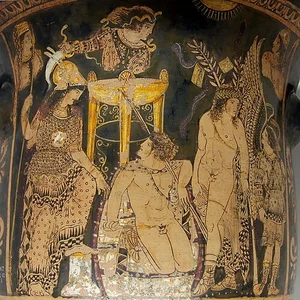
After Orestes killed his mother Clytemnestra to avenge his father Agamemnon, the Erinyes pursued him relentlessly, driving him into a terrifying madness. His trial before the court of the Areopagus in Athens, presided over by Athena, ended in his acquittal and the transformation of the Erinyes into the Eumenides, the 'Kindly Ones'.
The Erinyes did not punish only murderers — they also hunted down perjurers and those who broke their oaths. In the Iliad, Homer calls upon them to punish anyone who betrays a solemn vow, showing their fundamental role in upholding the moral and social order of the Greek world.
In Athens, the Erinyes were honored under the name of the Eumenides ('the Kindly Ones') in an underground sanctuary at the foot of the Areopagus. This officially recognized cult showed that the Greeks preferred to appease them rather than confront them: offerings of honey and water were made to them, without wine or flowers, as their chthonic nature demanded particular rites.
Sophocles, in Oedipus at Colonus, places the death of Oedipus in a sacred grove dedicated to the Eumenides near Athens. The fact that Oedipus — himself hounded by a family curse — finds refuge and a peaceful death in their sanctuary illustrates the dual nature of the Erinyes: terrifying to the guilty, yet protective of those who seek their shelter.
Primary Sources
From the drops of blood that spurted forth were born the mighty Erinyes, who punish on earth those men guilty of perjury.
I am Night, ancient mother, and I am also called Erinys. I pursue the murderer to the very depths of the earth, for spilled blood cries out for vengeance.
The Erinyes, who beneath the earth punish the dead, rise up against those who have sworn falsely.
This grove is sacred: it belongs to the dread Eumenides, daughters of Darkness and Earth. No one may set foot within it without trembling.
There dwell the Erinyes, Tisiphone clad in a bloodstained mantle, keeping watch at the threshold day and night, never sleeping.
Key Places
Sacred hill of Athens where the mythic trial of Orestes took place: Athena founded the first human court of law there to judge crimes of blood. At the foot of the Areopagus lay the underground sanctuary of the Eumenides, where the Furies were venerated in their appeased form.
A deme of Attica near Athens where Sophocles set the sacred grove dedicated to the Eumenides, the site of Oedipus's death. This grove, forbidden to ordinary mortals, embodied the simultaneously fearsome and protective nature of the goddesses.
Sanctuary of Apollo where Orestes, fleeing the Furies, sought refuge after the murder of Clytemnestra. Apollo attempted to purify him of his mother's blood, illustrating the conflict between Olympian justice and the chthonic law of the Furies.
The mythological realm of origin and dwelling of the Furies, located at the very edge of the land of the dead. In ancient depictions, they patrol the underworld to ensure that the guilty suffer their eternal punishment.
City of the Peloponnese whose name is linked to one of the three Furies, Megaera. Local traditions placed a cult there of the chthonic deities who punished crimes against family.
Typical Objects

The Erinyes are depicted with serpents coiled through their hair, symbols of their chthonic nature and their connection to the forces of the underworld. These reptiles also evoke the venom of guilt that gnaws away at their victims.

They carry torches whose sinister light illuminates their nocturnal pursuit of the guilty. The torch does not shine to guide but to expose: no darkness can hide a criminal from their eyes.

The ultimate instrument of punishment, the whip of the Erinyes inflicts both physical pain and moral torment. It symbolizes the inexorable punishment that falls upon those who have violated the sacred laws of blood and sworn oath.

Their dark wings allow them to pursue their victims to the ends of the earth, from the heavens down to Hades. This ability to fly reinforces their inescapable nature: no one can flee from the Erinyes.

In their cult as the Eumenides, offerings of honey, water, and milk — never wine — were poured into bowls emptied directly onto the ground. This ritual, the inverse of what was offered to the Olympian gods, underscored their belonging to the underworld.

Dressed in black or blood-red in ancient iconography, their garments evoke the mourning and murder they are charged with punishing. This dark attire visually sets them apart from the radiant robes of the Olympian deities.
School Curriculum
Vocabulary & Tags
Key Vocabulary
Tags
Daily Life
Morning
At dawn, the Erinyes emerge from the depths of the earth to inspect crimes committed during the night that have not yet been punished. They receive the laments of the dead whose blood was shed unjustly, who point out to them the guilty parties to pursue. Their mythological 'morning' is that of the invisible tribunal: they build the case files of human guilt.
Afternoon
During the day, they relentlessly track their designated victims, appearing as hallucinations or accusing voices in the minds of the guilty. In their cultic role, this is the time when the priestesses of their Athenian sanctuary prepare libations and propitiatory rites to appease them. The Erinyes may also sit as witnesses at the solemn great oaths sworn in their name.
Evening
Evening is their preferred time: as night falls, their power intensifies, for darkness is their natural domain. They plunge their victims into terrifying dreams and visions of torment. At their sanctuaries, nocturnal offerings of honey and water are poured directly into the earth in silence, to win their goodwill.
Food
As divinities, the Erinyes do not eat as mortals do: they 'feed' symbolically on the guilt and remorse of their victims. In their cult, they were offered honey, barley cakes, and spring water — never meat or wine. These chthonic offerings stood in deliberate contrast to Olympian sacrifices, underscoring their subterranean and primordial nature.
Clothing
The Erinyes are depicted wearing long black or blood-red robes, evoking mourning and murder at once. Their robes are sometimes girdled with live serpents. Unlike the Olympian goddesses in their radiant peplos, their dark and severe attire reflects their role as implacable judges of crimes against blood and oath.
Housing
The Erinyes dwell in the depths of the earth, in Erebus or Tartarus, where the dead reside and great criminals are punished. In Athens, their earthly dwelling is the underground sanctuary carved at the foot of the Areopagus — a semi-subterranean space forbidden to the impure. The sacred grove of Colonus, shadowed and off-limits to mortals, represents their threshold between the world of the living and the world of the dead.
Historical Timeline
Period Vocabulary
Visual Style
Style céramique grec entre archaïque et classique, dominé par des noirs profonds, des rouges sang et des ocres brûlés, représentant trois déesses ailées aux cheveux de serpents portant torches et fouets.
Sound Ambience
L'univers sonore des Érinyes mêle le sifflement des serpents, le crépitement des torches infernales et les lamentations des coupables pourchassés dans les profondeurs chthoniennes.
Liens externes & ressources
Références
Œuvres
L'Orestie (trilogie) — Eschyle
458 av. J.-C.
Théogonie — Hésiode
vers 700 av. J.-C.
Œdipe à Colone — Sophocle
401 av. J.-C.
Iliade — Homère
vers 750-700 av. J.-C.
Énéide — Virgile
vers 29-19 av. J.-C.