 flip
flipPavlova with fresh fruit
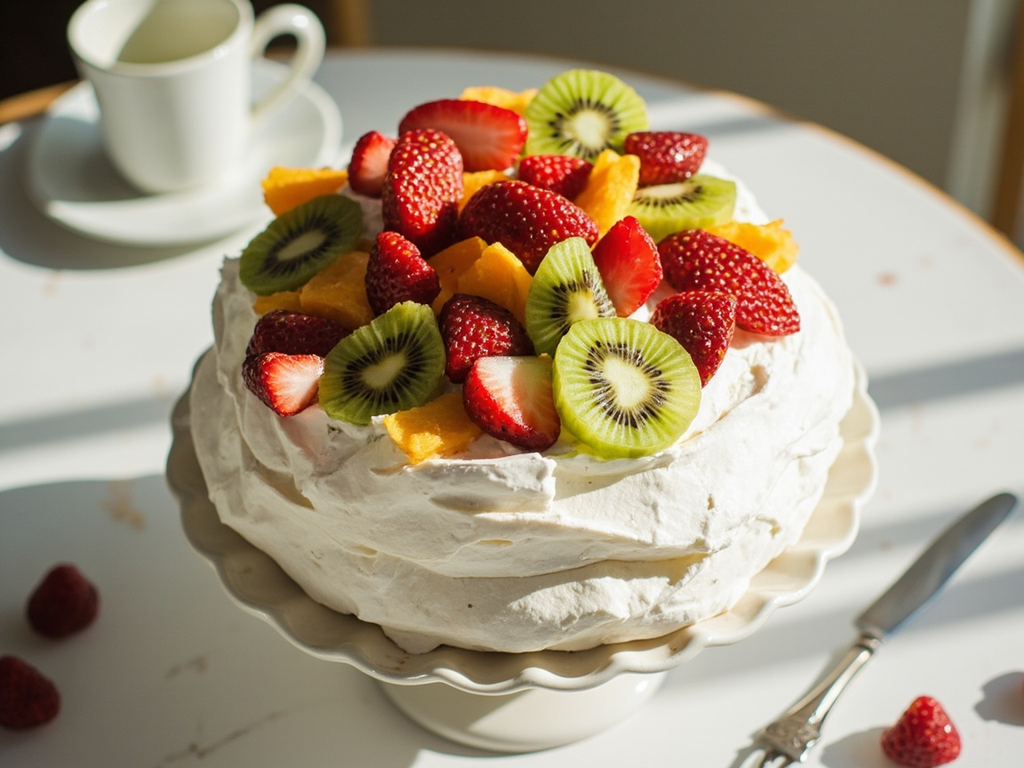
Pavlova with fresh fruit
Why this dish? Settled in Wellington from 1915, Marsden spent most of his life there. Pavlova—a crisp meringue with a soft heart, crowned with fruit—became in the 1920s-30s the iconic festive dessert of New Zealand, his adopted country where he made his entire scientific and public career.
A cloud of meringue with a crunchy shell and marshmallow center, topped with whipped cream and tangy fresh fruit. The dessert for birthdays and summer Christmas celebrations in the southern hemisphere.
When I settled in Wellington, I discovered an upside-down Christmas, celebrated in the full austral summer. On festive tables reigned this airy cake: a meringue that must be dried in a very low oven, without haste, until the shell becomes firm while keeping a tender marshmallow heart. We covered it with cream and seasonal fruits. It is a dessert that demands patience and an oven not to be rushed—two virtues that my trade as an experimenter had, I believe, well taught me.
- •Fresh egg whites — four (meringue structure)
- •Fine granulated sugar — two cups (sweetness and structure)
- •White vinegar — one teaspoon (soft center)
- •Cornflour — one teaspoon (stabilizer)
- •Whipping cream — one bowl (topping)
- •Seasonal fruit (kiwi, strawberry, passion fruit) — as available (tangy freshness)
Pavlova with fresh fruit
A cloud of meringue with a crunchy shell and marshmallow center, topped with whipped cream and tangy fresh fruit. The dessert for birthdays and summer Christmas celebrations in the southern hemisphere.
Why this dish? Settled in Wellington from 1915, Marsden spent most of his life there. Pavlova—a crisp meringue with a soft heart, crowned with fruit—became in the 1920s-30s the iconic festive dessert of New Zealand, his adopted country where he made his entire scientific and public career.
When I settled in Wellington, I discovered an upside-down Christmas, celebrated in the full austral summer. On festive tables reigned this airy cake: a meringue that must be dried in a very low oven, without haste, until the shell becomes firm while keeping a tender marshmallow heart. We covered it with cream and seasonal fruits. It is a dessert that demands patience and an oven not to be rushed—two virtues that my trade as an experimenter had, I believe, well taught me.
Ingredients (period version)
- Fresh egg whites — four (meringue structure)
- Fine granulated sugar — two cups (sweetness and structure)
- White vinegar — one teaspoon (soft center)
- Cornflour — one teaspoon (stabilizer)
- Whipping cream — one bowl (topping)
- Seasonal fruit (kiwi, strawberry, passion fruit) — as available (tangy freshness)
Ingredients
- Egg whites at room temperature — 4 (≈120 g) (structure)
- Fine granulated sugar — 220 g (sweetness and structure)
- White vinegar or lemon juice — 1 tsp (soft center)
- Cornflour — 1 tsp (stabilizer)
- Heavy cream — 300 ml (whipped topping)
- Kiwis, strawberries, passion fruit — 300 g total (tangy topping)
Method
- Preheat oven to 150 °C. Whisk egg whites to stiff peaks, then add sugar spoon by spoon until smooth and glossy.
- Gently fold in vinegar and cornflour.
- Shape a thick disc on a baking sheet lined with parchment, slightly hollowing the center.
- Bake immediately, reduce to 120 °C and dry for 1 hour 15 minutes. Turn off oven and let cool inside with door ajar.
- Just before serving, top with whipped cream and fresh cut fruit.
How it was made : The pavlova's origin is disputed between New Zealand and Australia; the name honors ballerina Anna Pavlova, who toured the region in 1926. In Marsden's time, the meringue was dried in the residual wood-fired oven after bread baking.
The contemporary twist : Make it individual: one mini-pavlova per guest, and play with single-color fruits for a graphic presentation.
Ernest Marsden · Charactorium