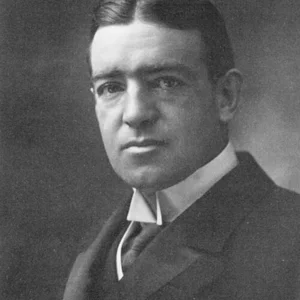

Anglo-Irish polar explorer (1874–1922), an iconic figure of the heroic age of Antarctic exploration. His Endurance expedition (1914–1916), despite failing to cross Antarctica, is celebrated as a feat of survival and leadership.
Ernest Shackleton(1874 — 1922)
Ernest Shackleton
Royaume-Uni de Grande-Bretagne et d'Irlande
9 min read
Frequently asked questions
Famous Quotes
« Difficulties are just things to overcome, after all.»
« Optimism is true moral courage.»
Key Facts
- 1901–1903: Takes part in Robert Falcon Scott's Discovery expedition to Antarctica
- 1907–1909: Leads the Nimrod expedition, coming within 180 km of the South Pole
- 1914–1916: The Endurance is trapped in the ice and crushed; Shackleton saves all 27 of his men
- 1916: Crosses 1,300 km of open sea in a lifeboat to reach South Georgia and organise the rescue
- 1922: Dies of a heart attack at South Georgia during his fourth Antarctic expedition
Works & Achievements
The first polar expedition led by Shackleton as commander, which set a new record for the farthest south latitude, reaching within 180 km of the pole. The expedition also brought back valuable scientific data on geology, meteorology, and terrestrial magnetism.
An account of the Nimrod Expedition published in two volumes, which was a tremendous success in Britain and helped make Shackleton a national celebrity. The work precisely describes the extreme living conditions and scientific challenges of polar exploration.
An attempt to cross the Antarctic continent from the Weddell Sea to the Ross Sea, which became a feat of survival after the ship was lost. None of the 28 expedition members lost their lives, making it one of the greatest examples of crisis leadership in the history of exploration.
An account of the Endurance Expedition, considered a classic of exploration literature. Shackleton describes with humility and precision the hardships endured by his crew, emphasizing solidarity and collective determination.
Shackleton's final polar expedition, which aimed to explore the Antarctic coastline. It was cut short by Shackleton's sudden death in South Georgia on 5 January 1922, before the expedition had even reached Antarctica.
Anecdotes
In January 1915, the ship Endurance became trapped in the ice of the Weddell Sea, unable to move forward. For ten months, the crew lived aboard the immobilized vessel, watching helplessly as the pack ice slowly crushed the hull. Shackleton then made a radical decision: abandon the ship and camp on the floating ice to survive.
After the sinking of the Endurance in November 1915, Shackleton organized a lifeboat crossing of 1,300 kilometres across one of the most dangerous oceans in the world, the Southern Ocean, aboard the James Caird, a vessel less than seven metres long. This sixteen-day crossing, accomplished with five men through fifteen-metre waves and polar temperatures, is still considered one of the greatest maritime epics in history.
Having reached the island of South Georgia after the lifeboat crossing, Shackleton still had to cross unmapped, snow-covered mountains on foot to reach the Stromness whaling station. In 1955, the legendary mountaineer Edmund Hillary acknowledged that this crossing without adequate equipment represented an exceptional mountaineering feat for its time.
Shackleton did not lose a single one of his twenty-eight men during the Endurance expedition, despite surviving for more than twenty months in extreme conditions. His ability to maintain his team's morale, manage difficult personalities, and make quick decisions under pressure made him a role model still studied today in management and leadership schools.
During the Nimrod Expedition (1907–1909), Shackleton and three companions reached a latitude of 88°23' South, just 180 kilometres from the South Pole — a world record at the time. But faced with a shortage of food, he made the difficult decision to turn back, telling his wife: “I thought you'd rather have a live donkey than a dead lion.”
Primary Sources
I had told the men what I thought was best, and I had no doubt that they would follow me to the end. The question was not of courage but of endurance, and endurance had become a word of life for us.
We had seen God in His splendours, heard the text that Nature renders. We had reached the naked soul of man.
I pray God I can manage to get the men through safely. I have failed to cross the continent but at least I must save them.
A collection of more than 500 photographs and glass plates documenting the entirety of the Endurance expedition, from the departure from London to the rescue on Elephant Island.
You know I am devoted to you and the children. My whole life has been a struggle and fight. I am just good as an explorer and nothing else.
Key Places
Birthplace of Ernest Shackleton on 15 February 1874. His Irish Protestant family moved to London when he was ten years old, setting him on a path toward a career in the British merchant navy.
The area where the *Endurance* became trapped in pack ice in January 1915 before sinking in November of the same year. This body of water east of the Antarctic Peninsula is one of the most dangerous seas in the world due to its drifting ice.
A rocky island where the 22 crew members waited for 136 days for Shackleton to return and rescue them after the loss of the *Endurance*. It was the first solid ground the team had stood on in 497 days.
An island in the South Atlantic where Shackleton died on 5 January 1922 and where he is buried in the whalers' cemetery at Grytviken. It was also the starting and ending point of the *James Caird* voyage, and the place where he crossed the mountains on foot to reach the whaling station at Stromness.
The city where Shackleton grew up, planned his expeditions, and worked to raise funds from patrons and the British government. It was here that he wrote his books and delivered numerous lectures upon returning from his voyages.
Typical Objects

An optical instrument used to measure the altitude of celestial bodies in order to determine position at sea. Shackleton and his navigator Frank Worsley used the sextant with remarkable precision during the crossing of the Southern Ocean aboard the James Caird, guiding the vessel toward South Georgia.

A light, flexible sledge made of ash and hickory wood, designed by Norwegian explorer Fridtjof Nansen for polar expeditions. Members of the Endurance expedition used these sledges to haul their boats and supplies across the pack ice after abandoning the ship.

A small pressurized stove invented in Sweden in the late 19th century, which became the standard cooking tool of polar expeditions. It allowed the Endurance crew to melt snow for drinking water and prepare hot meals in extreme temperatures.

Traditional Sami boots made from reindeer skin, worn by polar explorers for their lightness and resistance to the cold. Shackleton and his team were equipped with them, though they were often soaked through and inadequate during crossings over melting ice.

A 6.9-metre lifeboat modified by carpenter Harry McNish to withstand the open sea. It was aboard this small vessel that Shackleton and five men crossed 1,300 kilometres of the Southern Ocean to seek rescue at South Georgia.

The camera and glass plates with which Australian photographer Frank Hurley documented the entire Endurance expedition. His images — some of them in colour — stand as an exceptional historical record and contributed to the worldwide fame of the expedition.

An indispensable navigation instrument in polar environments, where visual landmarks are absent for weeks at a time. During the night-time crossing of the South Georgia mountains, Shackleton and his two companions relied on the compass to find their way to the Stromness whaling station.
School Curriculum
Vocabulary & Tags
Key Vocabulary
Tags
Daily Life
Morning
On expedition, the day began before dawn to make the most of the available daylight in polar regions. Shackleton imposed a structured wake-up routine: inspection of the ship or camp, consultation of the meteorological and magnetic instruments, then a meeting with his officers to plan the day's tasks. Breakfast, generally oatmeal porridge or hoosh (a mixture of pemmican and flour), was prepared collectively.
Afternoon
Afternoons were devoted to scientific work, topographic surveys, hunting seals and penguins to supplement provisions, or marching across the ice when the expedition was advancing. Shackleton personally monitored the morale of his men, not hesitating to join in the manual work himself to maintain team cohesion and lead by example.
Evening
In the evenings, gathered around the kerosene stove, Shackleton encouraged discussions, readings aloud, and songs to keep spirits up in the polar darkness. He spent part of the evening writing his logbook, drafting correspondence, and revising charts. The evening meals, more substantial than the rest, were an essential moment of camaraderie vital to team cohesion.
Food
On polar expeditions, the diet was dominated by pemmican — a mixture of dried ground meat and animal fat, extremely high in calories — accompanied by hardtack biscuits, chocolate, and tea. During periods of shortage, the crew hunted seals, penguins, and albatrosses to survive. Rations were calculated to the gram, and any fresh food was considered an extraordinary luxury.
Clothing
In Antarctica, the explorers wore multiple layered garments: wool undergarments, thick pullovers, a waterproofed tweed jacket, and over everything an oilskin canvas suit to repel wind and moisture. The feet were protected by wool socks, leather boots, and reindeer-skin finnesko. Wool mittens and balaclavas completed the outfit, without ever guaranteeing full protection against the extreme cold.
Housing
Aboard the Endurance, Shackleton had a modest but functional commander's cabin. After abandoning the ship, the crew lived in Burberry tents on the pack ice, then in shelters built beneath upturned boats on Elephant Island. These cramped and damp living conditions required rigorous organization to maintain the health and hygiene of every man.
Historical Timeline
Period Vocabulary
Liens externes & ressources
Références
Œuvres
Expédition Nimrod (1907-1909)
1907-1909
The Heart of the Antarctic (Au cœur de l'Antarctique)
1909
Expédition Endurance — Traversée impériale transantarctique
1914-1916
South : The Story of Shackleton's Last Expedition 1914-1917
1919
Expédition Quest (1921-1922)
1921-1922