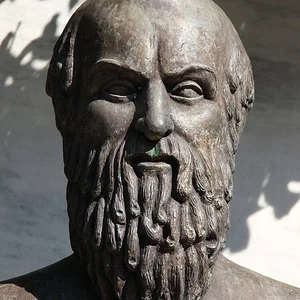

Aeschylus (524–455 BC) is considered the father of Greek tragedy. He introduced a second actor on stage, revolutionizing ancient theatre. His works, most notably the Oresteia, explore divine justice and the human condition.
Aeschylus(524 av. J.-C. — 455 av. J.-C.)
Aeschylus
Athènes
7 min read
Frequently asked questions
Famous Quotes
« In war, truth is the first casualty.»
« A wise man learns more from his enemies than a fool from his friends.»
Key Facts
- Born around 524 BC in Eleusis, near Athens
- Fought at Marathon (490 BC) and likely at Salamis (480 BC)
- Introduced the second actor in tragedy, reducing the role of the chorus
- Author of nearly 90 plays, of which only 7 have survived
- Died around 455 BC in Sicily, at Gela
Works & Achievements
The only surviving Greek tragedy dealing with contemporary events, it depicts the defeat of Xerxes at Salamis as seen from the Persian court. Aeschylus himself was a witness to the battle.
The final play of a Theban trilogy, it stages the fratricidal duel between Eteocles and Polynices. It won first prize at the Dionysia festival.
A play exploring the right of asylum and the condition of women, through the story of the Danaids fleeing a forced marriage. Its recently revised dating transformed our understanding of the evolution of Greek theater.
The only complete trilogy from ancient Greece to have survived. It traces the cycle of vengeance in the house of Agamemnon, culminating in the founding of human justice embodied by the Areopagus.
A play attributed to Aeschylus depicting the Titan Prometheus punished by Zeus for giving fire to humanity. It raises fundamental questions about power, rebellion, and the human condition.
Anecdotes
Aeschylus personally fought in the battles of Marathon (490 BC) and Salamis (480 BC). He was so proud of his participation in the Persian Wars that his epitaph, which he reportedly wrote himself, made no mention of his dramatic work — only his valor in battle.
According to an ancient legend reported by Aelian, Aeschylus is said to have died when an eagle, mistaking his bald head for a rock, dropped a tortoise on it to crack open its shell. Though almost certainly apocryphal, this anecdote reflects the fascination that the ancients had with this most extraordinary of authors.
Aeschylus was the first playwright to introduce a second actor onto the stage, making dramatic dialogue between two characters possible. Before him, Greek theater featured only a single actor interacting with the chorus. This innovation permanently revolutionized the art of theater.
Aeschylus won the dramatic competition at the City Dionysia at least thirteen times over the course of his career. He is thought to have written between seventy and ninety plays, of which only seven survive, pointing to the vast scale of a body of work now largely lost.
Toward the end of his life, Aeschylus settled in Sicily at the court of Hiero of Syracuse, who welcomed many artists and poets. He died there at Gela around 455 BC, far from Athens — the very city that had brought him fame.
Primary Sources
Zeus, whoever you are, if that name pleases you, by that name I call upon you. Weighing all things in the balance, I can find nothing to compare with you — nothing, save Zeus — if I truly wish to cast aside the vain burden that weighs upon my soul.
O Zeus, king, you have destroyed the great and proud army of the Persians, and you have shrouded the cities of Susa and Ecbatana in mourning.
I know it well, I know: one who holds power is always harsh, at least toward those he has only lately come to rule. But a day will come when he grows gentler.
The city, if the gods are willing, is saved. But two brothers, two leaders of the same blood, have slain one another with their spears.
Key Places
Aeschylus's birthplace, famous for its Mysteries dedicated to Demeter. This origin deeply shaped his sensitivity to the sacred and the divine.
Athens' first stone theatre, at the foot of the Acropolis, where nearly all of Aeschylus's tragedies were first performed during the City Dionysia festival.
Site of the famous battle of 490 BC in which Aeschylus fought. He took such pride in this that he wished to be remembered as a soldier more than as a poet.
Site of the decisive naval battle of 480 BC against Xerxes' Persian fleet, brilliantly depicted in Aeschylus's play The Persians.
Greek city in Sicily where Aeschylus died around 455 BC. He had traveled there to join the court of Hiero, tyrant of Syracuse.
Typical Objects

The mask was worn by all actors in ancient Greek theater. Aeschylus helped codify its expressive forms to distinguish emotions and character types.

Thick-soled boots introduced into theater by Aeschylus according to ancient tradition, allowing actors to be seen from a distance in large open-air theaters.

A writing surface used by Athenian authors and scribes to draft their texts. It was on this type of support that Aeschylus composed his plays.

Aeschylus fought as a hoplite at Marathon and Salamis. This large round shield of bronze and wood was the central piece of equipment for the Athenian citizen-soldier.

A wind instrument omnipresent in Greek theatrical performances, the aulos accompanied the choral songs in Aeschylus's tragedies.

Athenian pottery from the time of Aeschylus frequently depicts mythological scenes close to the themes of his tragedies, such as the adventures of Orestes or Prometheus.
School Curriculum
Vocabulary & Tags
Key Vocabulary
Daily Life
Morning
Aeschylus rose at dawn, like most Athenians. He likely participated in the morning religious rituals, including libations to the gods, before devoting himself to writing his plays and directing his actors and chorus members during rehearsals.
Afternoon
In the afternoon, he might visit the agora to discuss with other citizens, philosophers, or artists, or oversee the technical preparations for performances. Staging, costume design, and mask-making were entirely the responsibility of the poet-playwright.
Evening
Evening meals (deipnon) were shared with family or at banquets (symposia) among men of the Athenian elite, where poetry and music held a central place. Aeschylus may have recited passages from works he was composing at the time.
Food
The diet of a wealthy Athenian citizen centered on barley or wheat bread, olives and olive oil, vegetables (lentils, beans, onions), fresh fish, goat cheese, and wine diluted with water. Meat was reserved for sacrifices and special occasions.
Clothing
Aeschylus wore the chiton, a tunic of linen or wool, covered by a himation (a large draped cloak) for formal outings. As a member of the elite, his garments were likely dyed and of good quality. His actors wore elaborate costumes with masks and platform boots (cothurni).
Housing
Aeschylus most likely lived in a house in Athens or Eleusis built around a central courtyard (aule), with separate rooms for men (andron) and women (gynaeceum). Walls were of mud brick on a stone foundation, with packed-earth or paved floors.
Historical Timeline
Period Vocabulary
Visual Style
Un style inspiré de la céramique à figures rouges et de l'architecture classique athénienne : tons ocre, blanc et noir intense, sous la lumière vive de la Méditerranée.
Sound Ambience
L'ambiance sonore d'une représentation théâtrale à Athènes au Ve siècle av. J.-C. : le chœur, l'aulos et le murmure du public dans un grand théâtre en plein air.
Liens externes & ressources
Références
Œuvres
Les Perses
472 av. J.-C.
Les Sept contre Thèbes
467 av. J.-C.
Les Suppliantes
v. 463 av. J.-C.
L'Orestie (Agamemnon, Les Choéphores, Les Euménides)
458 av. J.-C.
Prométhée enchaîné
v. 460 av. J.-C.